Digital Biology Laboratory, Computer Science Department and Christopher S, Bond Life Sciences Center, University of Missouri, Columbia, MO 65211, USA.
BMC Bioinformatics. 2010 Jan 18;11 Suppl 1(Suppl 1):S14. doi: 10.1186/1471-2105-11-S1-S14.
Small non-coding RNAs (21 to 24 nucleotides) regulate a number of developmental processes in plants and animals by silencing genes using multiple mechanisms. Among these, the most conserved classes are microRNAs (miRNAs) and small interfering RNAs (siRNAs), both of which are produced by RNase III-like enzymes called Dicers. Many plant miRNAs play critical roles in nutrient homeostasis, developmental processes, abiotic stress and pathogen responses. Currently, only 70 miRNA have been identified in soybean.
We utilized Illumina's SBS sequencing technology to generate high-quality small RNA (sRNA) data from four soybean (Glycine max) tissues, including root, seed, flower, and nodules, to expand the collection of currently known soybean miRNAs. We developed a bioinformatics pipeline using in-house scripts and publicly available structure prediction tools to differentiate the authentic mature miRNA sequences from other sRNAs and short RNA fragments represented in the public sequencing data.
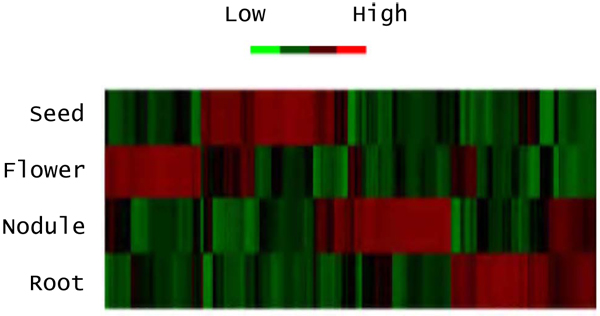
The combined sequencing and bioinformatics analyses identified 129 miRNAs based on hairpin secondary structure features in the predicted precursors. Out of these, 42 miRNAs matched known miRNAs in soybean or other species, while 87 novel miRNAs were identified. We also predicted the putative target genes of all identified miRNAs with computational methods and verified the predicted cleavage sites in vivo for a subset of these targets using the 5' RACE method. Finally, we also studied the relationship between the abundance of miRNA and that of the respective target genes by comparison to Solexa cDNA sequencing data.
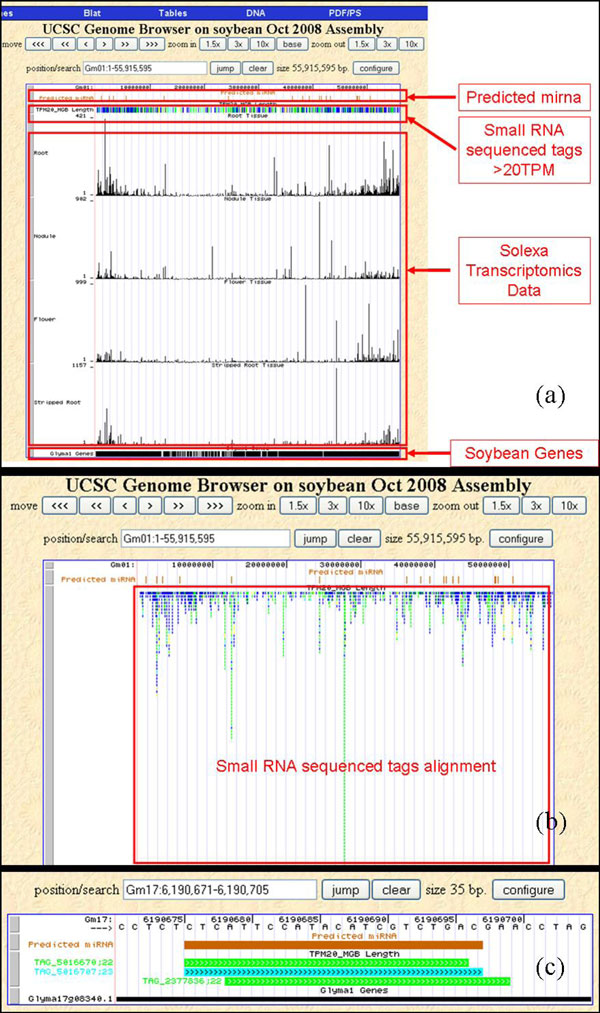
Our study significantly increased the number of miRNAs known to be expressed in soybean. The bioinformatics analysis provided insight on regulation patterns between the miRNAs and their predicted target genes expression. We also deposited the data in a soybean genome browser based on the UCSC Genome Browser architecture. Using the browser, we annotated the soybean data with miRNA sequences from four tissues and cDNA sequencing data. Overlaying these two datasets in the browser allows researchers to analyze the miRNA expression levels relative to that of the associated target genes. The browser can be accessed at http://digbio.missouri.edu/soybean_mirna/.
小非编码 RNA(21 到 24 个核苷酸)通过多种机制沉默基因来调节动植物的许多发育过程。其中,最保守的两类是 microRNAs(miRNAs)和 small interfering RNAs(siRNAs),它们都是由称为 Dicers 的 RNA 酶 III 样酶产生的。许多植物 miRNAs 在营养稳态、发育过程、非生物胁迫和病原体反应中发挥关键作用。目前,大豆中只鉴定出了 70 个 miRNA。
我们利用 Illumina 的 SBS 测序技术,从大豆的四个组织(根、种子、花和根瘤)中生成高质量的小 RNA(sRNA)数据,以扩大目前已知大豆 miRNAs 的集合。我们使用内部脚本和公开的结构预测工具开发了一个生物信息学管道,从公共测序数据中区分真实成熟 miRNA 序列和其他 sRNAs 和短 RNA 片段。
基于预测前体的发夹二级结构特征,组合测序和生物信息学分析鉴定了 129 个 miRNA。其中,42 个 miRNA 与大豆或其他物种中的已知 miRNA 匹配,而 87 个新的 miRNA 被鉴定出来。我们还使用计算方法预测了所有鉴定的 miRNA 的假定靶基因,并使用 5' RACE 方法在体内验证了这些靶基因中的一部分预测的切割位点。最后,我们还通过与 Solexa cDNA 测序数据的比较,研究了 miRNA 丰度与各自靶基因丰度之间的关系。
我们的研究显著增加了已知在大豆中表达的 miRNA 的数量。生物信息学分析提供了 miRNA 与其预测靶基因表达之间的调控模式的见解。我们还将数据以基于 UCSC 基因组浏览器架构的大豆基因组浏览器中进行了存储。使用该浏览器,我们在四个组织的 miRNA 序列和 cDNA 测序数据上注释了大豆数据。在浏览器中重叠这两个数据集允许研究人员分析相对于相关靶基因的 miRNA 表达水平。该浏览器可在 http://digbio.missouri.edu/soybean_mirna/ 访问。