Machine Intelligence Unit, Indian Statistical Institute, Kolkata, India.
BMC Bioinformatics. 2010 Jan 18;11 Suppl 1(Suppl 1):S22. doi: 10.1186/1471-2105-11-S1-S22.
MicroRNA (miRNA) expression profiling data has recently been found to be particularly important in cancer research and can be used as a diagnostic and prognostic tool. Current approaches of tumor classification using miRNA expression data do not integrate the experimental knowledge available in the literature. A judicious integration of such knowledge with effective miRNA and sample selection through a biclustering approach could be an important step in improving the accuracy of tumor classification.
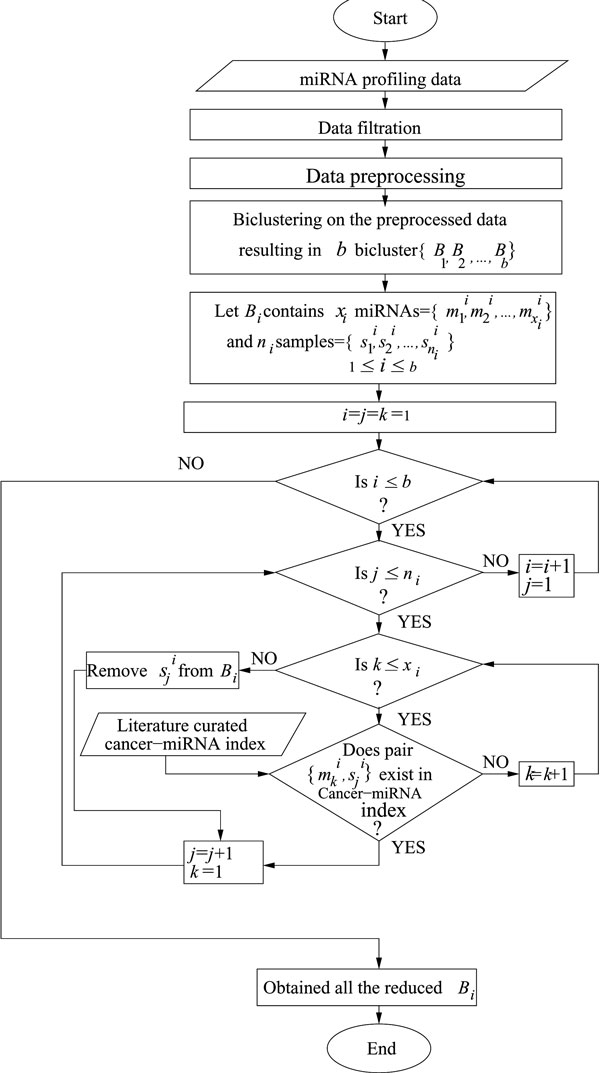
In this article, a novel classification technique called SFSSClass is developed that judiciously integrates a biclustering technique SAMBA for simultaneous feature (miRNA) and sample (tissue) selection (SFSS), a cancer-miRNA network that we have developed by mining the literature of experimentally verified cancer-miRNA relationships and a classifier uncorrelated shrunken centroid (USC). SFSSClass is used for classifying multiple classes of tumors and cancer cell lines. In a part of the investigation, poorly differentiated tumors (PDT) having non diagnostic histological appearance are classified while training on more differentiated tumor (MDT) samples. The proposed method is found to outperform the best known accuracy in the literature on the experimental data sets. For example, while the best accuracy reported in the literature for classifying PDT samples is approximately 76.5%, the accuracy of SFSSClass is found to be approximately 82.3%. The advantage of incorporating biclustering integrated with the cancer-miRNA network is evident from the consistently better performance of SFSSClass (integration of SAMBA, cancer-miRNA network and USC) over USC (eg., approximately 70.5% for SFSSClass versus approximately 58.8% in classifying a set of 17 MDT samples from 9 tumor types, approximately 91.7% for SFSSClass versus approximately 75% in classifying 12 cell lines from 6 tumor types and approximately 82.3% for SFSSClass versus approximately 41.2% in classifying 17 PDT samples from 11 tumor types).
In this article, we develop the SFSSClass algorithm which judiciously integrates a biclustering technique for simultaneous feature (miRNA) and sample (tissue) selection, the cancer-miRNA network and a classifier. The novel integration of experimental knowledge with computational tools efficiently selects relevant features that have high intra-class and low inter-class similarity. The performance of the SFSSClass is found to be significantly improved with respect to the other existing approaches.
最近发现 miRNA(microRNA)表达谱数据在癌症研究中尤为重要,可作为诊断和预后工具。目前使用 miRNA 表达数据进行肿瘤分类的方法并未整合文献中可用的实验知识。通过双聚类方法明智地整合此类知识,并通过双聚类方法有效地选择 miRNA 和样本,这可能是提高肿瘤分类准确性的重要步骤。
本文开发了一种名为 SFSSClass 的新型分类技术,该技术明智地整合了用于同时进行特征(miRNA)和样本(组织)选择的双聚类技术 SAMBA、我们通过挖掘实验验证的癌症-miRNA 关系文献开发的癌症-miRNA 网络以及无相关性收缩质心分类器(USC)。SFSSClass 用于对多种类型的肿瘤和癌细胞系进行分类。在研究的一部分中,在对具有非诊断性组织学外观的低分化肿瘤(PDT)进行分类时,在对高分化肿瘤(MDT)样本进行训练。在实验数据集上,所提出的方法被发现优于文献中已知的最佳准确性。例如,文献中报告的用于分类 PDT 样本的最佳准确性约为 76.5%,而 SFSSClass 的准确性被发现约为 82.3%。从 SFSSClass(整合 SAMBA、癌症-miRNA 网络和 USC)始终优于 USC 的性能(例如,在对来自 9 种肿瘤类型的 17 个 MDT 样本进行分类时,SFSSClass 约为 70.5%,而 USC 约为 58.8%;在对来自 6 种肿瘤类型的 12 个细胞系进行分类时,SFSSClass 约为 91.7%,而 USC 约为 75%;在对来自 11 种肿瘤类型的 17 个 PDT 样本进行分类时,SFSSClass 约为 82.3%,而 USC 约为 41.2%),可以明显看出整合双聚类与癌症-miRNA 网络和分类器的优势。
本文开发了 SFSSClass 算法,该算法明智地整合了用于同时进行特征(miRNA)和样本(组织)选择的双聚类技术、癌症-miRNA 网络和分类器。该算法将实验知识与计算工具的新颖整合有效地选择了具有高内类相似性和低间类相似性的相关特征。与其他现有方法相比,SFSSClass 的性能得到了显著提高。