Dept of Medicine, School of Medicine, The University of Illinois at Chicago, Chicago, Illinois, USA.
J Am Med Inform Assoc. 2012 Mar-Apr;19(2):156-60. doi: 10.1136/amiajnl-2011-000419. Epub 2011 Nov 18.
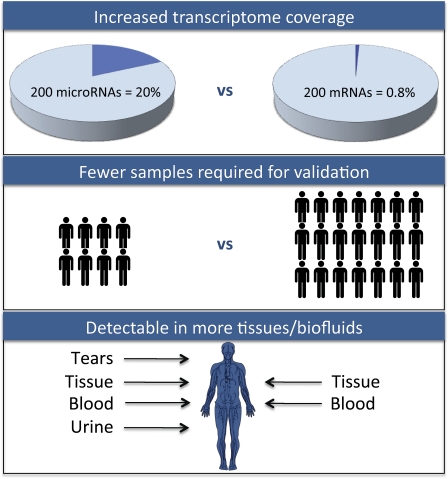
MicroRNAs, small non-coding RNAs, may act as tumor suppressors or oncogenes, and each regulate their own transcription and that of hundreds of genes, often in a tissue-dependent manner. This creates a tightly interwoven network regulating and underlying oncogenesis and cancer biology. Although protein-coding gene signatures and single protein pathway markers have proliferated over the past decade, routine adoption of the former has been hampered by interpretability, reproducibility, and dimensionality, whereas the single molecule-phenotype reductionism of the latter is often overly simplistic to account for complex phenotypes. MicroRNA-derived biomarkers offer a powerful alternative; they have both the flexibility of gene expression signature classifiers and the desirable mechanistic transparency of single protein biomarkers. Furthermore, several advances have recently demonstrated the robust detection of microRNAs from various biofluids, thus providing an additional opportunity for obtaining bioinformatically derived biomarkers to accelerate the identification of individual patients for personalized therapy.
微小 RNA 是一种小型非编码 RNA,可能作为肿瘤抑制因子或癌基因发挥作用,每种微小 RNA 都可以调节自身和数百个基因的转录,这种调节通常依赖于组织。这就形成了一个紧密交织的网络,调节着肿瘤的发生和癌症生物学。尽管过去十年中蛋白质编码基因标志物和单一蛋白质途径标志物大量涌现,但由于可解释性、可重复性和维度问题,前者的常规应用受到了阻碍,而后者的单一分子表型简化论往往过于简单,无法解释复杂的表型。miRNA 衍生的生物标志物提供了一种强大的替代方法;它们既有基因表达标志物分类器的灵活性,又有单一蛋白质生物标志物的理想机制透明度。此外,最近的一些进展表明,可以从各种生物流体中可靠地检测到 microRNAs,从而为获得生物信息衍生的生物标志物提供了额外的机会,以加速确定接受个体化治疗的个体患者。