School of Computer Science and Software Engineering, The University of Western Australia, Perth, WA 6009, Australia.
Nucleic Acids Res. 2010 Apr;38(7):e103. doi: 10.1093/nar/gkq021. Epub 2010 Jan 31.
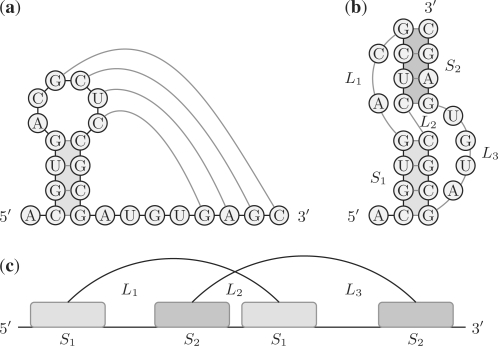
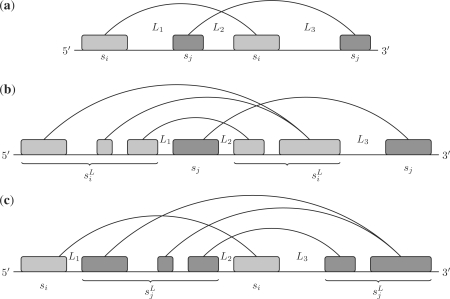
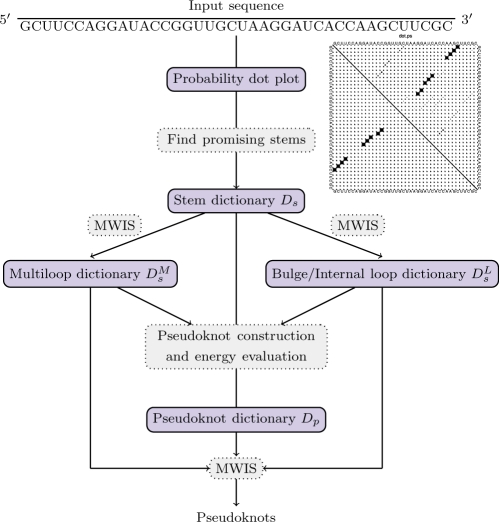
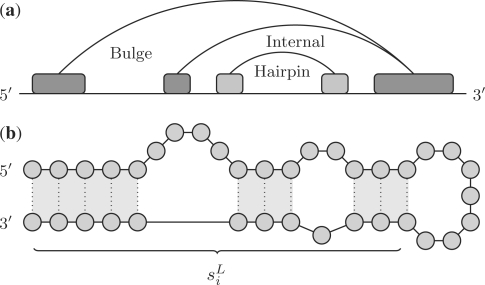
RNA pseudoknots are functional structure elements with key roles in viral and cellular processes. Prediction of a pseudoknotted minimum free energy structure is an NP-complete problem. Practical algorithms for RNA structure prediction including restricted classes of pseudoknots suffer from high runtime and poor accuracy for longer sequences. A heuristic approach is to search for promising pseudoknot candidates in a sequence and verify those. Afterwards, the detected pseudoknots can be further analysed using bioinformatics or laboratory techniques. We present a novel pseudoknot detection method called DotKnot that extracts stem regions from the secondary structure probability dot plot and assembles pseudoknot candidates in a constructive fashion. We evaluate pseudoknot free energies using novel parameters, which have recently become available. We show that the conventional probability dot plot makes a wide class of pseudoknots including those with bulged stems manageable in an explicit fashion. The energy parameters now become the limiting factor in pseudoknot prediction. DotKnot is an efficient method for long sequences, which finds pseudoknots with higher accuracy compared to other known prediction algorithms. DotKnot is accessible as a web server at http://dotknot.csse.uwa.edu.au.
RNA 假结是具有关键作用的功能结构元件,在病毒和细胞过程中发挥作用。预测假结的最小自由能结构是 NP 完全问题。包括限制类假结的 RNA 结构预测实用算法由于运行时间长和对较长序列的准确性差而受到限制。一种启发式方法是在序列中搜索有前途的假结候选,并验证这些候选。之后,可以使用生物信息学或实验室技术进一步分析检测到的假结。我们提出了一种名为 DotKnot 的新假结检测方法,该方法从二级结构概率点图中提取茎区,并以建设性的方式组装假结候选。我们使用最近可用的新参数评估假结自由能。我们表明,传统的概率点图以显式方式处理广泛的假结类,包括具有凸起茎的假结。能量参数现在成为假结预测的限制因素。DotKnot 是一种适用于长序列的高效方法,与其他已知的预测算法相比,它可以更准确地发现假结。DotKnot 可作为网络服务器在 http://dotknot.csse.uwa.edu.au 上使用。