Department of Biophysics and Biochemistry, Graduate School of Science, CREST, Japan Science and Technology Agency, University of Tokyo, Tokyo, Japan.
PLoS One. 2010 Feb 2;5(2):e9011. doi: 10.1371/journal.pone.0009011.
Continuous NGF stimulation induces PC12 cell differentiation. However, why continuous NGF stimulation is required for differentiation is unclear. In this study, we investigated the underlying mechanisms of the timing-dependent requirement of NGF action for cell differentiation.
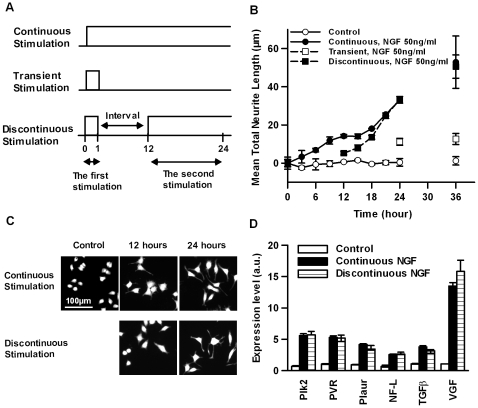
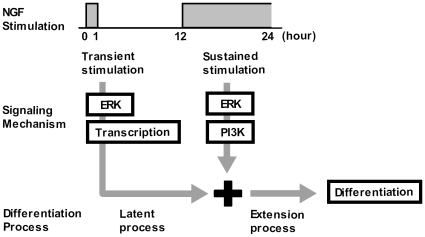
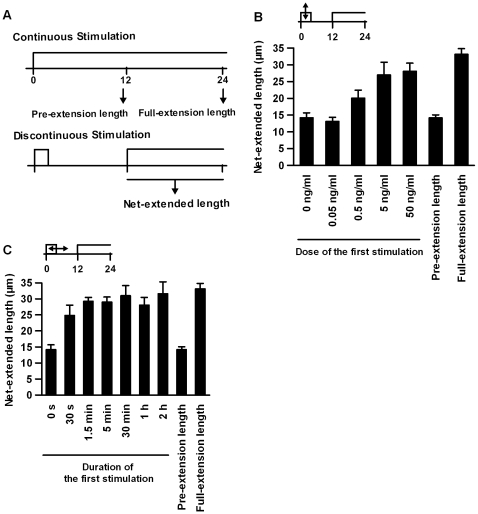
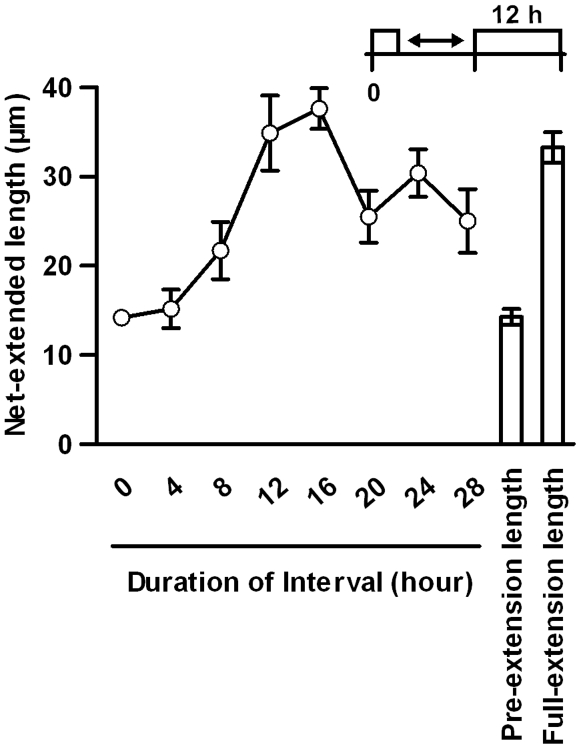
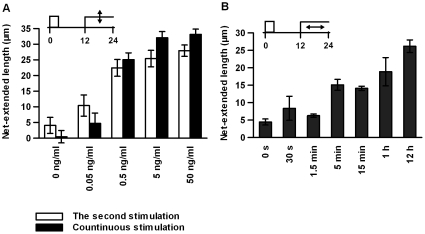
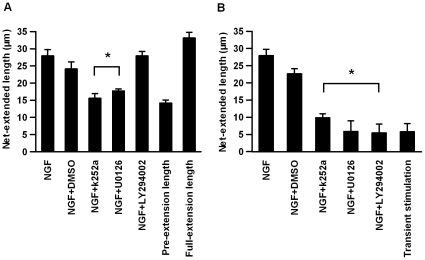
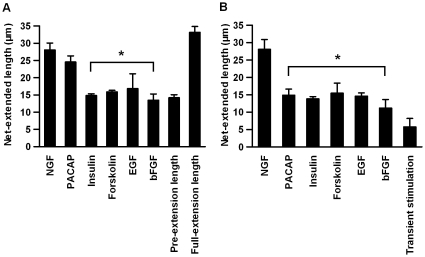
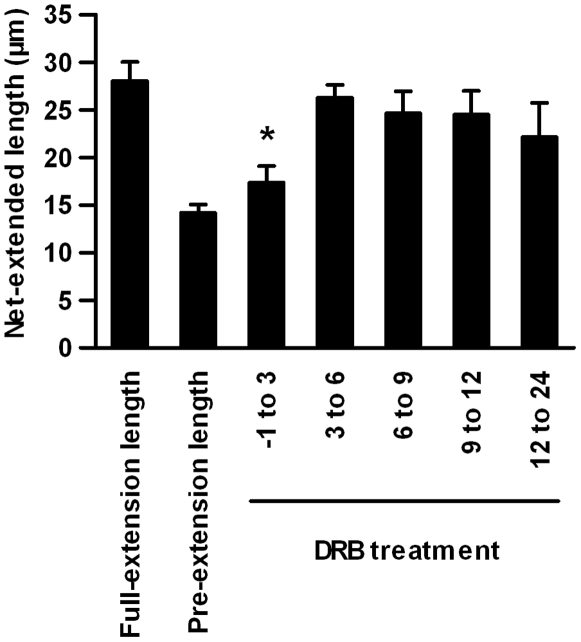
METHODOLOGY/PRINCIPAL FINDINGS: To address the timing-dependency of the NGF action, we performed a discontinuous stimulation assay consisting of a first transient stimulation followed by an interval and then a second sustained stimulation and quantified the neurite extension level. Consequently, we observed a timing-dependent action of NGF on cell differentiation, and discontinuous NGF stimulation similarly induced differentiation. The first stimulation did not induce neurite extension, whereas the second stimulation induced fast neurite extension; therefore, the first stimulation is likely required as a prerequisite condition. These observations indicate that the action of NGF can be divided into two processes: an initial stimulation-driven latent process and a second stimulation-driven extension process. The latent process appears to require the activities of ERK and transcription, but not PI3K, whereas the extension-process requires the activities of ERK and PI3K, but not transcription. We also found that during the first stimulation, the activity of NGF can be replaced by PACAP, but not by insulin, EGF, bFGF or forskolin; during the second stimulation, however, the activity of NGF cannot be replaced by any of these stimulants. These findings allowed us to identify potential genes specifically involved in the latent process, rather than in other processes, using a microarray.
CONCLUSIONS/SIGNIFICANCE: These results demonstrate that NGF induces the differentiation of PC12 cells via mechanically distinct processes: an ERK-driven and transcription-dependent latent process, and an ERK- and PI3K-driven and transcription-independent extension process.
持续的 NGF 刺激诱导 PC12 细胞分化。然而,为什么连续的 NGF 刺激是分化所必需的尚不清楚。在这项研究中,我们研究了 NGF 作用的时间依赖性对细胞分化的潜在机制。
方法/主要发现:为了解决 NGF 作用的时间依赖性,我们进行了一个不连续的刺激实验,包括第一次短暂刺激,然后是间隔,然后是第二次持续刺激,并量化了神经突延伸水平。因此,我们观察到 NGF 对细胞分化的时间依赖性作用,不连续的 NGF 刺激也诱导了分化。第一次刺激不会诱导神经突延伸,而第二次刺激会诱导快速的神经突延伸;因此,第一次刺激可能是必要的前提条件。这些观察结果表明,NGF 的作用可以分为两个过程:初始刺激驱动的潜伏过程和第二次刺激驱动的延伸过程。潜伏过程似乎需要 ERK 和转录的活性,但不需要 PI3K,而延伸过程需要 ERK 和 PI3K 的活性,但不需要转录。我们还发现,在第一次刺激期间,NGF 的活性可以被 PACAP 取代,但不能被胰岛素、EGF、bFGF 或 forskolin取代;然而,在第二次刺激期间,NGF 的活性不能被任何这些刺激物取代。这些发现使我们能够使用微阵列来鉴定特定参与潜伏过程而非其他过程的潜在基因。
结论/意义:这些结果表明,NGF 通过机械上不同的过程诱导 PC12 细胞分化:ERK 驱动和转录依赖性的潜伏过程,以及 ERK 和 PI3K 驱动和转录独立性的延伸过程。