Pearson John, Roitman J D, Brannon E M, Platt M L, Raghavachari Sridhar
Department of Neurobiology, Duke University School of Medicine Durham, NC, USA.
Front Behav Neurosci. 2010 Jan 27;4:1. doi: 10.3389/neuro.08.001.2010. eCollection 2010.
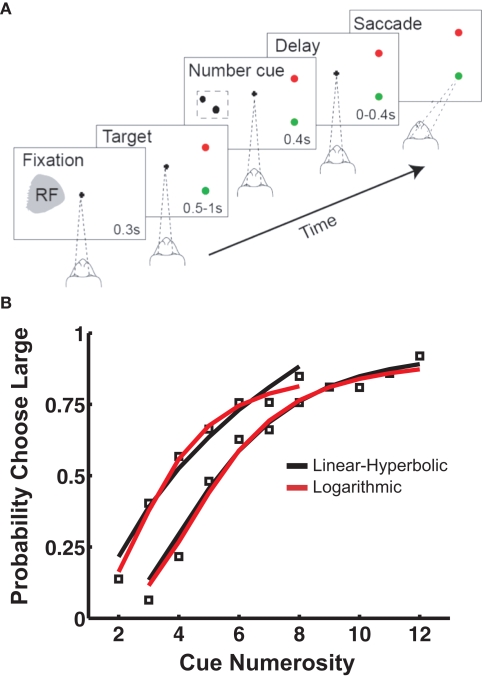
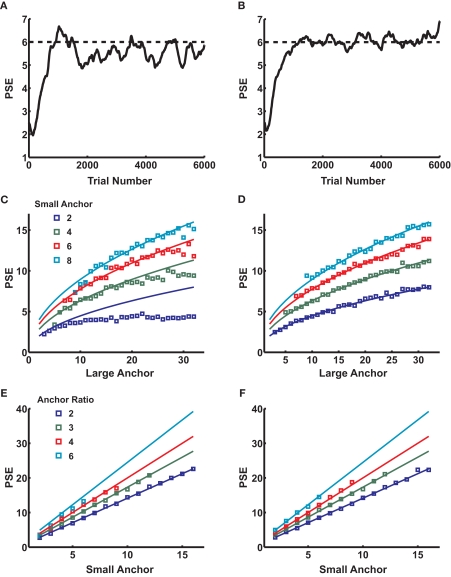
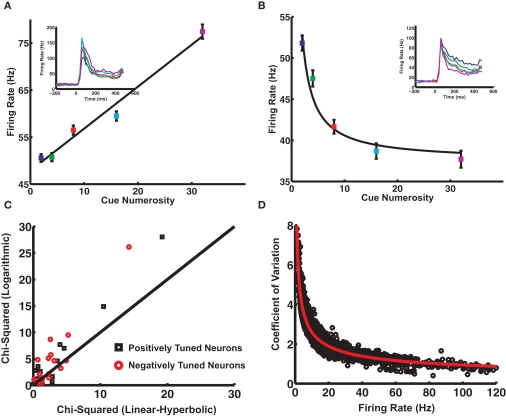
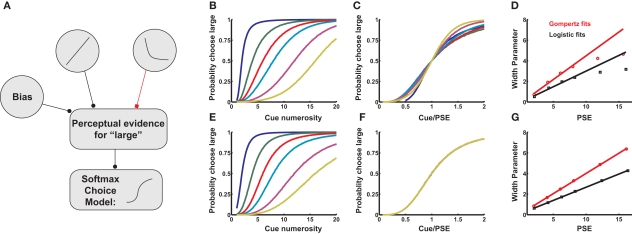
In most natural decision contexts, the process of selecting among competing actions takes place in the presence of informative, but potentially ambiguous, stimuli. Decisions about magnitudes - quantities like time, length, and brightness that are linearly ordered - constitute an important subclass of such decisions. It has long been known that perceptual judgments about such quantities obey Weber's Law, wherein the just-noticeable difference in a magnitude is proportional to the magnitude itself. Current physiologically inspired models of numerical classification assume discriminations are made via a labeled line code of neurons selectively tuned for numerosity, a pattern observed in the firing rates of neurons in the ventral intraparietal area (VIP) of the macaque. By contrast, neurons in the contiguous lateral intraparietal area (LIP) signal numerosity in a graded fashion, suggesting the possibility that numerical classification could be achieved in the absence of neurons tuned for number. Here, we consider the performance of a decision model based on this analog coding scheme in a paradigmatic discrimination task - numerosity bisection. We demonstrate that a basic two-neuron classifier model, derived from experimentally measured monotonic responses of LIP neurons, is sufficient to reproduce the numerosity bisection behavior of monkeys, and that the threshold of the classifier can be set by reward maximization via a simple learning rule. In addition, our model predicts deviations from Weber Law scaling of choice behavior at high numerosity. Together, these results suggest both a generic neuronal framework for magnitude-based decisions and a role for reward contingency in the classification of such stimuli.
在大多数自然决策情境中,在相互竞争的行动之间进行选择的过程是在信息丰富但可能存在模糊性的刺激下发生的。关于量级的决策——诸如时间、长度和亮度等呈线性排序的量——构成了这类决策的一个重要子类。长期以来人们就知道,对这些量的知觉判断遵循韦伯定律,即量级上的刚刚可觉察差异与量级本身成正比。当前受生理学启发的数字分类模型假定,辨别是通过对数量进行选择性调谐的神经元标记线路编码来进行的,这种模式在猕猴腹侧顶内区(VIP)神经元的放电率中可以观察到。相比之下,相邻的外侧顶内区(LIP)的神经元以分级方式信号化数量,这表明在没有针对数字进行调谐的神经元的情况下也有可能实现数字分类。在这里,我们在一个典型的辨别任务——数量二等分任务中考虑基于这种模拟编码方案的决策模型的性能。我们证明,一个基于对LIP神经元实验测量的单调反应而推导出来的基本双神经元分类器模型,足以重现猴子的数量二等分行为,并且分类器的阈值可以通过一个简单的学习规则通过奖励最大化来设定。此外,我们的模型预测在高数量时选择行为会偏离韦伯定律的标度。总之,这些结果既表明了一个基于量级的决策的通用神经元框架,也表明了奖励偶然性在这类刺激分类中的作用。