Department of Psychiatry and Behavioral Sciences, Stanford University School of Medicine Palo Alto, CA, USA.
Front Mol Neurosci. 2010 Jan 20;2:31. doi: 10.3389/neuro.02.031.2009. eCollection 2010.
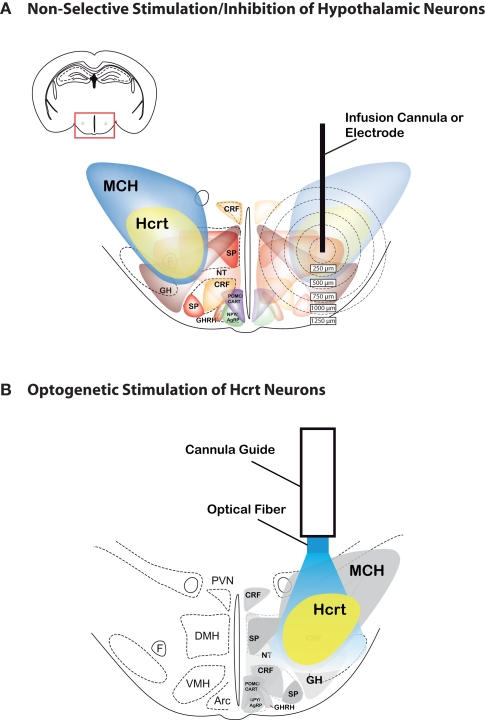
How does the brain regulate the sleep-wake cycle? What are the temporal codes of sleep and wake-promoting neural circuits? How do these circuits interact with each other across the light/dark cycle? Over the past few decades, many studies from a variety of disciplines have made substantial progress in answering these fundamental questions. For example, neurobiologists have identified multiple, redundant wake-promoting circuits in the brainstem, hypothalamus, and basal forebrain. Sleep-promoting circuits have been found in the preoptic area and hypothalamus. One of the greatest challenges in recent years has been to selectively record and manipulate these sleep-wake centers in vivo with high spatial and temporal resolution. Recent developments in microbial opsin-based neuromodulation tools, collectively referred to as "optogenetics," have provided a novel method to demonstrate causal links between neural activity and specific behaviors. Here, we propose to use optogenetics as a fundamental tool to probe the necessity, sufficiency, and connectivity of defined neural circuits in the regulation of sleep and wakefulness.
大脑如何调节睡眠-觉醒周期?睡眠和促进觉醒的神经回路的时间代码是什么?这些回路如何在光/暗周期中相互作用?在过去的几十年中,来自多个学科的许多研究在回答这些基本问题方面取得了实质性进展。例如,神经生物学家已经在脑干、下丘脑和基底前脑中确定了多个冗余的促进觉醒的回路。在视前区和下丘脑中发现了促进睡眠的回路。近年来最大的挑战之一是如何以高时空分辨率选择性地在体内记录和操纵这些睡眠-觉醒中心。近年来,基于微生物视蛋白的神经调节工具的发展,统称为“光遗传学”,为证明神经活动与特定行为之间的因果关系提供了一种新方法。在这里,我们建议将光遗传学作为一种基本工具,用于探测在调节睡眠和觉醒中定义明确的神经回路的必要性、充分性和连通性。