School of Nursing, Trinity Western University, Langley, British Columbia (BC) V2Y 1Y1, Canada.
Health Qual Life Outcomes. 2010 Feb 3;8:17. doi: 10.1186/1477-7525-8-17.
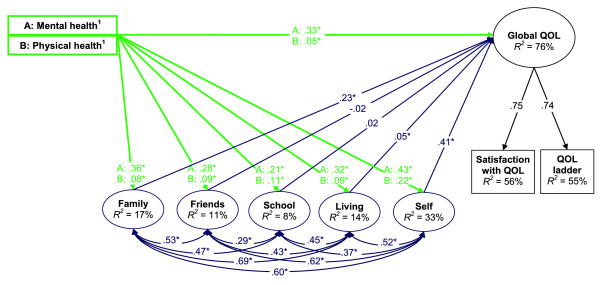
We examined adolescents' differentiation of their self-reported physical and mental health status, the relative importance of these variables and five important life domains (satisfaction with family, friends, living environment, school and self) with respect to adolescents' global quality of life (QOL), and the extent to which the five life domains mediate the relationships between self-reported physical and mental health status and global QOL.
The data were obtained via a cross-sectional health survey of 8,225 adolescents in 49 schools in British Columbia, Canada. Structural equation modeling was applied to test the implied latent variable mediation model. The Pratt index (d) was used to evaluate variable importance.
Relative to one another, self-reported mental health status was found to be more strongly associated with depressive symptoms, and self-reported physical health status more strongly associated with physical activity. Self-reported physical and mental health status and the five life domains explained 76% of the variance in global QOL. Relatively poorer mental health and physical health were significantly associated with lower satisfaction in each of the life domains. Global QOL was predominantly explained by three of the variables: mental health status (d = 30%), satisfaction with self (d = 42%), and satisfaction with family (d = 20%). Satisfaction with self and family were the predominant mediators of mental health and global QOL (45% total mediation), and of physical health and global QOL (68% total mediation).
This study provides support for the validity and relevance of differentiating self-reported physical and mental health status in adolescent health surveys. Self-reported mental health status and, to a lesser extent, self-reported physical health status were associated with significant differences in the adolescents' satisfaction with their family, friends, living environment, school experiences, self, and their global QOL. Questions about adolescents' self-reported physical and mental health status and their experiences with these life domains require more research attention so as to target appropriate supportive services, particularly for adolescents with mental or physical health challenges.
本研究旨在探讨青少年对自身身心健康状况的区分能力,以及这些变量与五个重要生活领域(对家庭、朋友、生活环境、学校和自我的满意度)对青少年整体生活质量(QOL)的相对重要性,同时还检验了五个生活领域在多大程度上调节了自我报告的身心健康状况与整体 QOL 之间的关系。
该研究通过对加拿大不列颠哥伦比亚省 49 所学校的 8225 名青少年进行横断面健康调查获得数据。采用结构方程模型来检验潜在的中介变量模型。普拉特指数(d)用于评估变量的重要性。
与彼此相比,自我报告的心理健康状况与抑郁症状的相关性更强,而自我报告的身体健康状况与身体活动的相关性更强。自我报告的身心健康状况和五个生活领域解释了全球 QOL 方差的 76%。相对较差的心理健康和身体健康与每个生活领域的满意度较低显著相关。全球 QOL 主要由三个变量解释:心理健康状况(d = 30%)、自我满意度(d = 42%)和家庭满意度(d = 20%)。自我满意度和家庭满意度是心理健康和全球 QOL(45%的总中介)以及身体健康和全球 QOL(68%的总中介)的主要中介。
本研究支持在青少年健康调查中区分自我报告的身心健康状况的有效性和相关性。自我报告的心理健康状况以及在较小程度上的自我报告的身体健康状况与青少年对家庭、朋友、生活环境、学校经历、自我以及整体生活质量的满意度存在显著差异有关。需要进一步研究青少年自我报告的身心健康状况及其对这些生活领域的体验,以便针对有心理健康或身体健康挑战的青少年提供适当的支持性服务。