Department of Psychological Sciences, University of Missouri-Columbia and Midwest Alcoholism Research Center, Columbia, Missouri 65211-0001, USA.
J Abnorm Psychol. 2010 Feb;119(1):93-105. doi: 10.1037/a0017512.
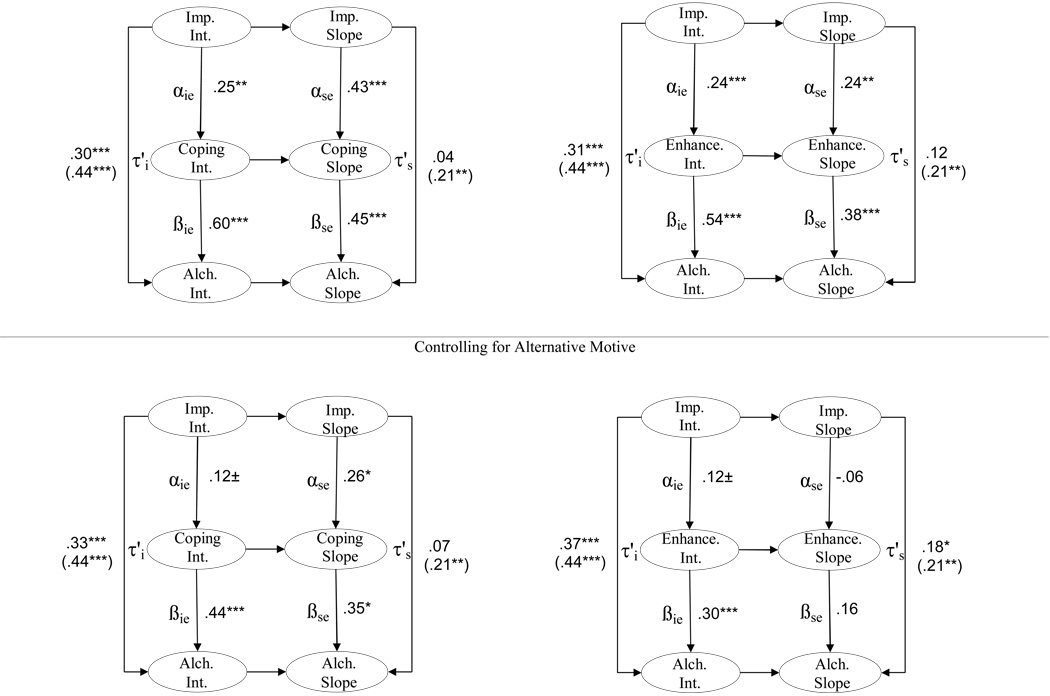
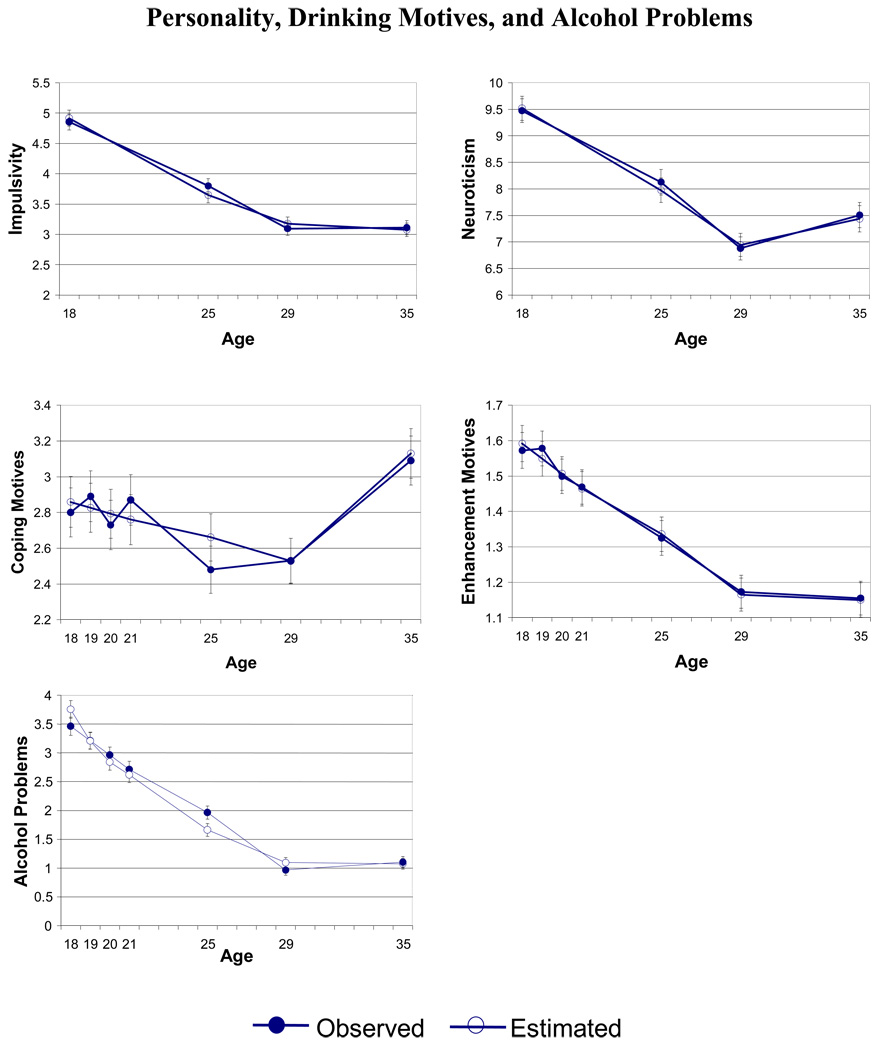
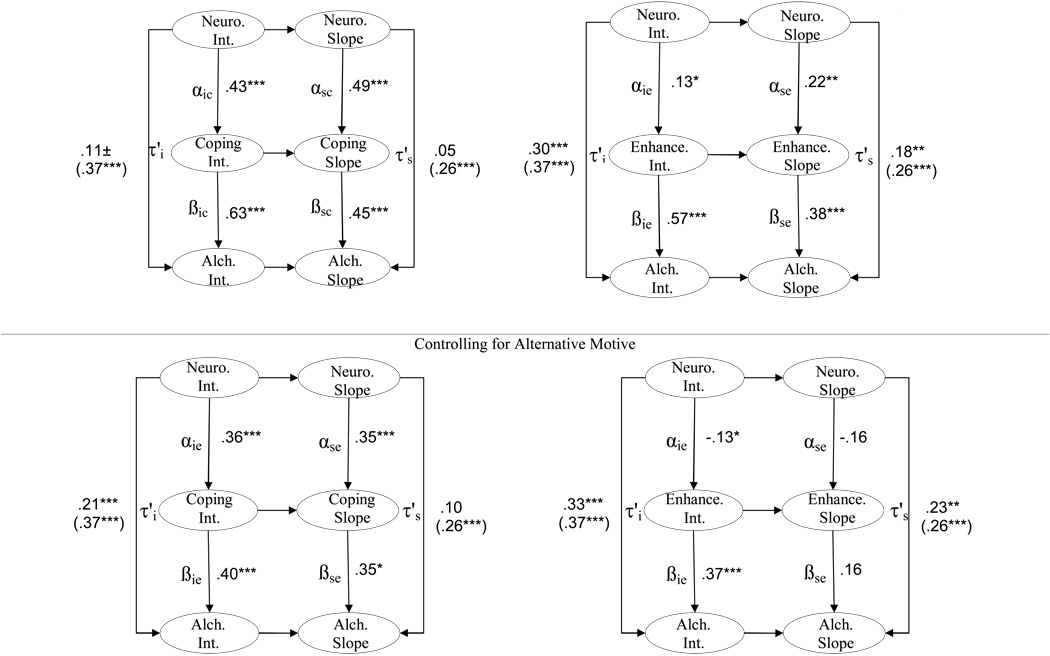
Recent research has indicated that developmental changes in the personality traits of neuroticism and impulsivity correlate with changes in problem drinking during emerging and young adulthood. However, it remains unclear what potential mechanisms, or mediators, could account for these associations. Drinking motives, particularly drinking to regulate negative affect (drinking to cope) and to get "high" or "drunk" (drinking for enhancement), have been posited to mediate the relationship between personality and drinking problems. Recent work indicates that changes in drinking motives parallel changes in alcohol involvement from adolescence to young adulthood. The present study examined changes in drinking motives (i.e., coping and enhancement) as potential mediators of the relation between changes in personality (impulsivity and neuroticism) with changes in alcohol problems in emerging and young adulthood. Analyses were based on data collected from a cohort of college students (N = 489) at varying risk for alcohol use disorders from ages 18 to 35. Parallel process latent growth modeling indicated that change in coping (but not enhancement) motives specifically mediated the relation between changes in neuroticism and alcohol problems as well as the relation between changes in impulsivity and alcohol problems. Findings suggest that change in coping motives is an important mechanism in the relation between personality change and the "maturing out" of problematic alcohol involvement.
最近的研究表明,神经质和冲动性人格特质的发展变化与青少年和年轻成人时期的酗酒问题变化有关。然而,目前尚不清楚哪些潜在机制或中介因素可以解释这些关联。饮酒动机,特别是为了调节负面情绪(借酒消愁)和为了获得“兴奋”或“醉酒”状态(借酒提神)而饮酒,被认为可以调节人格与饮酒问题之间的关系。最近的研究表明,从青少年到年轻成人,饮酒动机的变化与酒精摄入的变化是一致的。本研究考察了饮酒动机(即应对和增强)的变化,作为人格变化(冲动和神经质)与青少年和年轻成人时期酒精问题变化之间关系的潜在中介因素。分析基于从一个有不同酒精使用障碍风险的大学生队列(N=489)在 18 至 35 岁期间收集的数据。平行过程潜在增长模型表明,应对(而非增强)动机的变化专门调节了神经质变化与酒精问题之间的关系,以及冲动性变化与酒精问题之间的关系。研究结果表明,应对动机的变化是人格变化与问题性酒精摄入“成熟”之间关系的一个重要机制。