Jagers Robert J, Morgan-Lopez Antonio A, Howard Terry-Lee, Browne Dorothy C, Flay Brian R
Prevention Science Research Center, School of Public Health and Policy, Morgan State University, Montebello Complex, D-103 2201, Argonne Drive, Baltimore, MD 21251, USA.
Prev Sci. 2007 Sep;8(3):171-9. doi: 10.1007/s11121-007-0067-4. Epub 2007 Jun 9.
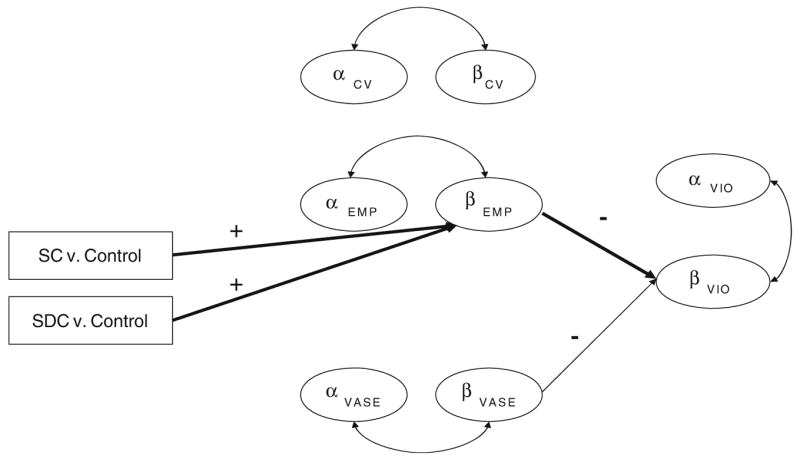
The purpose of this investigation was to determine if the Aban Aya Youth Project, a culturally grounded intervention, produced differences in changes over time in core intervening variables (i.e., communal value orientation, empathy, violence avoidance efficacy beliefs) and whether these variables mediated intervention effects on the development of youth violent behavior. Fifth grade cohorts at 12 schools were randomly assigned to one of two intervention conditions or an attention placebo control condition and followed longitudinally through eighth grade. A total of 668 students (49% male) participated in the study. Mediation analyses suggested that both program conditions (as compared to the control condition) led to steeper increases over time in empathy which, in turn were related to reductions in the likelihood of violent behavior over time. No other significant program effects were detected, although changes over time in violence avoidance efficacy were associated with reduced likelihood of violent behavior. Findings are discussed in terms of theory development, program development and points of refinement of the Aban Aya Youth Project and implications for future research.
本调查的目的是确定基于文化的干预措施阿班阿亚青年项目是否会在核心干预变量(即集体价值取向、同理心、避免暴力效能信念)随时间的变化上产生差异,以及这些变量是否介导了干预对青少年暴力行为发展的影响。12所学校的五年级学生被随机分配到两种干预条件之一或注意力安慰剂对照条件,并从五年级到八年级进行纵向跟踪。共有668名学生(49%为男性)参与了该研究。中介分析表明,与对照条件相比,两种项目条件都会使同理心随时间的增长更为显著,而这又与暴力行为随时间的可能性降低相关。虽然避免暴力效能随时间的变化与暴力行为可能性的降低有关,但未检测到其他显著的项目效果。研究结果从理论发展、项目发展、阿班阿亚青年项目的改进要点以及对未来研究的启示等方面进行了讨论。