Structural Biology & Bioinformatics Division, Indian Institute of Chemical Biology, 4, Raja S C Mullick Road, Kolkata - 700 032, India.
BMC Genomics. 2010 Feb 10;11:103. doi: 10.1186/1471-2164-11-103.
The marine cyanobacterium Prochlorococcus marinus, having multiple ecotypes of distinct genotypic/phenotypic traits and being the first documented example of genome shrinkage in free-living organisms, offers an ideal system for studying niche-driven molecular micro-diversity in closely related microbes. The present study, through an extensive comparative analysis of various genomic/proteomic features of 6 high light (HL) and 6 low light (LL) adapted strains, makes an attempt to identify molecular determinants associated with their vertical niche partitioning.
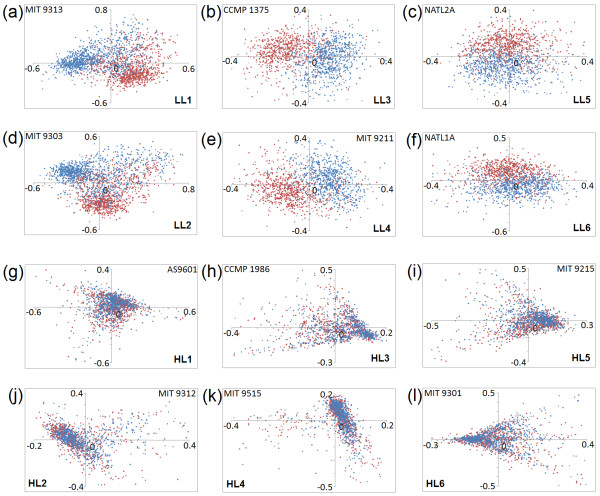
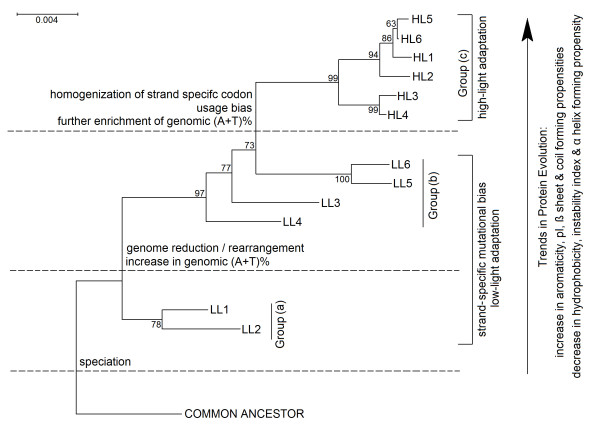
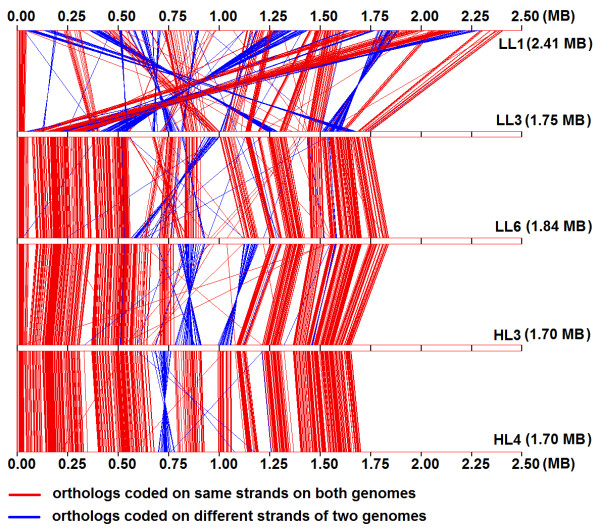
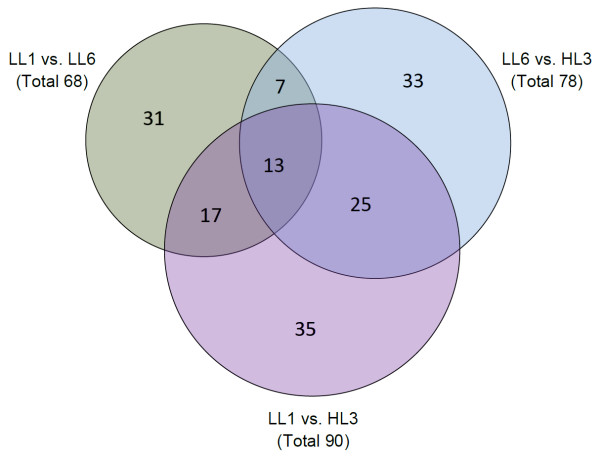
Pronounced strand-specific asymmetry in synonymous codon usage is observed exclusively in LL strains. Distinct dinucleotide abundance profiles are exhibited by 2 LL strains with larger genomes and G+C-content approximately 50% (group LLa), 4 LL strains having reduced genomes and G+C-content approximately 35-37% (group LLb), and 6 HL strains. Taking into account the emergence of LLa, LLb and HL strains (based on 16S rRNA phylogeny), a gradual increase in average aromaticity, pI values and beta- & coil-forming propensities and a decrease in mean hydrophobicity, instability indices and helix-forming propensities of core proteins are observed. Greater variations in orthologous gene repertoire are found between LLa and LLb strains, while higher number of positively selected genes exist between LL and HL strains.
Strains of different Prochlorococcus groups are characterized by distinct compositional, physicochemical and structural traits that are not mere remnants of a continuous genetic drift, but are potential outcomes of a grand scheme of niche-oriented stepwise diversification, that might have driven them chronologically towards greater stability/fidelity and invoked upon them a special ability to inhabit diverse oceanic environments.
海洋蓝藻原绿球藻(Prochlorococcus marinus)有多个不同基因型/表型特征的生态型,是自由生活生物中第一个被记录的基因组缩小的例子,为研究密切相关微生物中受小生境驱动的分子微多样性提供了理想的系统。本研究通过对 6 株高光(HL)和 6 株低光(LL)适应株的各种基因组/蛋白质组特征进行广泛比较分析,试图确定与它们垂直小生境划分相关的分子决定因素。
仅在 LL 株中观察到明显的链特异性同义密码子使用偏性。2 个具有较大基因组和 G+C 含量约为 50%(LLa 组)、4 个具有较小基因组和 G+C 含量约为 35-37%(LLb 组)以及 6 个 HL 株的独特二核苷酸丰度图谱。考虑到 LLa、LLb 和 HL 株的出现(基于 16S rRNA 系统发育),核心蛋白的平均芳香性、pI 值和β-及卷曲形成倾向逐渐增加,而平均疏水性、不稳定性指数和螺旋形成倾向逐渐降低。LLa 和 LLb 株之间的同源基因库变化较大,而 LL 和 HL 株之间存在更多的正选择基因。
不同的聚球藻组的菌株具有不同的组成、物理化学和结构特征,这些特征不仅仅是连续遗传漂移的残余物,而是小生境导向的逐步多样化的宏伟计划的潜在结果,这可能使它们在时间上朝着更大的稳定性/保真度发展,并赋予它们栖息于多种海洋环境的特殊能力。