Biomechanics Laboratory, Division of Orthopedic Research, Mayo Clinic, 200 First Street SW, Rochester, MN 55095, USA.
J Neuroeng Rehabil. 2010 Feb 10;7:5. doi: 10.1186/1743-0003-7-5.
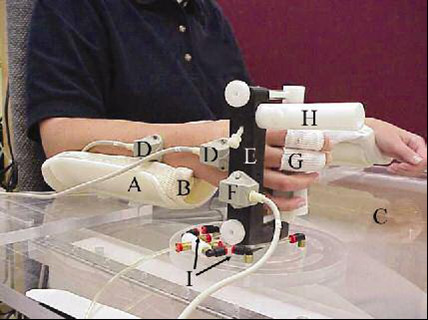
Aspects of afferent inputs, generally termed proprioception, are being increasingly studied. Extraneous factors such as cutaneous inputs can dramatically interfere while trying to design studies in order to determine the participation of the different structures involved in proprioception in the wrist position sense. We tried to determine validity and repeatability of a new wrist joint position measurement device using methodology designed to minimize extraneous factors and isolate muscle and joint inputs.
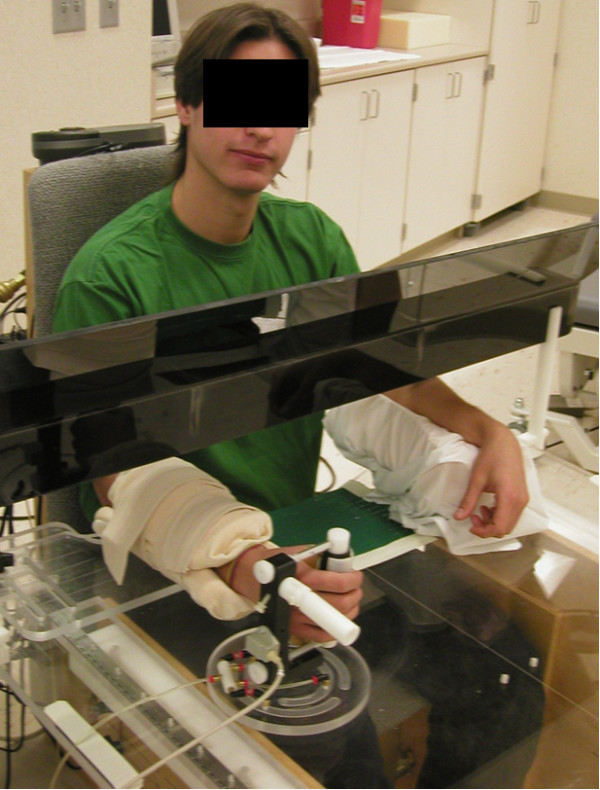
In order to test the reliability of the system, eighty young-adult subjects without musculoskeletal or neurologic impairments affecting the right upper extremity were tested using a custom made motion tracking system. Testing consisted of two conditions: active reproduction of active placement and passive reproduction of passive placement. Subjects performed two repetitions of each target position (10, 20, and 30 degrees of flexion and extension) presented in a random order. Test- retest reliability was then tested.
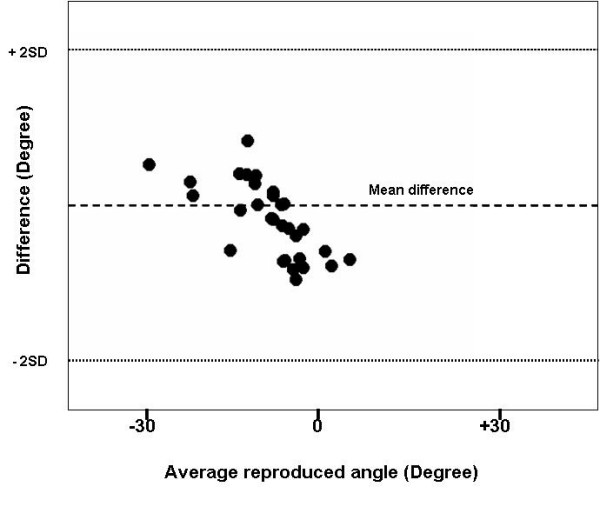
The average constant error in the passive condition was -0.7 degrees +/- 4.7 degrees as compared to the active condition at 3.7 degrees +/- 5.1 degrees. Average absolute error in the passive condition was 4.9 degrees +/- 2.9 degrees compared to the active condition in which absolute error was 5.9 degrees +/- 3.5 degrees.
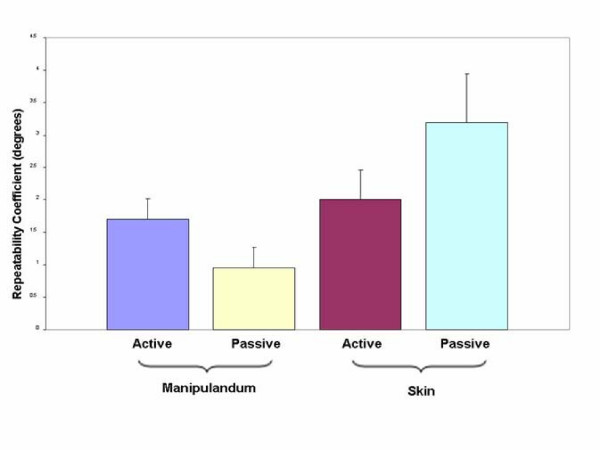
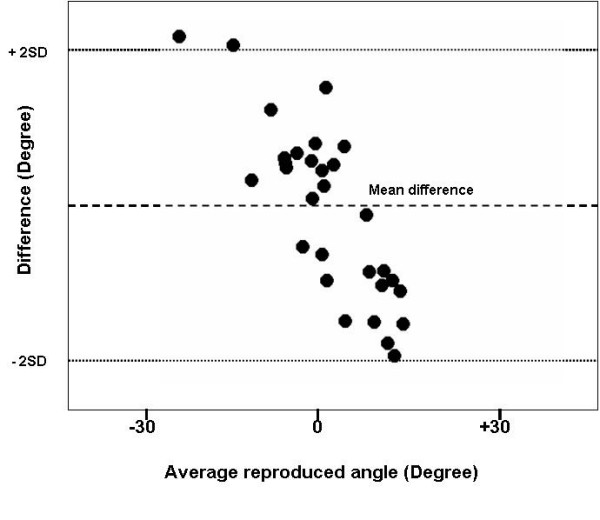
Test-retest repeatability in both conditions was less than the 5 degrees magnitude typical of clinical goniometry. Errors in the active condition (less than 2 degrees ) were slightly smaller than the passive condition, and the passive condition was also associated with poorer consistency between apparatus sensors and skin sensors.
The current system for measurement of wrist joint proprioception allows the researcher to decrease extraneous influences that may affect joint position sense awareness, and will help in future study aiming to determine precisely the role of the different structure involved in proprioception.
传入输入的各个方面,通常称为本体感觉,正越来越多地受到研究。在试图设计研究以确定参与本体感觉的不同结构在腕关节位置感中的作用时,皮肤等外来因素会产生显著干扰。我们试图确定一种新的腕关节位置测量装置的有效性和可重复性,该装置采用旨在最小化外来因素并分离肌肉和关节输入的方法设计。
为了测试系统的可靠性,八十名无影响上肢的肌肉骨骼或神经功能障碍的年轻成年人使用定制的运动跟踪系统进行了测试。测试包括两种条件:主动再现主动放置和被动再现被动放置。受试者以随机顺序执行每个目标位置(10、20 和 30 度屈伸)的两次重复。然后测试测试-重测可靠性。
在被动条件下,平均恒定误差为-0.7 度 +/- 4.7 度,而在主动条件下为 3.7 度 +/- 5.1 度。在被动条件下,平均绝对误差为 4.9 度 +/- 2.9 度,而在主动条件下,绝对误差为 5.9 度 +/- 3.5 度。
两种条件下的测试-重测重复性均小于临床测角术典型的 5 度幅度。主动条件下的误差(小于 2 度)略小于被动条件,并且被动条件下仪器传感器和皮肤传感器之间的一致性也较差。
目前用于测量腕关节本体感觉的系统允许研究人员减少可能影响关节位置感的外来影响,并将有助于未来旨在精确确定参与本体感觉的不同结构的作用的研究。