Department of Pathophysiology, North China Coal Medical College, Tangshan, China.
Acta Orthop. 2010 Apr;81(2):263-7. doi: 10.3109/17453671003587085.
CHOP is a C/EBP family transcription factor involved in endoplasmic reticulum (ER) stress-mediated apoptosis. Several studies have demonstrated that ischemia reperfusion results in apoptosis. Oxidative stress is central to ischemia reperfusion-induced apoptosis. Taurine protects against lung injury after limb ischemia reperfusion (LIR) through antioxidation. The effects of taurine on ER stress-induced apoptosis have not been well explored, however. We studied the effects of taurine in ER stress-induced apoptosis following LIR.
Adult male Sprague-Dawley rats (n = 40) were randomized into 4 groups: (1) a control group, (2) an LIR group, (3) an LIR group treated with taurine, and (4) an LIR group treated with saline. Bilateral hindlimb ischemia was induced by application of a rubber band proximal to the level of the greater trochanters for 4 h. The treatment groups received either taurine (200 mg/kg as a 4% solution in 0.9% saline) or saline alone prior to reperfusion. Following 4h of reperfusion, blood oxygen was analyzed. The animals were killed and plasma and lung tissue were harvested for evaluation.
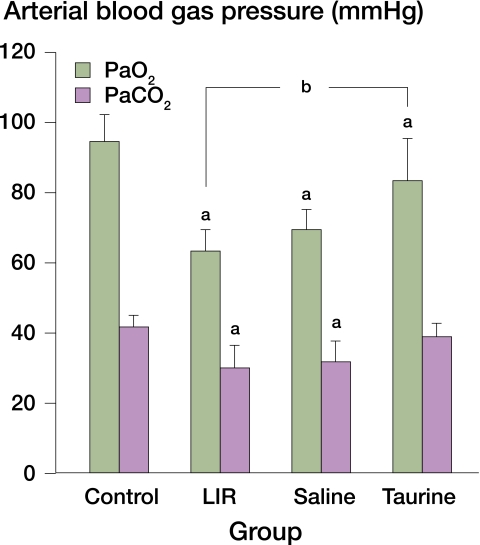
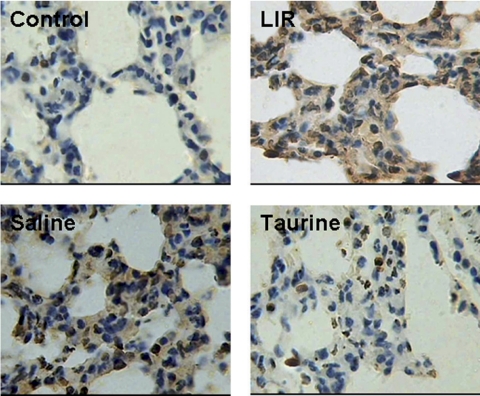
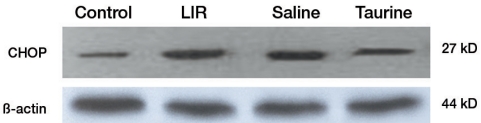
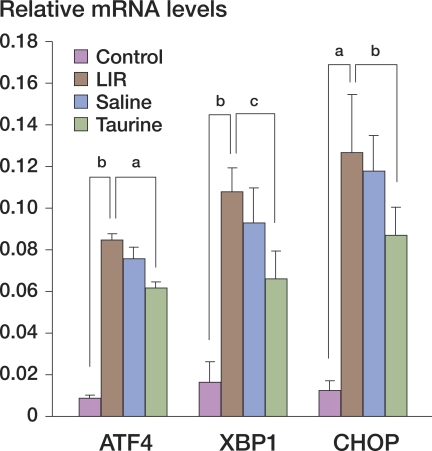
Taurine statistically significantly attenuated lung injury following LIR, as shown by reduced malondialdehyde content, reduced cell apoptosis, and expression of activating transcription factor 4 (ATF4), X-box binding protein 1 (XBP1), and transcriptional activators of the CHOP gene. Furthermore, partial pressure values of oxygen in arterial blood and the activities of superoxide dismutase and catalase were higher in the taurine pretreatment group than in the group of rats that underwent LIR alone.
Our results suggest that taurine attenuates endoplasmic reticulum stress-induced apoptosis in the lungs of rats after limb ischemia reperfusion.
CHOP 是一种 C/EBP 家族转录因子,参与内质网(ER)应激介导的细胞凋亡。多项研究表明,缺血再灌注可导致细胞凋亡。氧化应激是缺血再灌注诱导细胞凋亡的核心。牛磺酸通过抗氧化作用保护肢体缺血再灌注(LIR)后的肺损伤。然而,牛磺酸对 ER 应激诱导的细胞凋亡的影响尚未得到充分探讨。本研究旨在探讨牛磺酸在 LIR 后 ER 应激诱导的细胞凋亡中的作用。
成年雄性 Sprague-Dawley 大鼠(n = 40)随机分为 4 组:(1)对照组,(2)LIR 组,(3)LIR 组用牛磺酸治疗,(4)LIR 组用生理盐水治疗。通过在大转子水平近端应用橡胶带将双侧后肢缺血 4 h 诱导缺血再灌注。治疗组在再灌注前分别给予牛磺酸(200mg/kg,以 4%的溶液溶于 0.9%的生理盐水)或生理盐水。再灌注 4 h 后,分析血氧。处死动物并采集血浆和肺组织进行评估。
牛磺酸显著减轻了 LIR 后的肺损伤,表现为丙二醛含量降低、细胞凋亡减少、激活转录因子 4(ATF4)、X 盒结合蛋白 1(XBP1)和 CHOP 基因转录激活物的表达减少。此外,牛磺酸预处理组的动脉血氧分压值和超氧化物歧化酶和过氧化氢酶的活性均高于单纯 LIR 组。
我们的结果表明,牛磺酸可减轻肢体缺血再灌注后大鼠肺内质网应激诱导的细胞凋亡。