Department of Anesthesiology, the First Affiliated Hospital of Xinjiang Medical University, Xinjiang, China.
Braz J Cardiovasc Surg. 2023 Feb 10;38(1):79-87. doi: 10.21470/1678-9741-2021-0043.
To explore the effect of ischemic postconditioning on myocardial ischemia-reperfusion-induced acute lung injury (ALI).
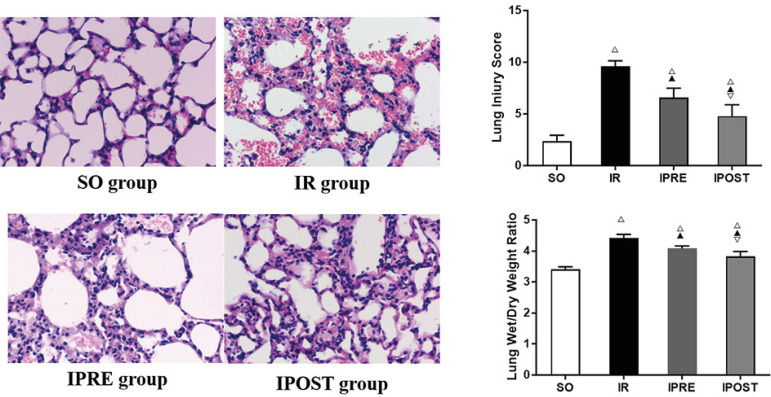
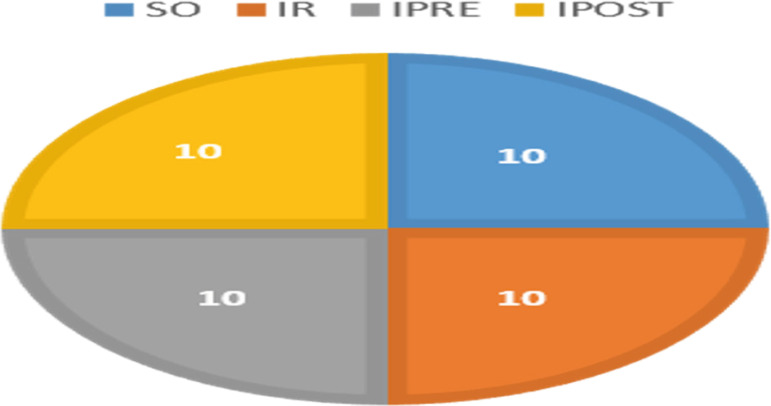
Forty adult male C57BL/6 mice were randomly divided into sham operation group (SO group), myocardial ischemia-reperfusion group (IR group), ischemic preconditioning group (IPRE group) and ischemic postconditioning group (IPOST group) (10 mice in each group). Anterior descending coronary artery was blocked for 60 min and then reperfused for 15 min to induce myocardial IR. For the IPRE group, 3 consecutive cycles of 5 min of occlusion and 5 minutes of reperfusion of the coronary arteries were performed before ischemia. For the IPOST group, 3 consecutive cycles of 5 min reperfusion and 5 minutes of occlusion of the coronary arteries were performed before reperfusion. Pathological changes of lung tissue, lung wet-to-dry (W/D) weight ratio, inflammatory factors, oxidative stress indicators, apoptosis of lung cells and endoplasmic reticulum stress (ERS) protein were used to evaluate lung injury.
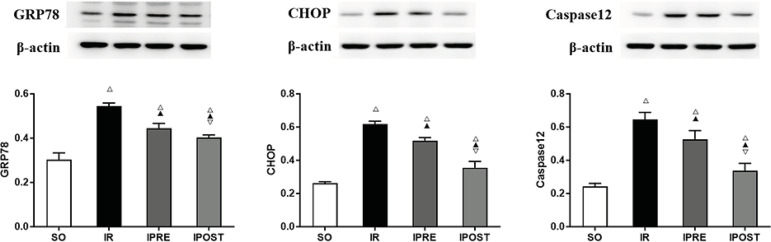
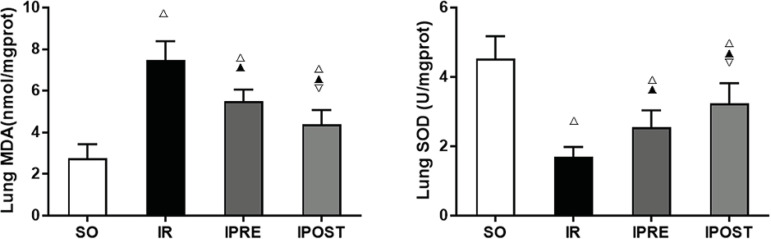
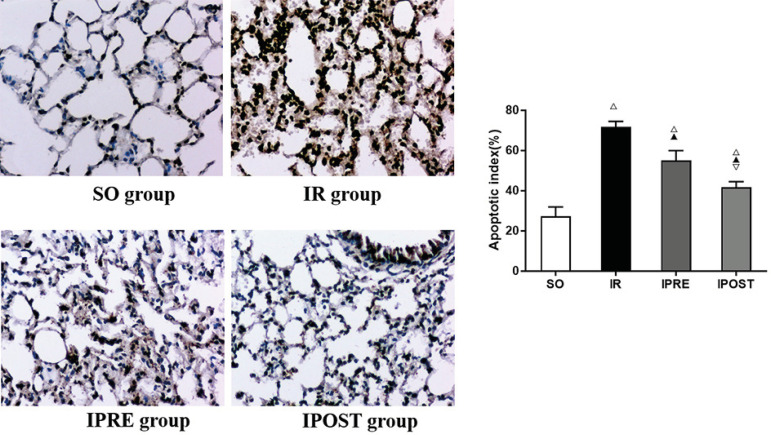
After myocardial IR, lung injury worsened significantly, manifested by alveolar congestion, hemorrhage, structural destruction of alveolar septal thickening, and interstitial neutrophil infiltration. In addition, lung W/D ratio was increased, plasma inflammatory factors, including interleukin (IL)-6, tumor necrosis factor (TNF)-α, and IL-17A, were increased, malondialdehyde (MDA) activity of lung tissue was increased, and superoxide dismutase (SOD) activity was decreased after myocardial IR. It was accompanied by the increased protein expression levels of ERS-related protein glucose regulatory protein 78 (GRP78), CCAAT/enhancer-binding protein (C/EBP) homologous protein (CHOP), and caspase-12, and the increased apoptotic indices of lung tissues.
IPOST can effectively improve myocardial IR-induced ALI by inhibiting ERS-induced apoptosis of alveolar epithelial cells.
探讨缺血后处理对心肌缺血再灌注诱导的急性肺损伤(ALI)的影响。
40 只成年雄性 C57BL/6 小鼠随机分为假手术组(SO 组)、心肌缺血再灌注组(IR 组)、缺血预处理组(IPRE 组)和缺血后处理组(IPOST 组)(每组 10 只)。结扎前降支冠状动脉 60min 后再灌注 15min 诱导心肌缺血再灌注。IPRE 组在缺血前进行 3 个循环的 5min 冠脉闭塞和 5min 再灌注。IPOST 组在再灌注前进行 3 个循环的 5min 再灌注和 5min 冠脉闭塞。通过观察肺组织的病理变化、肺湿干重(W/D)比值、炎性因子、氧化应激指标、肺细胞凋亡和内质网应激(ERS)蛋白来评估肺损伤。
心肌缺血再灌注后,肺损伤明显加重,表现为肺泡淤血、出血、肺泡间隔结构破坏、间质中性粒细胞浸润。此外,肺 W/D 比值升高,血浆炎性因子如白细胞介素(IL)-6、肿瘤坏死因子(TNF)-α 和 IL-17A 增加,肺组织丙二醛(MDA)活性增加,超氧化物歧化酶(SOD)活性降低,同时 ERS 相关蛋白葡萄糖调节蛋白 78(GRP78)、CCAAT/增强子结合蛋白(C/EBP)同源蛋白(CHOP)和半胱天冬酶-12 的蛋白表达水平增加,肺组织的凋亡指数增加。
IPOST 可通过抑制 ERS 诱导的肺泡上皮细胞凋亡有效改善心肌缺血再灌注诱导的 ALI。