Department of Clinical and Experimental Medicine, University of Padova, Medical School, Padova, Italy.
Diabetes Care. 2010 May;33(5):1097-102. doi: 10.2337/dc09-1999. Epub 2010 Feb 11.
Reduction of bone marrow-derived circulating progenitor cells has been proposed as a novel mechanism of cardiovascular disease in type 2 diabetes. The present study was designed to describe the extent and potential mechanisms of progenitor cell reduction during the natural history of type 2 diabetes.
We identified 425 individuals, divided into seven categories according to carbohydrate metabolism status (normal glucose tolerance [NGT], impaired fasting glucose, impaired glucose tolerance [IGT], and newly diagnosed type 2 diabetes) and diabetes duration (0-9, 10-19, and >or=20 years). These categories were examined as ideally describing the natural history of type 2 diabetes development and progression. We measured CD34+ and CD34+KDR+ progenitor cells by flow cytometry. We also evaluated progenitor cells in 20 coupled bone marrow and peripheral blood samples and examined progenitor cell apoptosis in 34 subjects.
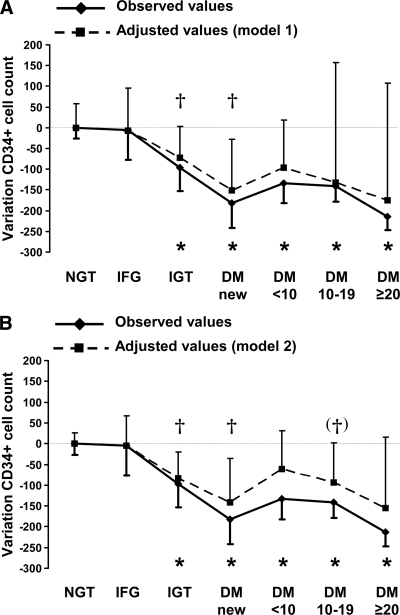
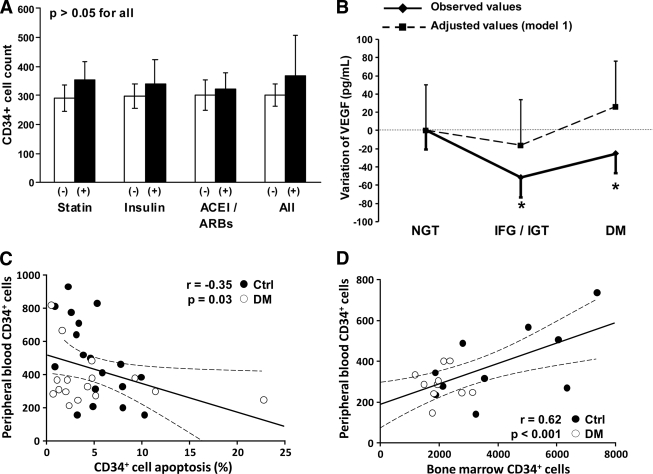
In comparison to NGT, CD34+ cells were significantly reduced in IGT and had a first nadir in newly diagnosed type 2 diabetes and a second nadir after 20 years of diabetes. Statistical adjustment for possible confounders confirmed that CD34+ cell counts are deeply reduced at time of diagnosis, that they partially recover during the subsequent 0-19 years, and that they dip again after >or=20 years. A similar, but less consistent, trend was detected for CD34+KDR+ cells. Peripheral blood CD34+ cells were directly correlated with bone marrow CD34+ cells and inversely correlated with CD34+ cell apoptosis.
Circulating progenitor cell reduction marks the clinical onset of type 2 diabetes. Both defective mobilization and increased apoptosis may account for this phenomenon. While a partial recovery occurs during subsequent years, bone marrow reserve seems exhausted in the long term.
骨髓源性循环祖细胞的减少被认为是 2 型糖尿病心血管疾病的新机制。本研究旨在描述 2 型糖尿病自然史中祖细胞减少的程度和潜在机制。
我们鉴定了 425 个人,根据碳水化合物代谢状态(正常糖耐量[NGT]、空腹血糖受损、糖耐量受损[IGT]和新诊断的 2 型糖尿病)和糖尿病病程(0-9、10-19 和≥20 年)将其分为七个类别。这些类别被认为可以理想地描述 2 型糖尿病发展和进展的自然史。我们通过流式细胞术测量 CD34+和 CD34+KDR+祖细胞。我们还评估了 20 对骨髓和外周血样本中的祖细胞,并在 34 名受试者中检查了祖细胞凋亡。
与 NGT 相比,IGT 中的 CD34+细胞明显减少,在新诊断的 2 型糖尿病时出现第一个低谷,在糖尿病 20 年后出现第二个低谷。对可能的混杂因素进行统计学调整后证实,CD34+细胞计数在诊断时明显减少,随后的 0-19 年内部分恢复,在≥20 年后再次下降。CD34+KDR+细胞也存在类似但不太一致的趋势。外周血 CD34+细胞与骨髓 CD34+细胞直接相关,与 CD34+细胞凋亡呈负相关。
循环祖细胞减少标志着 2 型糖尿病的临床发病。动员缺陷和细胞凋亡增加都可能导致这种现象。虽然在随后的几年中会出现部分恢复,但骨髓储备似乎在长期内耗尽。