School of Environment and Sustainability, Royal Roads University, 2005 Sooke Road, Victoria, BC, V9B 5Y2 Canada.
J Exp Bot. 2010 Mar;61(5):1365-74. doi: 10.1093/jxb/erq004. Epub 2010 Feb 11.
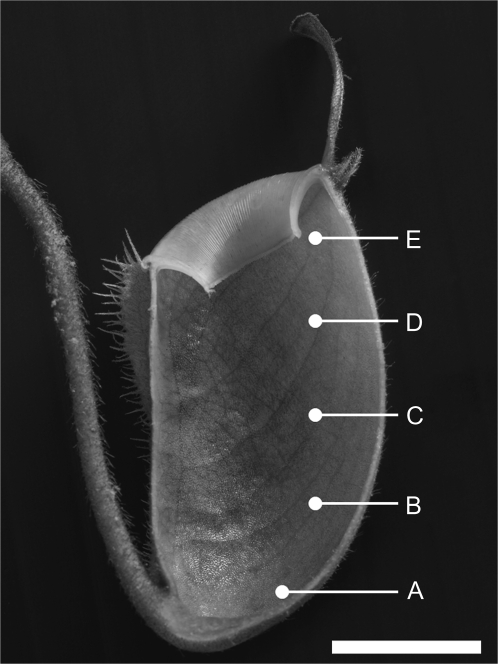
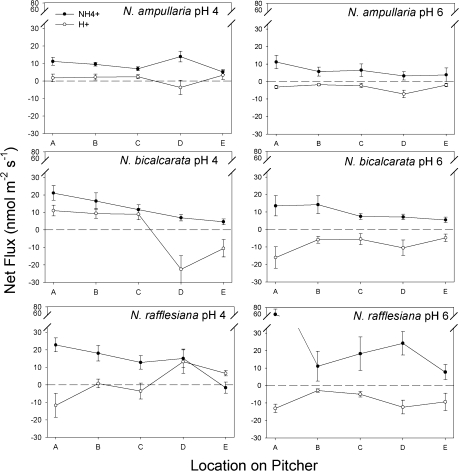
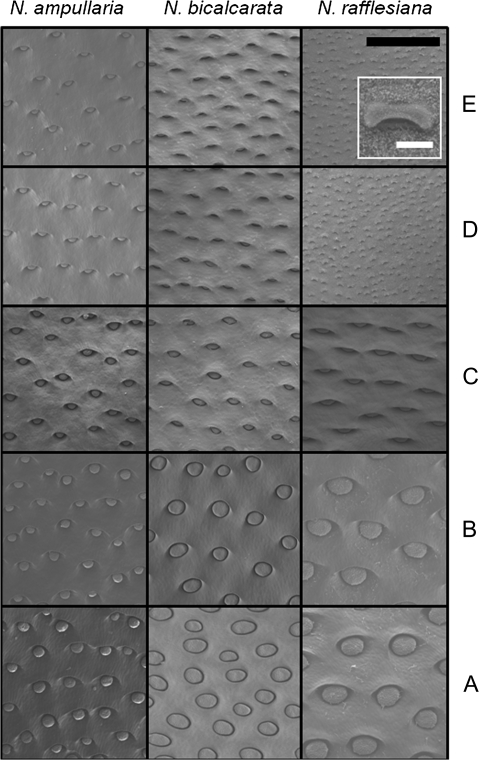
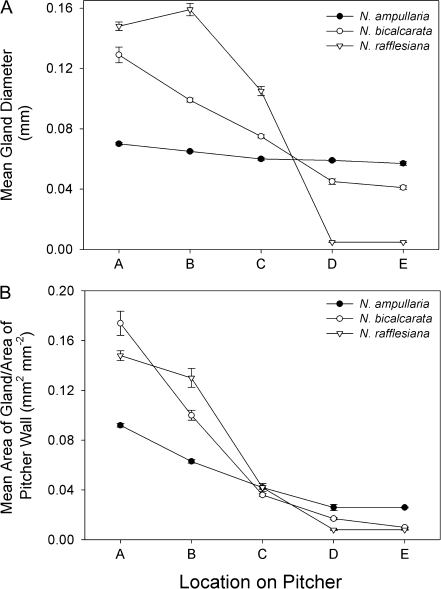
Nepenthes pitcher plant species differ in their prey capture strategies, prey capture rates, and pitcher longevity. In this study, it is investigated whether or not interspecific differences in nutrient sequestration strategy are reflected in the physiology and microstructure of the pitchers themselves. Using a non-invasive technique (MIFE), ion fluxes in pitchers of Nepenthes ampullaria Jack, Nepenthes bicalcarata Hook.f., and Nepenthes rafflesiana Jack were measured. Scanning electron microscopy was also used to characterize the distribution of glandular and other structures on the inner pitcher walls. The results demonstrate that nutrient sequestration strategy is indeed mirrored in pitcher physiology and microstructure. Species producing long-lived pitchers with low prey capture rates (N. ampullaria, N. bicalcarata) showed lower rates of NH(4)(+) uptake than N. rafflesiana, a species producing short-lived pitchers with high capture rates. Crucially, species dependent upon aquatic commensals (N. ampullaria, N. bicalcarata) actively manipulated H(+) fluxes to maintain less acid pitcher fluid than found in 'typical' species; in addition, these species lacked the lunate cells and epicuticular waxes characteristic of 'typical' insectivorous congeners. An unexpected finding was that ion fluxes occurred in the wax-covered, non-glandular zones in N. rafflesiana. The only candidates for active transport of aqueous ions in these zones appear to be the epidermal cells lying beneath the lunate cells, as these are the only sites not visibly coated with epicuticular waxes.
猪笼草物种在其猎物捕获策略、猎物捕获率和瓶寿命方面存在差异。在这项研究中,研究人员调查了种间养分固存策略的差异是否反映在猪笼草本身的生理学和微观结构上。研究人员使用一种非侵入性技术(MIFE)测量了猪笼草属(Nepenthes ampullaria Jack、Nepenthes bicalcarata Hook.f.和 Nepenthes rafflesiana Jack)的瓶中的离子通量。扫描电子显微镜也用于描述内瓶壁上腺体和其他结构的分布。结果表明,养分固存策略确实反映在瓶的生理学和微观结构上。产生长寿命、低猎物捕获率的物种(N. ampullaria、N. bicalcarata)的 NH(4)(+)摄取率低于产生短寿命、高捕获率的物种 N. rafflesiana。至关重要的是,依赖水生共生物的物种(N. ampullaria、N. bicalcarata)积极地操纵 H(+)通量,以维持比“典型”物种中酸性更低的瓶内液体;此外,这些物种缺乏半月形细胞和特有的角质层蜡,这些都是“典型”食虫近缘种的特征。一个意外的发现是,离子通量发生在蜡覆盖的非腺体区,N. rafflesiana。这些区域中,水合离子主动运输的唯一候选者似乎是位于半月形细胞下方的表皮细胞,因为这些是唯一没有明显覆盖角质层蜡的部位。