Institute for Molecular Plant Physiology and Biophysics, University of Würzburg, Würzburg, Germany.
Botanische Staatssammlung München and GeoBio-Center LMU, Ludwig-Maximilians-University Munich, Munich, Germany.
Plant Physiol. 2022 Aug 29;190(1):44-59. doi: 10.1093/plphys/kiac232.
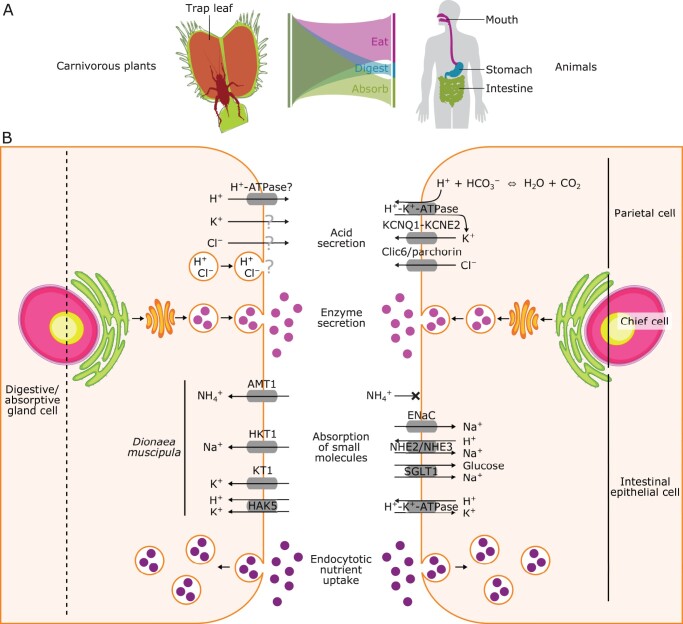
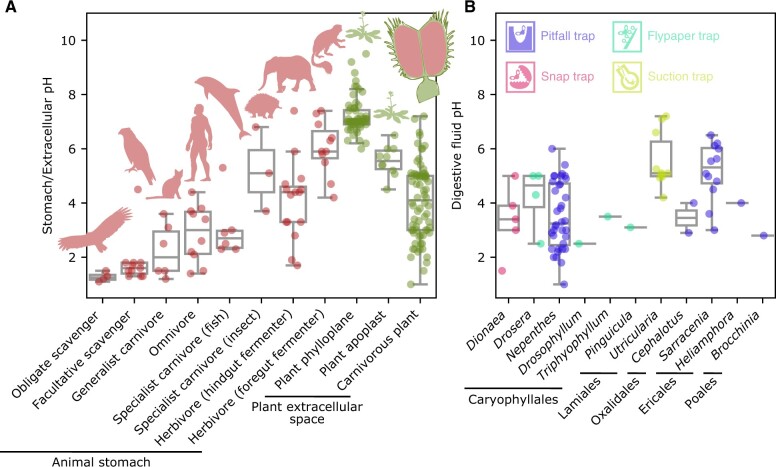
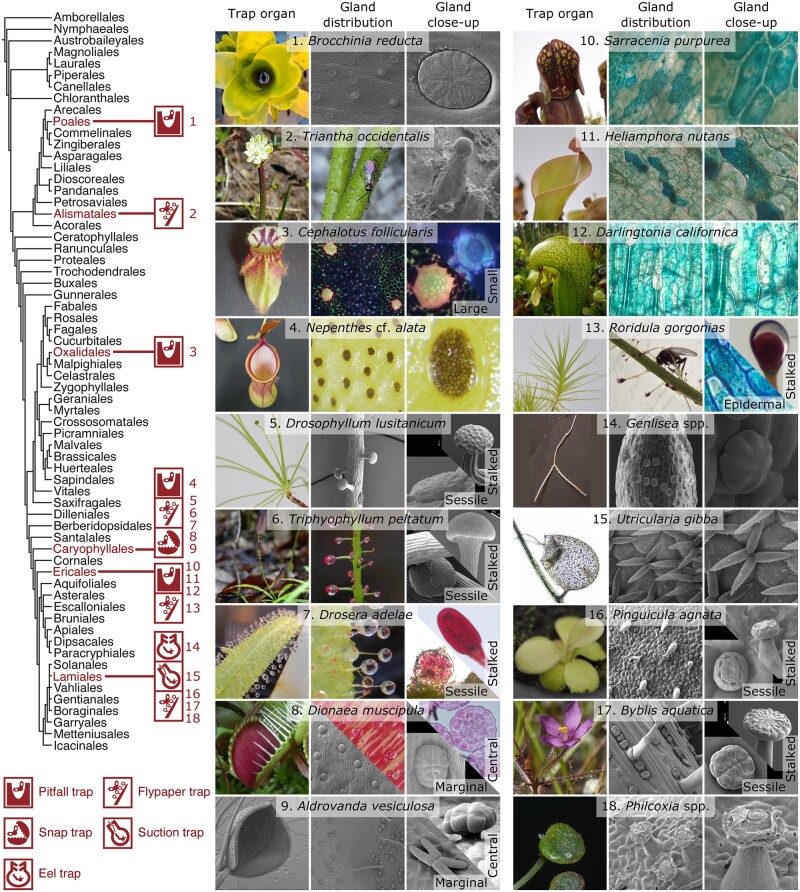
To survive in the nutrient-poor habitats, carnivorous plants capture small organisms comprising complex substances not suitable for immediate reuse. The traps of carnivorous plants, which are analogous to the digestive systems of animals, are equipped with mechanisms for the breakdown and absorption of nutrients. Such capabilities have been acquired convergently over the past tens of millions of years in multiple angiosperm lineages by modifying plant-specific organs including leaves. The epidermis of carnivorous trap leaves bears groups of specialized cells called glands, which acquire substances from their prey via digestion and absorption. The digestive glands of carnivorous plants secrete mucilage, pitcher fluids, acids, and proteins, including digestive enzymes. The same (or morphologically distinct) glands then absorb the released compounds via various membrane transport proteins or endocytosis. Thus, these glands function in a manner similar to animal cells that are physiologically important in the digestive system, such as the parietal cells of the stomach and intestinal epithelial cells. Yet, carnivorous plants are equipped with strategies that deal with or incorporate plant-specific features, such as cell walls, epidermal cuticles, and phytohormones. In this review, we provide a systematic perspective on the digestive and absorptive capacity of convergently evolved carnivorous plants, with an emphasis on the forms and functions of glands.
为了在营养贫瘠的栖息地中生存,食虫植物会捕获包含不适合立即再利用的复杂物质的小型生物体。食虫植物的陷阱类似于动物的消化系统,配备有分解和吸收营养物质的机制。这种能力是通过在过去数千万年中,在多个被子植物谱系中,对包括叶子在内的植物特化器官进行修饰而获得的。食虫陷阱叶的表皮上有一组称为腺体的特化细胞,这些细胞通过消化和吸收从猎物中获取物质。食虫植物的消化腺会分泌黏液、瓶状液、酸和蛋白质,包括消化酶。然后,相同(或形态上不同)的腺体通过各种膜转运蛋白或内吞作用吸收释放的化合物。因此,这些腺体的功能类似于在生理上对消化系统很重要的动物细胞,例如胃的壁细胞和肠上皮细胞。然而,食虫植物配备了应对或整合植物特有的特征的策略,例如细胞壁、表皮角质层和植物激素。在这篇综述中,我们从系统的角度介绍了趋同进化的食虫植物的消化和吸收能力,重点介绍了腺体的形式和功能。