WHO Collaborating Centre for Obesity Prevention, Deakin University, Geelong, Australia 3217.
BMC Public Health. 2010 Feb 12;10:65. doi: 10.1186/1471-2458-10-65.
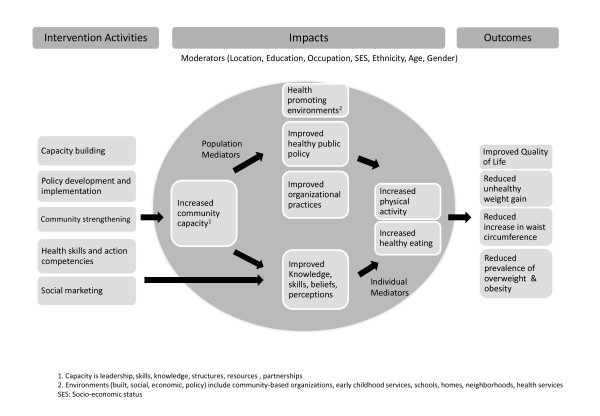
There is only limited evidence available on how best to prevent childhood obesity and community-based interventions hold promise, as several successful interventions have now been published. The Victorian Government has recently funded six disadvantaged communities across Victoria, Australia for three years to promote healthy eating and physical activity for children, families, and adults in a community-based participatory manner. Five of these intervention communities are situated in Primary Care Partnerships and are the subject of this paper. The interventions will comprise a mixture of capacity-building, environmental, and whole-of-community approaches with targeted and population-level interventions. The specific intervention activities will be determined locally within each community through stakeholder and community consultation. Implementation of the interventions will occur through funded positions in primary care and local government. This paper describes the design of the evaluation of the five primary care partnership-based initiatives in the 'Go for your life' Health Promoting Communities: Being Active Eating Well (HPC:BAEW) initiative.
METHODS/DESIGN: A mixed method and multi-level evaluation of the HPC:BAEW initiative will capture process, impact and outcome data and involve both local and state-wide evaluators. There will be a combined analysis across the five community intervention projects with outcomes compared to a comparison group using a cross-sectional, quasi-experimental design. The evaluation will capture process, weight status, socio-demographic, obesity-related behavioral and environmental data in intervention and comparison areas. This will be achieved using document analysis, paper-based questionnaires, interviews and direct measures of weight, height and waist circumference from participants (children, adolescents and adults).
This study will add significant evidence on how to prevent obesity at a population level in disadvantaged and ethnically diverse communities. The outcomes will have direct influence on policy and practice and guide the development and implementation of future obesity prevention efforts in Australia and internationally.
ACTRN12609000892213.
目前,关于如何最好地预防儿童肥胖的证据有限,而基于社区的干预措施有很大的希望,因为现在已经有几项成功的干预措施被发表。澳大利亚维多利亚州政府最近为六个维多利亚州的贫困社区提供了为期三年的资金,以通过基于社区的参与式方法促进儿童、家庭和成年人的健康饮食和身体活动。这五个干预社区都位于初级保健合作伙伴关系中,是本文的主题。这些干预措施将包括能力建设、环境和全社区方法,以及有针对性和人口层面的干预措施。具体的干预活动将通过每个社区的利益相关者和社区咨询来确定。干预措施的实施将通过初级保健和地方政府的资金职位进行。本文介绍了“争取你的生活”促进社区健康:积极饮食(HPC:BAEW)计划中五个基于初级保健合作伙伴关系的倡议的评估设计。
方法/设计:对 HPC:BAEW 倡议的混合方法和多层次评估将捕获过程、影响和结果数据,并涉及当地和全州评估人员。将对五个社区干预项目进行综合分析,并将结果与使用横断面、准实验设计的对照组进行比较。评估将在干预和比较区域捕获过程、体重状况、社会人口统计学、肥胖相关行为和环境数据。这将通过文件分析、纸质问卷、访谈和对参与者(儿童、青少年和成年人)的体重、身高和腰围的直接测量来实现。
这项研究将为如何在贫困和族裔多样化的社区中在人口层面预防肥胖提供重要证据。结果将对政策和实践产生直接影响,并指导澳大利亚和国际上未来肥胖预防工作的发展和实施。
ACTRN12609000892213。