Institute of Pharmacology, Jessenius Faculty of Medicine, Sklabinska 26, Martin 03601, Slovakia.
Eur J Med Res. 2009 Dec 7;14 Suppl 4(Suppl 4):6-8. doi: 10.1186/2047-783x-14-s4-6.
Exhaled nitric oxide (eNO) has been suggested as a marker of airway inflammatory diseases. The level of eNO is influenced by many various factor including age, sex, menstrual cycle, exercise, food, drugs, etc. The aim of our study was to investigate a potential influence of circadian variation on eNO level in healthy subjects.
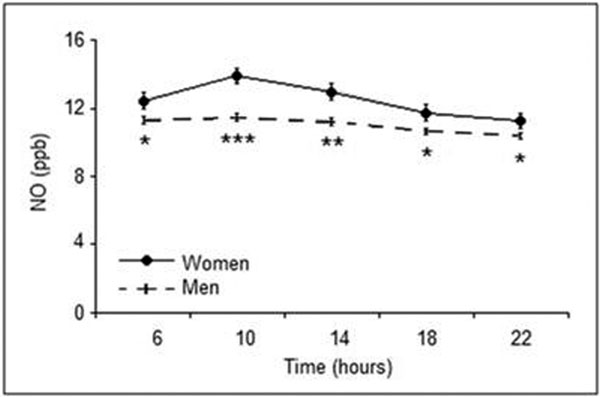
Measurements were performed in 44 women and 10 men, non-smokers, without respiratory tract infection in last 2 weeks. The eNO was detected at 4-hour intervals from 6 a.m. to 10 p.m. using an NIOX analyzer. We followed the ATS/ERS guidelines for eNO measurement and analysis.
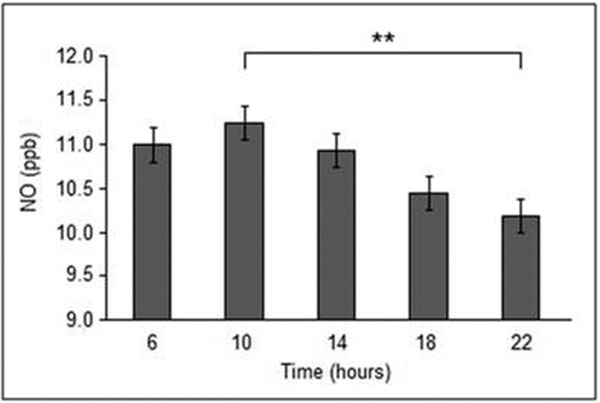
Peak of eNO levels were observed at 10 a.m. (11.1 +/- 7.2 ppb), the lowest value was detected at 10 p.m. (10.0 +/- 5.8 ppb). The difference was statistically significant (paired t-test, P<0.001).
The daily variations in eNO, with the peak in the morning hours, could be of importance in clinical practice regarding the choice of optimal time for monitoring eNO in patients with respiratory disease.
呼气一氧化氮(eNO)已被认为是气道炎症性疾病的标志物。eNO 的水平受许多因素的影响,包括年龄、性别、月经周期、运动、食物、药物等。我们的研究目的是调查昼夜节律变化对健康受试者 eNO 水平的潜在影响。
在 44 名女性和 10 名男性非吸烟者中进行了测量,他们在过去 2 周内没有呼吸道感染。使用 NIOX 分析仪,从上午 6 点到晚上 10 点每隔 4 小时检测一次 eNO。我们遵循 ATS/ERS 关于 eNO 测量和分析的指南。
eNO 水平的峰值出现在上午 10 点(11.1±7.2 ppb),最低值出现在晚上 10 点(10.0±5.8 ppb)。差异具有统计学意义(配对 t 检验,P<0.001)。
eNO 的日变化,早晨峰值,在临床实践中监测呼吸道疾病患者 eNO 的最佳时间选择方面可能具有重要意义。