Nock Matthew K
Harvard University.
Curr Dir Psychol Sci. 2009 Apr 1;18(2):78-83. doi: 10.1111/j.1467-8721.2009.01613.x.
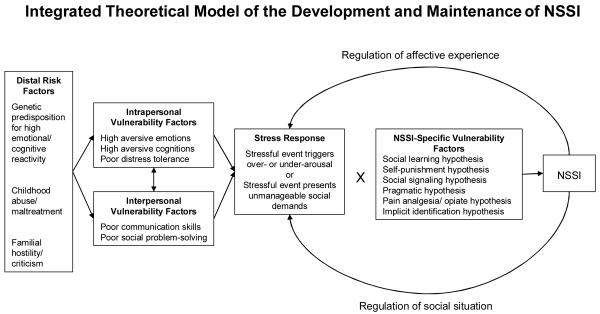
Nonsuicidal self-injury (NSSI) is a prevalent but perplexing behavior problem in which people deliberately harm themselves without lethal intent. Research reveals that NSSI typically has its onset during early adolescence; most often involves cutting or carving the skin; and appears equally prevalent across sexes, ethnicities, and socioeconomic statuses. Less is known about why people engage in NSSI. This article presents a theoretical model of the development and maintenance of NSSI. Rather than a symptom of mental disorder, NSSI is conceptualized as a harmful behavior that can serve several intrapersonal (e.g., affect regulation) and interpersonal (e.g., help-seeking) functions. Risk of NSSI is increased by general factors that contribute to problems with affect regulation or interpersonal communication (e.g., childhood abuse) and by specific factors that influence the decision to use NSSI rather than some other behavior to serve these functions (e.g., social modeling). This model synthesizes research from several different areas of the literature and points toward several lines of research needed to further advance the understanding of why people hurt themselves.
非自杀性自伤(NSSI)是一种普遍但令人困惑的行为问题,即人们故意伤害自己但并无致死意图。研究表明,NSSI通常始于青春期早期;最常见的方式是切割或划破皮肤;在不同性别、种族和社会经济地位中出现的频率相当。对于人们为何会有非自杀性自伤行为,我们所知甚少。本文提出了一个关于非自杀性自伤行为发展与维持的理论模型。非自杀性自伤并非精神障碍的症状,而是一种有害行为,它可以起到多种个人内部功能(如情绪调节)和人际功能(如寻求帮助)。导致情绪调节或人际沟通出现问题的一般因素(如童年期受虐)以及影响人们决定采用非自杀性自伤行为而非其他行为来实现这些功能的特定因素(如社会榜样作用),都会增加非自杀性自伤行为的风险。该模型整合了来自文献中几个不同领域的研究,并指出了为进一步深入理解人们为何伤害自己所需开展的几条研究方向。