Queensland Brain Institute, The University of Queensland, St. Lucia, Queensland, Australia.
PLoS One. 2010 Feb 8;5(2):e9110. doi: 10.1371/journal.pone.0009110.
The honeybee has to detect, process and learn numerous complex odours from her natural environment on a daily basis. Most of these odours are floral scents, which are mixtures of dozens of different odorants. To date, it is still unclear how the bee brain unravels the complex information contained in scent mixtures.
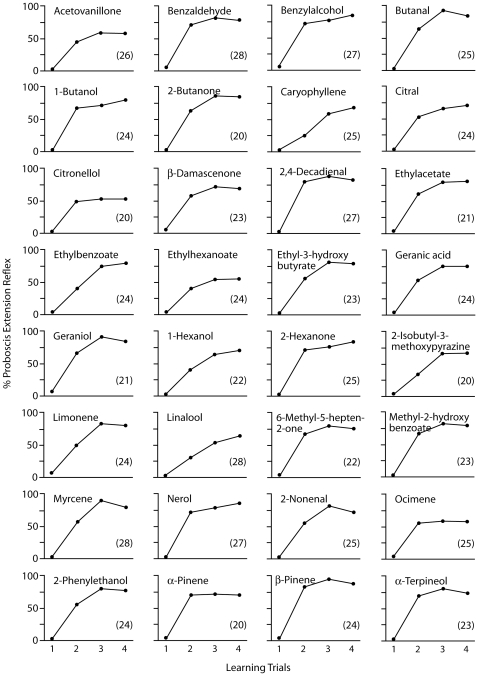
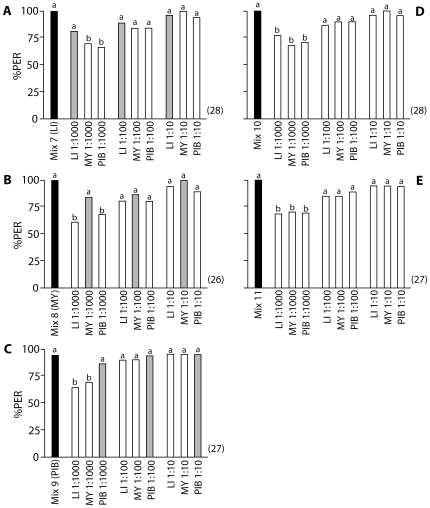
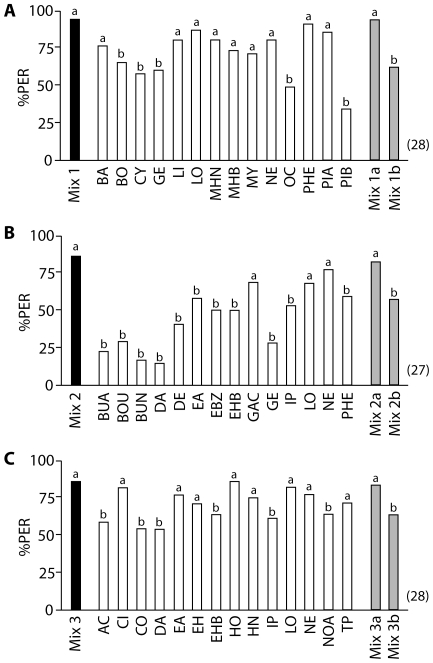
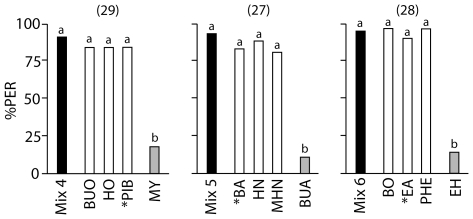
METHODOLOGY/PRINCIPAL FINDINGS: This study investigates learning of complex odour mixtures in honeybees using a simple olfactory conditioning procedure, the Proboscis-Extension-Reflex (PER) paradigm. Restrained honeybees were trained to three scent mixtures composed of 14 floral odorants each, and then tested with the individual odorants of each mixture. Bees did not respond to all odorants of a mixture equally: They responded well to a selection of key odorants, which were unique for each of the three scent mixtures. Bees showed less or very little response to the other odorants of the mixtures. The bees' response to mixtures composed of only the key odorants was as good as to the original mixtures of 14 odorants. A mixture composed of the other, non-key-odorants elicited a significantly lower response. Neither an odorant's volatility or molecular structure, nor learning efficiencies for individual odorants affected whether an odorant became a key odorant for a particular mixture. Odorant concentration had a positive effect, with odorants at high concentration likely to become key odorants.
CONCLUSIONS/SIGNIFICANCE: Our study suggests that the brain processes complex scent mixtures by predominantly learning information from selected key odorants. Our observations on key odorant learning lend significant support to previous work on olfactory learning and mixture processing in honeybees.
蜜蜂每天都要从自然环境中检测、处理和学习无数复杂的气味。这些气味大多是花香,是由数十种不同气味物质混合而成的。迄今为止,蜜蜂大脑如何解开混合气味中包含的复杂信息仍不清楚。
方法/主要发现:本研究使用简单的嗅觉条件反射程序——触角伸展反射(PER)范式,研究了蜜蜂对复杂气味混合物的学习。受约束的蜜蜂接受了三种由 14 种花香气味物质组成的气味混合物的训练,然后用每种混合物的单个气味物质进行测试。蜜蜂对混合物中的所有气味物质反应并不相同:它们对混合物中独特的一组关键气味物质反应良好,而对其他气味物质反应较差或几乎没有反应。只由关键气味物质组成的混合物的反应与由 14 种气味物质组成的原始混合物一样好。由其他非关键气味物质组成的混合物则引起的反应明显较低。一种气味物质的挥发性或分子结构,以及对单个气味物质的学习效率,都不会影响该气味物质是否成为特定混合物的关键气味物质。气味物质的浓度有积极的影响,高浓度的气味物质更有可能成为关键气味物质。
结论/意义:我们的研究表明,大脑通过主要从选定的关键气味物质中学习信息来处理复杂的气味混合物。我们关于关键气味物质学习的观察结果为之前在蜜蜂嗅觉学习和混合物处理方面的工作提供了重要支持。