Thevarajah Dhushan, Webb Ryan, Ferrall Christopher, Dorris Michael C
Department of Physiology, Centre for Neuroscience Studies and Canadian Institutes of Health Research Group in Sensory-Motor Systems, Queen's University Kingston, ON, Canada.
Front Behav Neurosci. 2010 Feb 8;3:57. doi: 10.3389/neuro.08.057.2009. eCollection 2010.
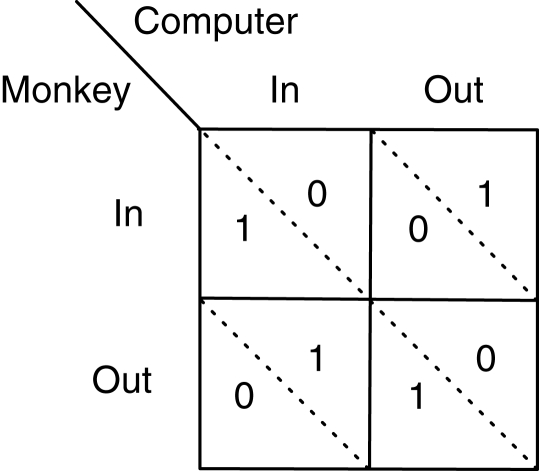
In learning models of strategic game play, an agent constructs a valuation (action value) over possible future choices as a function of past actions and rewards. Choices are then stochastic functions of these action values. Our goal is to uncover a neural signal that correlates with the action value posited by behavioral learning models. We measured activity from neurons in the superior colliculus (SC), a midbrain region involved in planning saccadic eye movements, while monkeys performed two saccade tasks. In the strategic task, monkeys competed against a computer in a saccade version of the mixed-strategy game "matching-pennies". In the instructed task, saccades were elicited through explicit instruction rather than free choices. In both tasks neuronal activity and behavior were shaped by past actions and rewards with more recent events exerting a larger influence. Further, SC activity predicted upcoming choices during the strategic task and upcoming reaction times during the instructed task. Finally, we found that neuronal activity in both tasks correlated with an established learning model, the Experience Weighted Attraction model of action valuation (Camerer and Ho, 1999). Collectively, our results provide evidence that action values hypothesized by learning models are represented in the motor planning regions of the brain in a manner that could be used to select strategic actions.
在策略性博弈的学习模型中,智能体根据过去的行动和奖励构建对未来可能选择的估值(行动价值)。然后,选择是这些行动价值的随机函数。我们的目标是揭示一种与行为学习模型所假定的行动价值相关的神经信号。当猴子执行两项眼跳任务时,我们测量了上丘(SC)神经元的活动,上丘是中脑的一个区域,参与计划扫视眼动。在策略性任务中,猴子在混合策略博弈“猜硬币”的眼跳版本中与计算机竞争。在指令性任务中,眼跳是通过明确的指令而非自由选择引发的。在这两项任务中,神经元活动和行为都受到过去行动和奖励的影响,近期事件的影响更大。此外,上丘活动在策略性任务中预测即将到来的选择,在指令性任务中预测即将到来的反应时间。最后,我们发现两项任务中的神经元活动都与一个已确立的学习模型——行动估值的经验加权吸引模型(Camerer和Ho,1999)相关。总体而言,我们的结果提供了证据,表明学习模型所假设的行动价值在大脑的运动规划区域中以一种可用于选择策略性行动的方式得到表征。