Low Jonathan, Chakravartty Arunava, Blosser Wayne, Dowless Michele, Chalfant Christopher, Bragger Patty, Stancato Louis
Departments of Cancer Growth and Translational Genetics, Eli Lilly and Company, Indianapolis, IN 46265, USA.
Curr Chem Genomics. 2009 Mar 24;3:13-21. doi: 10.2174/1875397300903010013.
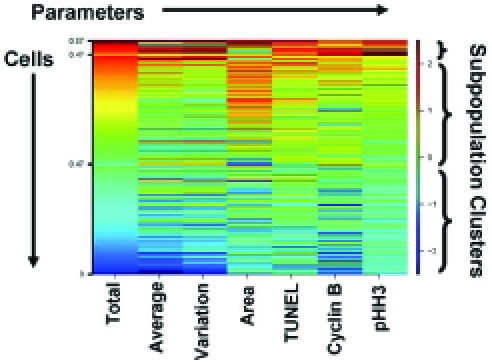
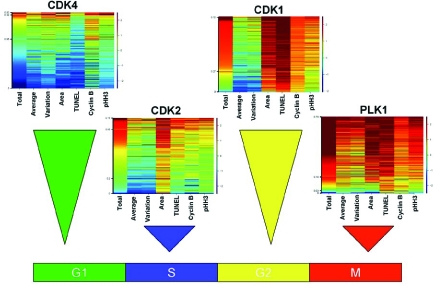
Phenotypic drug discovery, primarily abandoned in the 1980's in favor of targeted approaches to drug development, is once again demonstrating its value when used in conjunction with new technologies. Phenotypic discovery has been brought back to the fore mainly due to recent advances in the field of high content imaging (HCI). HCI elucidates cellular responses using a combination of immunofluorescent assays and computer analysis which increase both the sensitivity and throughput of phenotypic assays. Although HCI data characterize cellular responses in individual cells, these data are usually analyzed as an aggregate of the treated population and are unable to discern differentially responsive subpopulations. A collection of 44 kinase inhibitors affecting cell cycle and apoptosis were characterized with a number of univariate, bivariate, and multivariate subpopulation analyses demonstrating that each level of complexity adds additional information about the treated populations and often distinguishes between compounds with seemingly similar mechanisms of action. Finally, these subpopulation data were used to characterize compounds as they relate in chemical space.
表型药物发现,在20世纪80年代主要被抛弃,转而支持靶向药物开发方法,但当与新技术结合使用时,它再次展现出其价值。表型发现重新受到关注主要归因于高内涵成像(HCI)领域的最新进展。HCI使用免疫荧光测定和计算机分析相结合的方法来阐明细胞反应,这提高了表型测定的灵敏度和通量。尽管HCI数据表征了单个细胞中的细胞反应,但这些数据通常作为处理群体的汇总进行分析,无法辨别差异反应亚群。通过一系列单变量、双变量和多变量亚群分析,对44种影响细胞周期和凋亡的激酶抑制剂进行了表征,结果表明,每一级别的复杂性都能提供有关处理群体的额外信息,并且常常能区分作用机制看似相似的化合物。最后,这些亚群数据被用于在化学空间中表征化合物之间的关系。