Center for Cancer and Immunology Research, Children's Research Institute, Children's National Medical Center, 111 Michigan Avenue NW, Washington, DC 20010, USA.
J Gen Virol. 2010 Jun;91(Pt 6):1547-59. doi: 10.1099/vir.0.020313-0. Epub 2010 Feb 17.
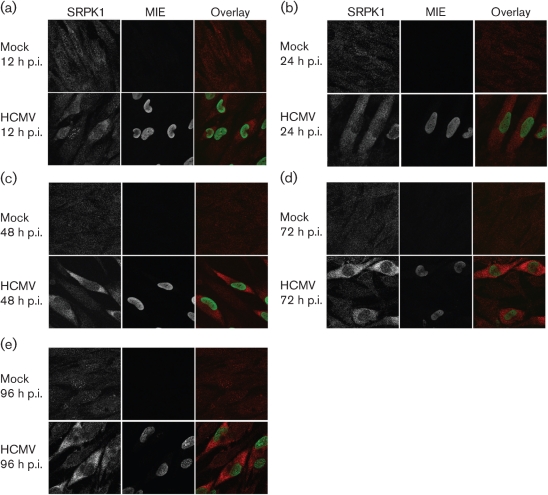
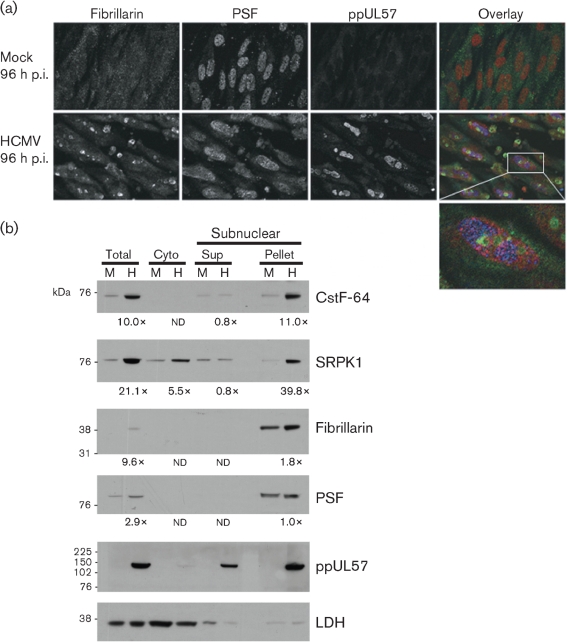
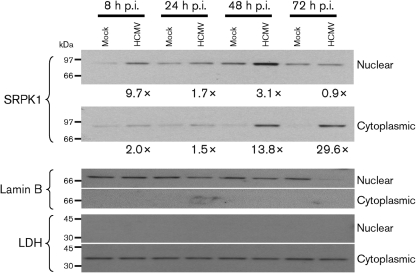
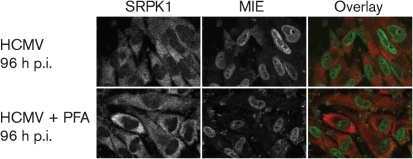
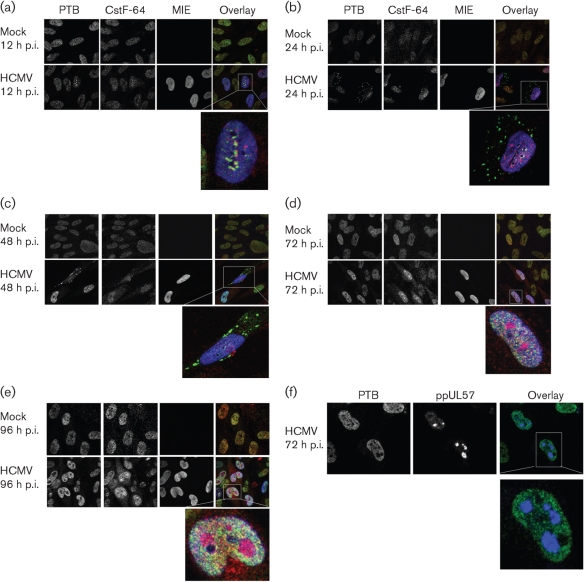
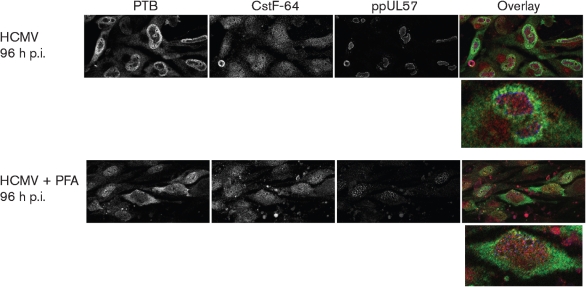
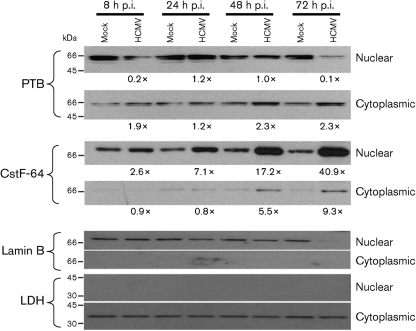
Alternative splicing and polyadenylation of human cytomegalovirus (HCMV) immediate-early (IE) pre-mRNAs are temporally regulated and rely on cellular RNA-processing factors. This study examined the location and abundance of essential RNA-processing factors, which affect alternative processing of UL37 IE pre-mRNAs, during HCMV infection. Serine/threonine protein kinase 1 (SRPK1) phosphorylates serine/arginine-rich proteins, necessary for pre-spliceosome commitment. It was found that HCMV infection progressively increased the abundance of cytoplasmic SRPK1, which is regulated by subcellular partitioning. The essential polyadenylation factor CstF-64 was similarly increased in abundance, albeit in the nucleus, proximal to and within viral replication compartments (VRCs). In contrast, the location of polypyrimidine tract-binding protein (PTB), known to adversely affect splicing of HCMV major IE RNAs, was temporally regulated during infection. PTB co-localized with CstF-64 in the nucleus at IE times. By early times, PTB was detected in punctate cytoplasmic sites of some infected cells. At late times, PTB relocalized to the nucleus, where it was notably excluded from HCMV VRCs. Moreover, HCMV infection induced the formation of nucleolar stress structures, fibrillarin-containing caps, in close proximity to its VRCs. PTB exclusion from HCMV VRCs required HCMV DNA synthesis and/or late gene expression, whereas the regulation of SRPK1 subcellular distribution did not. Taken together, these results indicated that HCMV increasingly regulates the subcellular distribution and abundance of essential RNA-processing factors, thereby altering their ability to affect the processing of viral pre-mRNAs. These results further suggest that HCMV infection selectively induces sorting of nucleolar and nucleoplasmic components.
人巨细胞病毒(HCMV)立即早期(IE)前 mRNA 的可变剪接和多聚腺苷酸化是受时间调控的,并依赖于细胞 RNA 处理因子。本研究检测了影响 UL37 IE 前 mRNA 可变剪接的关键 RNA 处理因子在 HCMV 感染期间的位置和丰度。丝氨酸/苏氨酸蛋白激酶 1(SRPK1)磷酸化丝氨酸/精氨酸丰富蛋白,是前剪接体形成所必需的。研究发现,HCMV 感染逐渐增加了细胞质 SRPK1 的丰度,而细胞质 SRPK1 的丰度受到亚细胞分区的调控。同样,必需的多聚腺苷酸化因子 CstF-64 的丰度也增加了,尽管在核内,靠近病毒复制区(VRC)并在其内部。相比之下,多嘧啶 tract 结合蛋白(PTB)的位置在感染期间受到时间调控,PTB 已知会对 HCMV 主要 IE RNA 的剪接产生不利影响。PTB 在 IE 时与 CstF-64 共定位于核内。早期时,在一些感染细胞的点状细胞质部位检测到 PTB。晚期时,PTB 重新定位到核内,明显从 HCMV VRC 中排除。此外,HCMV 感染诱导核仁应激结构的形成,富含纤维蛋白的帽,与 HCMV 的 VRC 紧密相邻。PTB 从 HCMV VRC 中的排除需要 HCMV DNA 合成和/或晚期基因表达,而 SRPK1 亚细胞分布的调节则不需要。综上所述,这些结果表明,HCMV 逐渐调节关键 RNA 处理因子的亚细胞分布和丰度,从而改变它们影响病毒前 mRNA 处理的能力。这些结果进一步表明,HCMV 感染选择性诱导核仁与核质成分的分拣。