Dattani Mamta, Prajapati Pb, Raval Dinkar
Malaria Branch, Health Department, Gandhinagar, India.
Indian J Community Med. 2009 Oct;34(4):288-92. doi: 10.4103/0970-0218.58384.
Indoor residual spray (IRS), with appropriate insecticide, is an effective weapon for the control of malaria. Two rounds of indoor residual spray, with synthetic pyrethroid, are given in highly malaria endemic areas. It aims to prevent transmission of malaria by adult vector mosquitoes.
To assess the impact of indoor residual spray in the highly malaria-endemic villages of Kalol taluka in Gandhinagar district.
High risk population for malaria, based on last three-year malaria situation.
Malaria endemic rural areas in Gandhinagar district where indoor residual spray was undertaken with synthetic pyrethroid in 2006 and 2007.
Exploratory - Rural areas; Outcome - coverage, acceptance.
Percentage and proportions.
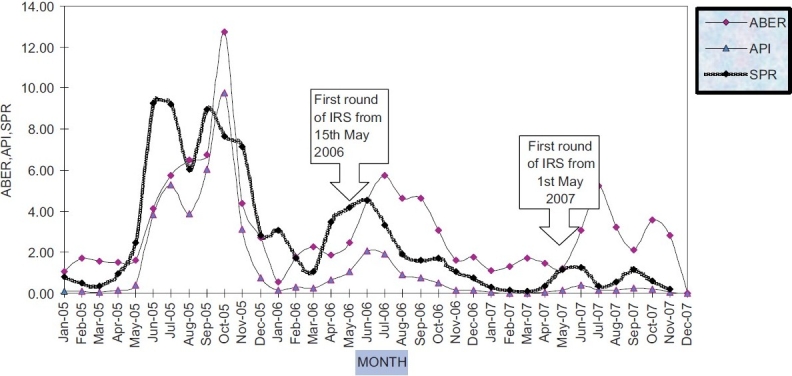
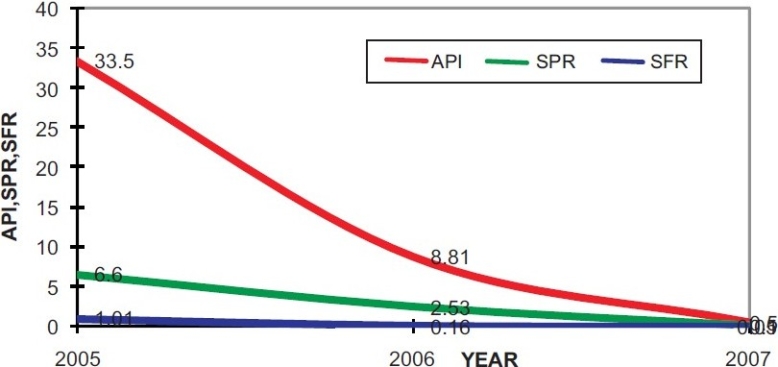
Prior to the introduction of synthetic pyrethroid, in 2005, the annual parasitic incidence of the sprayed villages was 33.4. It came down to 8.8 in 2006. Continuation of this strategy in the same villages further brought down the annual parasitic incidence to 1.5 in 2007. A similar trend of steady decline was observed in actual numbers of cases and other malariometric indices as well.
IRS, it still has a major role in the control of malaria if implemented with proper supervision, better coverage and community participation.
使用合适的杀虫剂进行室内滞留喷洒(IRS)是控制疟疾的有效手段。在疟疾高度流行地区进行两轮合成拟除虫菊酯室内滞留喷洒。其目的是防止成年媒介蚊子传播疟疾。
评估在甘地讷格尔区卡罗尔乡疟疾高度流行村庄进行室内滞留喷洒的效果。
根据过去三年的疟疾情况确定疟疾高风险人群。
甘地讷格尔区疟疾流行的农村地区,于2006年和2007年使用合成拟除虫菊酯进行室内滞留喷洒。
探索性变量——农村地区;结果变量——覆盖率、接受度。
百分比和比例。
在引入合成拟除虫菊酯之前,2005年喷洒村庄的年寄生虫发病率为33.4。2006年降至8.8。在同一村庄继续实施该策略,2007年年寄生虫发病率进一步降至1.5。病例实际数量和其他疟疾测量指标也呈现出类似的稳步下降趋势。
如果在适当监督、提高覆盖率和社区参与的情况下实施,室内滞留喷洒在疟疾控制中仍将发挥重要作用。