
坦桑尼亚农村医院收治儿童的侵袭性沙门氏菌病及其与既往研究的比较。
Invasive salmonellosis among children admitted to a rural Tanzanian hospital and a comparison with previous studies.
机构信息
National Institute for Medical Research-Amani Centre, Tanga, Tanzania.
出版信息
PLoS One. 2010 Feb 16;5(2):e9244. doi: 10.1371/journal.pone.0009244.
BACKGROUND
The importance of invasive salmonellosis in African children is well recognized but there is inadequate information on these infections. We conducted a fever surveillance study in a Tanzanian rural hospital to estimate the case fraction of invasive salmonellosis among pediatric admissions, examine associations with common co-morbidities and describe its clinical features. We compared our main findings with those from previous studies among children in sub-Saharan Africa.
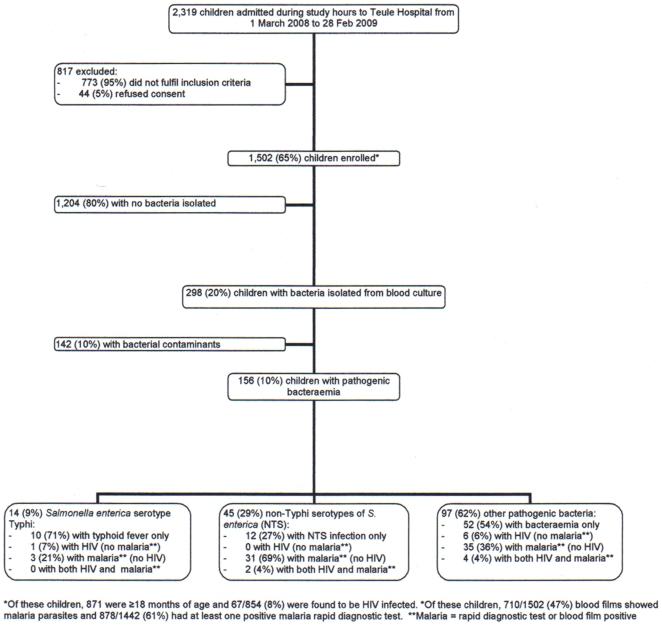
METHODOLOGY/PRINCIPAL FINDINGS: From 1 March 2008 to 28 Feb 2009, 1,502 children were enrolled into the study. We collected clinical information and blood for point of care tests, culture, and diagnosis of malaria and HIV. We analyzed the clinical features on admission and outcome by laboratory-confirmed diagnosis. Pathogenic bacteria were isolated from the blood of 156 (10%) children, of which 14 (9%) were S. typhi, 45 (29%) were NTS and 97 (62%) were other pathogenic bacteria. Invasive salmonellosis accounted for 59/156 (38%) bacteremic children. Children with typhoid fever were significantly older and presented with a longer duration of fever. NTS infections were significantly associated with prior antimalarial treatment, malarial complications and with a high risk for death.
CONCLUSIONS/SIGNIFICANCE: Invasive salmonellosis, particularly NTS infection, is an important cause of febrile disease among hospitalized children in our rural Tanzanian setting. Previous studies showed considerable variation in the case fraction of S. typhi and NTS infections. Certain suggestive clinical features (such as older age and long duration of fever for typhoid whereas concomitant malaria, anemia, jaundice and hypoglycemia for NTS infection) may be used to distinguish invasive salmonellosis from other severe febrile illness.
背景
侵袭性沙门氏菌病在非洲儿童中的重要性已得到充分认识,但对这些感染的了解还不够。我们在坦桑尼亚农村医院进行了发热监测研究,以估计儿科住院患者中侵袭性沙门氏菌病的病例比例,研究其与常见合并症的关系,并描述其临床特征。我们将主要发现与以前在撒哈拉以南非洲儿童中进行的研究进行了比较。
方法/主要发现:2008 年 3 月 1 日至 2009 年 2 月 28 日期间,共有 1502 名儿童参加了这项研究。我们收集了临床信息和血液,用于即时护理检测、培养和疟疾及艾滋病毒的诊断。我们通过实验室确诊的诊断分析了入院时和出院时的临床特征。从 156 名儿童的血液中分离出病原菌,其中 14 名(9%)为伤寒沙门氏菌,45 名(29%)为非伤寒沙门氏菌,97 名(62%)为其他病原菌。侵袭性沙门氏菌病占 156 名菌血症患儿的 59/156(38%)。患伤寒的儿童年龄明显较大,发热持续时间较长。非伤寒沙门氏菌感染与之前的抗疟治疗、疟疾并发症以及死亡风险高显著相关。
结论/意义:在我们坦桑尼亚农村的研究环境中,侵袭性沙门氏菌病,特别是非伤寒沙门氏菌感染,是住院儿童发热性疾病的一个重要原因。以前的研究表明,伤寒和非伤寒沙门氏菌感染的病例比例存在相当大的差异。某些提示性临床特征(如伤寒的年龄较大和发热时间较长,而非伤寒沙门氏菌感染则伴有疟疾、贫血、黄疸和低血糖)可用于将侵袭性沙门氏菌病与其他严重发热性疾病区分开来。
 Zotero 插件