Muhimbili University of Health and Allied Sciences, Dar es Salaam, Tanzania.
Field Epidemiology and Laboratory Training Programme, Dar es Salaam, Tanzania.
BMC Infect Dis. 2020 Feb 12;20(1):135. doi: 10.1186/s12879-020-4849-7.
Salmonellosis remains an important public health problem globally. The disease is among the leading causes of morbidity and mortality in developing countries that experience poor hygiene and lack of access to clean and safe water. There was an increase in reported cases of Salmonellosis in Njombe Region, Southern Highland of Tanzania between 2015 and 2016 based on clinical diagnosis. Nevertheless, little is known about the factors contributing to the transmission of this disease in the region. This study was conducted to determine the prevalence, antimicrobial susceptibility, and factors associated with Salmonella infection among patients who report gastrointestinal complaints.
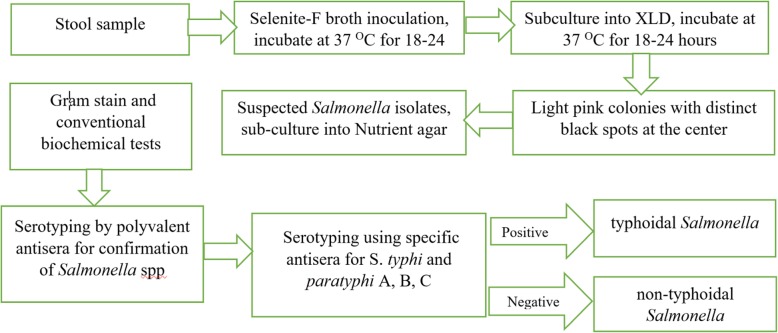
A cross-sectional study was conducted from December 2017 to February 2018 among patients with gastrointestinal complaints at Kibena Regional Hospital. Stool samples were submitted for isolation of Salmonella spp. Identification was based on conventional biochemical tests and serotyping to differentiate typhoid and non-typhoid Salmonella (NTS). Antimicrobial susceptibility was performed using the Kirby-Bauer disc diffusion method. Multivariable logistic regression analysis was performed to examine the factors independently associated with Salmonella infection.
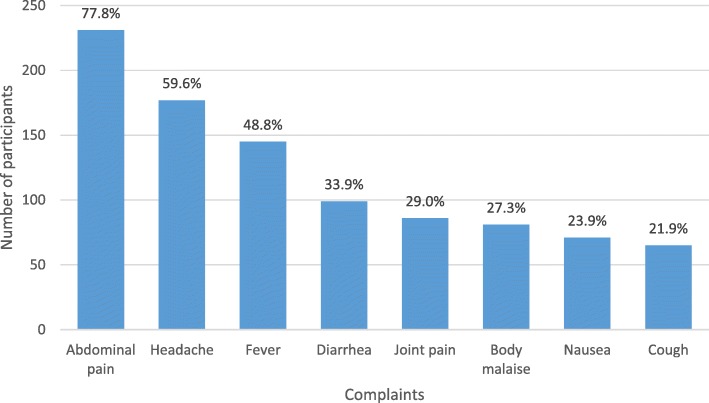
The prevalence of Salmonella infection among participants with gastrointestinal complaints was 16.5% (95% CI: 12.7-21.1) of them, 83.7, 95% CI: 70.9-91.5 were NTS while 16.3, 95% CI: 8.5-29.0 were Typhoid Salmonella species. All isolates were sensitive to ceftriaxone and ciprofloxacin, whereas 27.8 and 100% were resistant to co-trimoxazole and ampicillin respectively. The odd of Salmonella infection was fourfold higher among participants with formal employment (AOR 3.8, 95% CI, 1.53-9.40). Use of water from wells/rivers (AOR 2.2, 95% CI, 1.07-4.45), drinking untreated water (AOR 2.6, 95% CI, 1.21-5.48) and often eating at a restaurant (AOR 3.4, 95% CI, 1.28-8.93) had increased odds of Salmonella infection. Likewise, having abdominal pain (AOR 8.5, 95% CI, 1.81-39.78) and diarrhea (AOR 2.3, 95% CI, 1.12-4.68) were independent symptoms that predict Salmonella infection.
There is a high prevalence of Salmonella infection among people who report gastrointestinal complaints and it is clinically predicated by diarhoea and abdominal pain. Employed participants and those eating at restaurant and drinking unsafe water had higher risk of infection. Salmonella spp. causing gastroenteritis has developed resistance to commonly used antibiotics.
沙门氏菌病仍然是一个重要的全球公共卫生问题。在卫生条件差且缺乏清洁安全用水的发展中国家,这种疾病是发病率和死亡率的主要原因之一。根据临床诊断,2015 年至 2016 年,坦桑尼亚南部高地姆万扎地区报告的沙门氏菌病病例有所增加。然而,对于该地区导致这种疾病传播的因素知之甚少。本研究旨在确定报告有胃肠道投诉的患者中沙门氏菌感染的患病率、抗菌药物敏感性以及与沙门氏菌感染相关的因素。
2017 年 12 月至 2018 年 2 月期间,在基贝纳地区医院对有胃肠道投诉的患者进行了横断面研究。提交粪便样本进行沙门氏菌分离。鉴定基于常规生化试验和血清分型,以区分伤寒和非伤寒沙门氏菌(NTS)。采用 Kirby-Bauer 纸片扩散法进行抗菌药物敏感性试验。采用多变量逻辑回归分析,探讨与沙门氏菌感染相关的独立因素。
胃肠道投诉患者中沙门氏菌感染的患病率为 16.5%(95%CI:12.7-21.1),其中 83.7%(95%CI:70.9-91.5)为 NTS,16.3%(95%CI:8.5-29.0)为伤寒沙门氏菌。所有分离株对头孢曲松和环丙沙星均敏感,而对复方磺胺甲噁唑的耐药率分别为 27.8%和 100%,对氨苄西林的耐药率分别为 100%和 27.8%。有正式工作的参与者感染沙门氏菌的几率高出四倍(AOR 3.8,95%CI,1.53-9.40)。使用井水/河水(AOR 2.2,95%CI,1.07-4.45)、饮用未处理水(AOR 2.6,95%CI,1.21-5.48)和经常在餐馆就餐(AOR 3.4,95%CI,1.28-8.93)会增加感染沙门氏菌的几率。同样,有腹痛(AOR 8.5,95%CI,1.81-39.78)和腹泻(AOR 2.3,95%CI,1.12-4.68)是预测沙门氏菌感染的独立症状。
报告有胃肠道投诉的人群中沙门氏菌感染的患病率很高,临床上表现为腹泻和腹痛。有工作的参与者以及在餐馆就餐和饮用不安全水的参与者感染的风险更高。引起肠胃炎的沙门氏菌对常用抗生素已产生耐药性。