Seeber Laura M S, Zweemer Ronald P, Verheijen René H M, van Diest Paul J
Department of Gynaecological Oncology, University Medical Centre Utrecht, PO Box 85500, 3508 GA Utrecht, The Netherlands.
Obstet Gynecol Int. 2010;2010:580971. doi: 10.1155/2010/580971. Epub 2010 Feb 14.
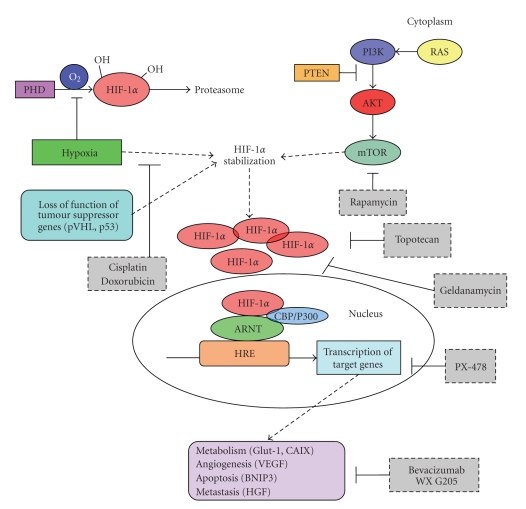
In the Western world, endometrial cancer (EC) is the most common malignant tumor of the female genital tract. Solid tumors like EC outgrow their vasculature resulting in hypoxia. Tumor hypoxia is important because it renders an aggressive phenotype and leads to radio- and chemo-therapy resistance. Hypoxia-inducible factor-1alpha (HIF-1alpha) plays an essential role in the adaptive cellular response to hypoxia and is associated with poor clinical outcome in EC. Therefore, HIF-1 could be an attractive therapeutic target. Selective HIF-1 inhibitors have not been identified. A number of nonselective inhibitors which target signaling pathways upstream or downstream HIF-1 are known to decrease HIF-1alpha protein levels. In clinical trials for the treatment of advanced and/or recurrent EC are the topoisomerase I inhibitor Topotecan, mTOR-inhibitor Rapamycin, and angiogenesis inhibitor Bevacizumab. Preliminary data shows encouraging results for these agents. Further work is needed to identify selective HIF-1 inhibitors and to translate these into clinical trials.
在西方世界,子宫内膜癌(EC)是女性生殖道最常见的恶性肿瘤。像EC这样的实体瘤生长超过其血管系统,导致缺氧。肿瘤缺氧很重要,因为它会呈现侵袭性表型并导致放疗和化疗耐药。缺氧诱导因子-1α(HIF-1α)在细胞对缺氧的适应性反应中起重要作用,并且与EC的不良临床结局相关。因此,HIF-1可能是一个有吸引力的治疗靶点。尚未鉴定出选择性HIF-1抑制剂。已知一些靶向HIF-1上游或下游信号通路的非选择性抑制剂可降低HIF-1α蛋白水平。在晚期和/或复发性EC治疗的临床试验中有拓扑异构酶I抑制剂托泊替康、mTOR抑制剂雷帕霉素和血管生成抑制剂贝伐单抗。初步数据显示这些药物有令人鼓舞的结果。需要进一步开展工作以鉴定选择性HIF-1抑制剂并将其转化为临床试验。