Department of Biomedical Engineering, Johns Hopkins University, Baltimore, MD 21205, USA.
Comput Intell Neurosci. 2010;2010:648202. doi: 10.1155/2010/648202. Epub 2010 Feb 14.
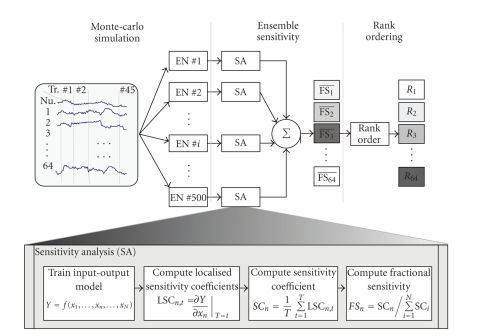
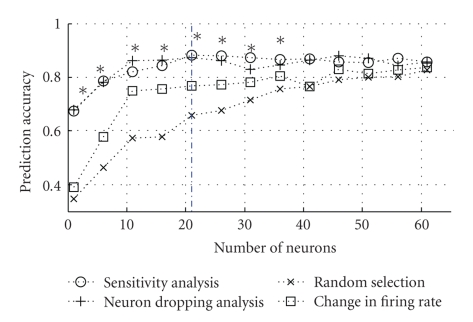
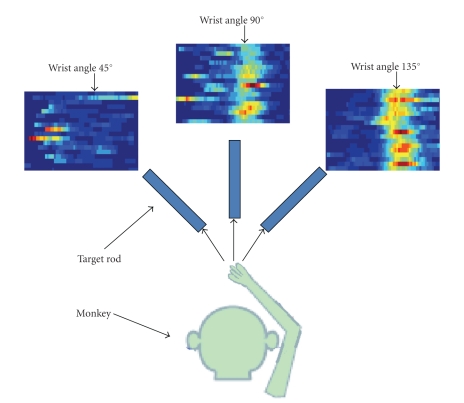
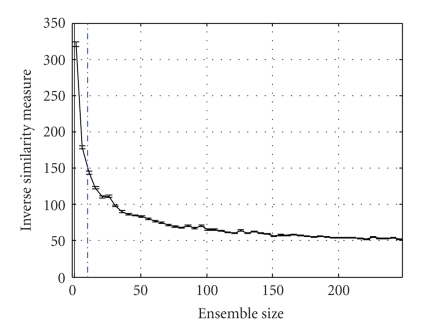
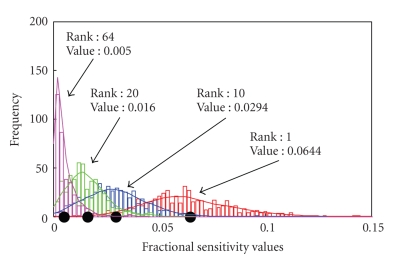
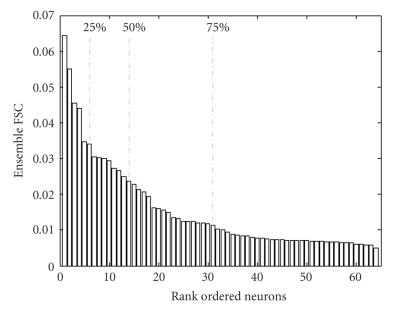
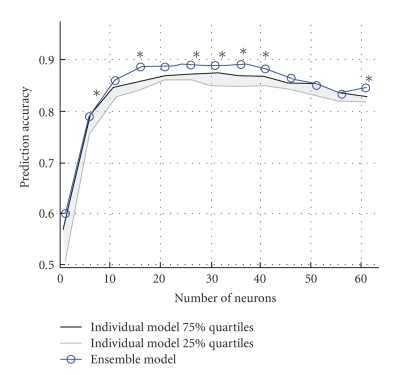
A robust method to help identify the population of neurons used for decoding motor tasks is developed. We use sensitivity analysis to develop a new metric for quantifying the relative contribution of a neuron towards the decoded output, called "fractional sensitivity." Previous model-based approaches for neuron ranking have been shown to largely depend on the collection of training data. We suggest the use of an ensemble of models that are trained on random subsets of trials to rank neurons. For this work, we tested a decoding algorithm on neuronal data recorded from two male rhesus monkeys while they performed a reach to grasp a bar at three orientations (45 degrees, 90 degrees, or 135 degrees). An ensemble approach led to a statistically significant increase of 5% in decoding accuracy and 25% increase in identification accuracy of simulated noisy neurons, when compared to a single model. Furthermore, ranking neurons based on the ensemble fractional sensitivities resulted in decoding accuracies 10%-20% greater than when randomly selecting neurons or ranking based on firing rates alone. By systematically reducing the size of the input space, we determine the optimal number of neurons needed for decoding the motor output. This selection approach has practical benefits for other BMI applications where limited number of electrodes and training datasets are available, but high decoding accuracies are desirable.
开发了一种强大的方法来帮助识别用于解码运动任务的神经元群体。我们使用敏感性分析来开发一种新的度量标准,用于量化神经元对解码输出的相对贡献,称为“分数敏感性”。以前基于模型的神经元排序方法已被证明在很大程度上取决于训练数据的收集。我们建议使用基于随机试验子集训练的模型集合来对神经元进行排序。在这项工作中,我们在两只雄性恒河猴记录的神经元数据上测试了一种解码算法,这些猴子在三个方向(45 度、90 度或 135 度)进行抓棒的伸手动作。与单个模型相比,集合方法可将解码准确性提高 5%,并将模拟噪声神经元的识别准确性提高 25%。此外,基于集合分数敏感性对神经元进行排序,可使解码准确性比随机选择神经元或仅根据放电率进行排序时提高 10%-20%。通过系统地减少输入空间的大小,我们确定了解码运动输出所需的最佳神经元数量。这种选择方法对于其他 BMI 应用具有实际意义,因为这些应用中可用的电极和训练数据集数量有限,但需要高的解码准确性。