Molecular and Computational Biology, University of Southern California, Los Angeles, California, USA.
PLoS Genet. 2010 Feb 12;6(2):e1000843. doi: 10.1371/journal.pgen.1000843.
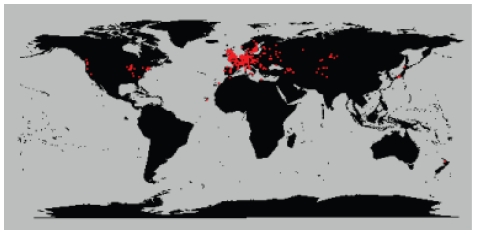
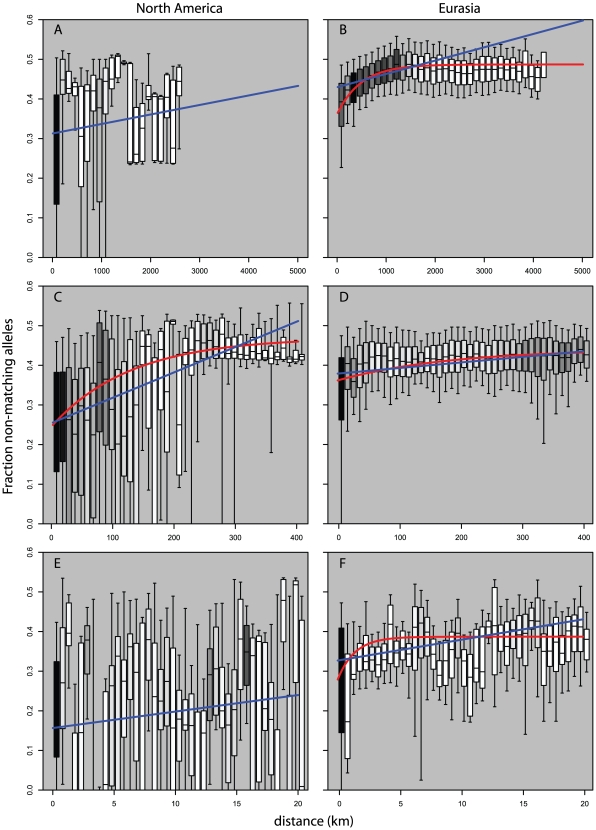
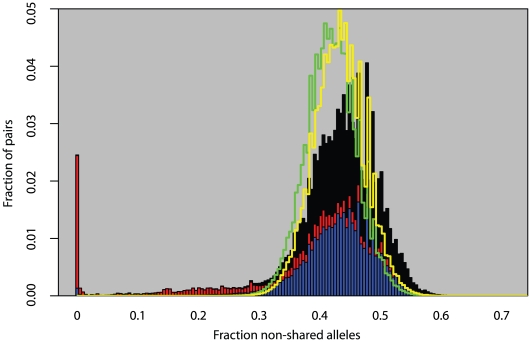
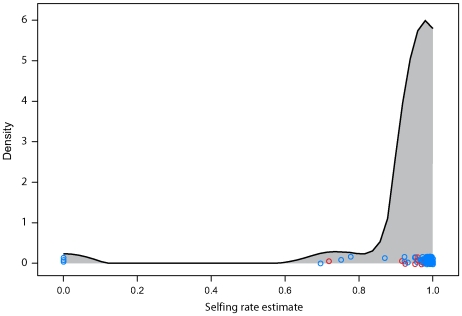
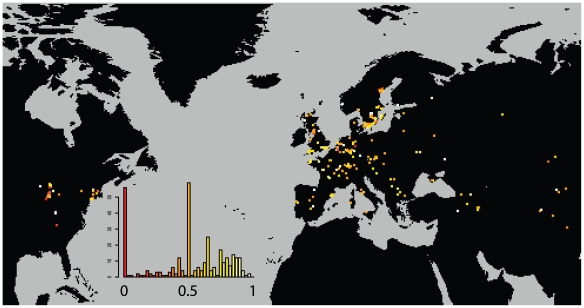
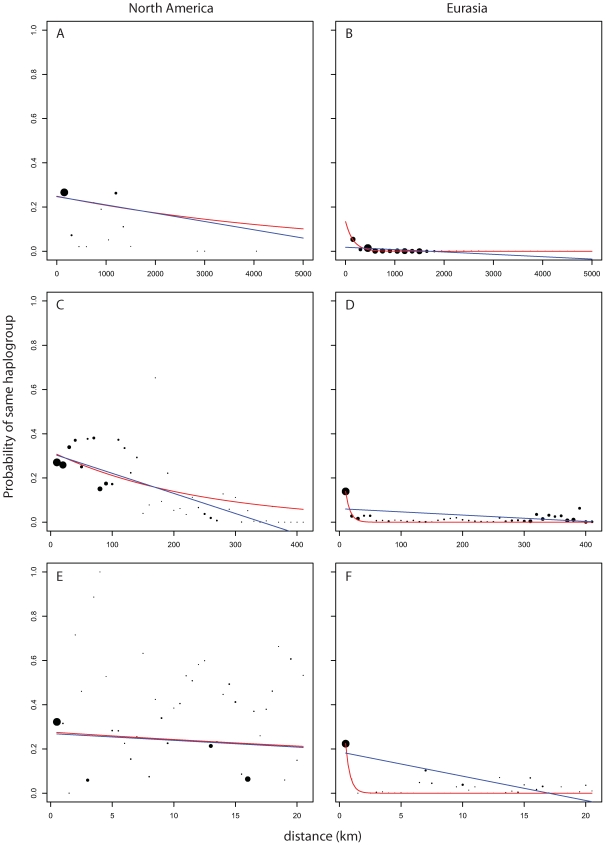
The population structure of an organism reflects its evolutionary history and influences its evolutionary trajectory. It constrains the combination of genetic diversity and reveals patterns of past gene flow. Understanding it is a prerequisite for detecting genomic regions under selection, predicting the effect of population disturbances, or modeling gene flow. This paper examines the detailed global population structure of Arabidopsis thaliana. Using a set of 5,707 plants collected from around the globe and genotyped at 149 SNPs, we show that while A. thaliana as a species self-fertilizes 97% of the time, there is considerable variation among local groups. This level of outcrossing greatly limits observed heterozygosity but is sufficient to generate considerable local haplotypic diversity. We also find that in its native Eurasian range A. thaliana exhibits continuous isolation by distance at every geographic scale without natural breaks corresponding to classical notions of populations. By contrast, in North America, where it exists as an exotic species, A. thaliana exhibits little or no population structure at a continental scale but local isolation by distance that extends hundreds of km. This suggests a pattern for the development of isolation by distance that can establish itself shortly after an organism fills a new habitat range. It also raises questions about the general applicability of many standard population genetics models. Any model based on discrete clusters of interchangeable individuals will be an uneasy fit to organisms like A. thaliana which exhibit continuous isolation by distance on many scales.
生物的种群结构反映了其进化历史,并影响其进化轨迹。它限制了遗传多样性的组合,并揭示了过去基因流动的模式。了解种群结构是检测受选择影响的基因组区域、预测种群干扰的影响或模拟基因流动的前提。本文研究了拟南芥的详细全球种群结构。我们使用了一组来自全球各地的 5707 株植物,对 149 个 SNP 进行了基因分型,结果表明,尽管拟南芥作为一个物种 97%的时间是自交的,但在当地群体中存在着相当大的变异。这种程度的异交大大限制了观察到的杂合度,但足以产生相当大的局部单倍型多样性。我们还发现,在其原生的欧亚大陆范围内,拟南芥在每一个地理尺度上都表现出连续的隔离,没有与经典种群概念相对应的自然断裂。相比之下,在北美,它作为一个外来物种存在,拟南芥在大陆尺度上几乎没有或没有种群结构,但存在数百公里的局部隔离。这表明了隔离距离发展的模式,这种模式可以在生物填补新的栖息地范围后不久就建立起来。它还提出了许多标准种群遗传学模型的普遍适用性问题。任何基于可互换个体离散聚类的模型都将与拟南芥等连续隔离的生物不太匹配,在许多尺度上都存在隔离。