Virus-Cell Interaction Section, HIV Drug Resistance Program, National Cancer Institute-Frederick, Bldg. 535/Rm 108, 1050 Boyles Street, Frederick, MD 21702-1201, USA.
Virology. 2010 Apr 25;400(1):137-44. doi: 10.1016/j.virol.2010.01.028. Epub 2010 Feb 20.
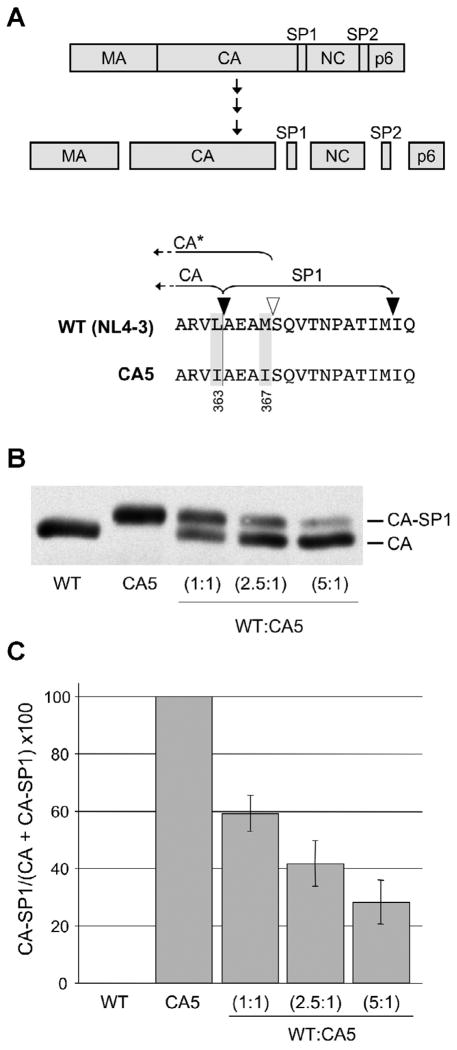
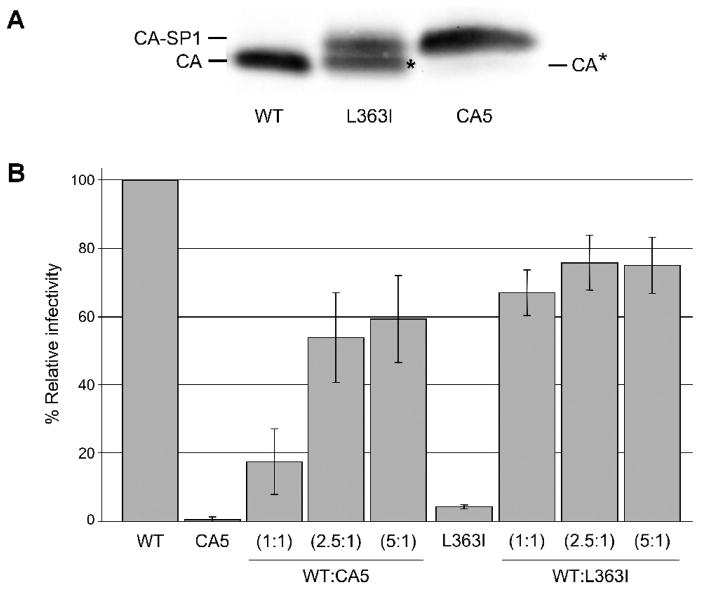
The human immunodeficiency virus type 1 (HIV-1) maturation inhibitor bevirimat disrupts virus replication by inhibiting the cleavage of the capsid-spacer peptide 1 (CA-SP1) Gag processing intermediate to mature CA. The observation that bevirimat delays but does not completely block CA-SP1 processing suggests that the presence of uncleaved CA-SP1 may disrupt the maturation process in trans. In this study, we validate this hypothesis by using a genetic approach to demonstrate that a non-cleavable CA-SP1 mutant exerts a dominant-negative effect on maturation of wild-type HIV-1. In contrast, a mutant in which cleavage can occur internally within SP1 is significantly less potent as a dominant-negative inhibitor. We also show that bevirimat blocks processing at both the major CA-SP1 cleavage site and the internal site. These data underscore the importance of full CA-SP1 processing for HIV-1 maturation and highlight the therapeutic potential of inhibitors that target this Gag cleavage event.
人类免疫缺陷病毒 1 型(HIV-1)成熟抑制剂贝伐单抗通过抑制衣壳-间隔肽 1(CA-SP1)Gag 加工中间体的切割来破坏病毒复制,从而使 CA 成熟。贝伐单抗延迟但不完全阻断 CA-SP1 加工的观察结果表明,未切割的 CA-SP1 可能会在转译过程中破坏成熟过程。在这项研究中,我们通过使用遗传方法验证了这一假设,该方法表明不可切割的 CA-SP1 突变体对野生型 HIV-1 的成熟具有显性负效应。相比之下,能够在 SP1 内部发生切割的突变体作为显性负抑制剂的效力则显著降低。我们还表明,贝伐单抗可阻断主要 CA-SP1 切割位点和内部位点的加工。这些数据强调了完整的 CA-SP1 加工对 HIV-1 成熟的重要性,并突出了针对该 Gag 切割事件的抑制剂的治疗潜力。