Gene Expression Laboratory, Salk Institute for Biological Studies, La Jolla, CA 92037, USA.
Trends Cell Biol. 2010 May;20(5):299-309. doi: 10.1016/j.tcb.2010.01.009. Epub 2010 Feb 19.
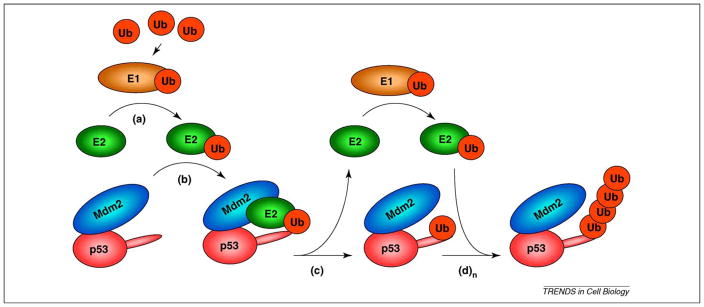
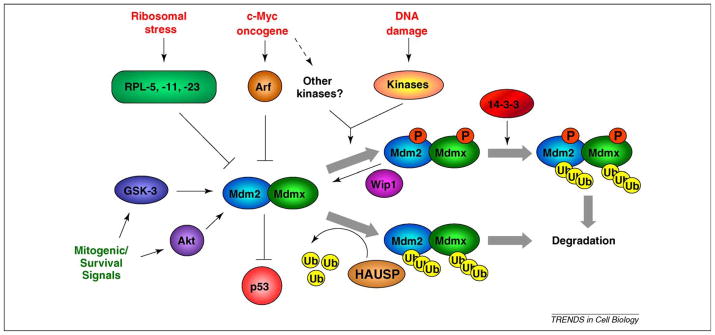
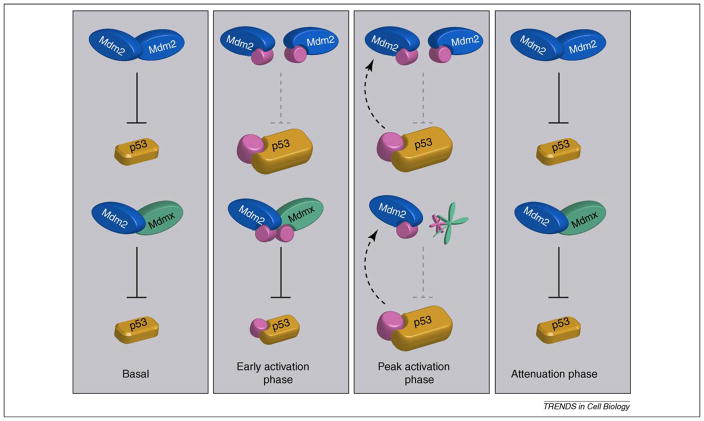
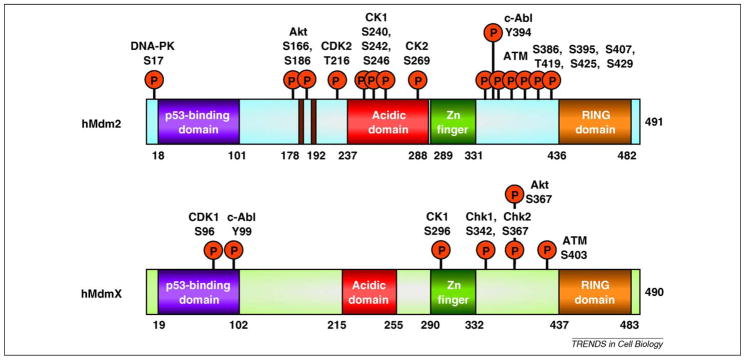
The activities of p53 cover diverse aspects of cell biology, including cell cycle control, apoptosis, metabolism, fertility, differentiation and cellular reprogramming. Although loss of p53 function engenders tumor susceptibility, hyperactivation of p53 is lethal. Therefore, p53 activity must be strictly regulated to maintain normal tissue homeostasis. Critical for the control of p53 function are its two main negative regulators: Mdm2 and Mdmx. Recent reports have provided insight into the complex mechanisms that regulate these two proteins and have revealed novel functions for each. Here, we review and evaluate models of Mdm2- and Mdmx-dependent regulation of p53 activity. Both Mdm2 and Mdmx receive input from numerous signaling pathways and interact with many proteins in addition to p53. Therefore, we also consider roles for Mdm2 and Mdmx in additional cancer-related networks, including Notch signaling and the epithelial-to-mesenchymal transition.
p53 的活性涵盖了细胞生物学的多个方面,包括细胞周期控制、细胞凋亡、代谢、生育、分化和细胞重编程。尽管 p53 功能的丧失会导致肿瘤易感性,但 p53 的过度激活是致命的。因此,p53 的活性必须受到严格的调节,以维持正常的组织内稳态。p53 功能的关键调控因子是其两个主要的负调控因子:Mdm2 和 Mdmx。最近的研究报告提供了对调节这两种蛋白的复杂机制的深入了解,并揭示了它们各自的新功能。在这里,我们回顾和评估了 Mdm2 和 Mdmx 对 p53 活性的调节模型。Mdm2 和 Mdmx 都受到许多信号通路的影响,并与除 p53 以外的许多蛋白质相互作用。因此,我们还考虑了 Mdm2 和 Mdmx 在其他与癌症相关的网络中的作用,包括 Notch 信号通路和上皮间质转化。