Department of Pathology, Stony Brook University, Stony Brook, NY 11794-8691, USA.
Cell Death Differ. 2010 Feb;17(2):255-67. doi: 10.1038/cdd.2009.173. Epub 2009 Nov 20.
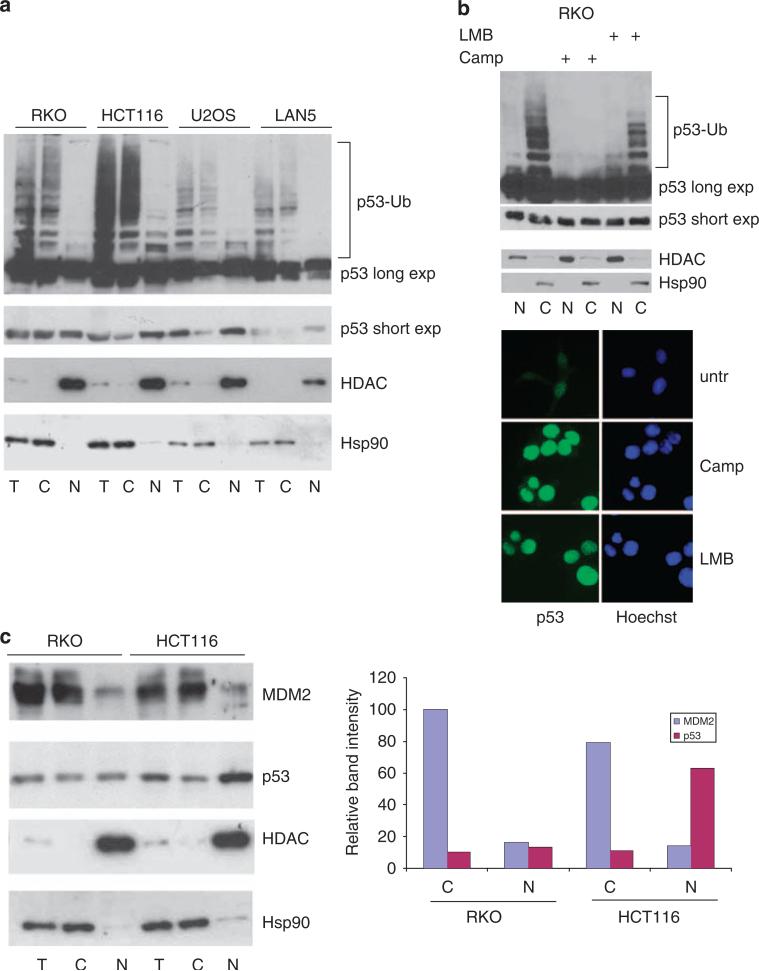
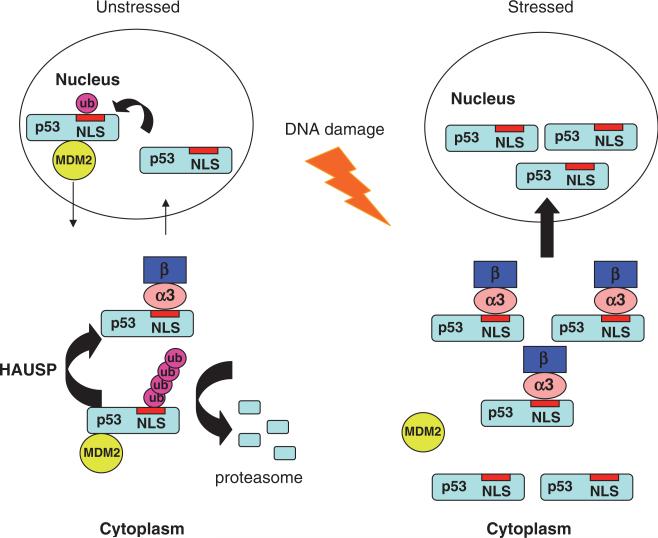
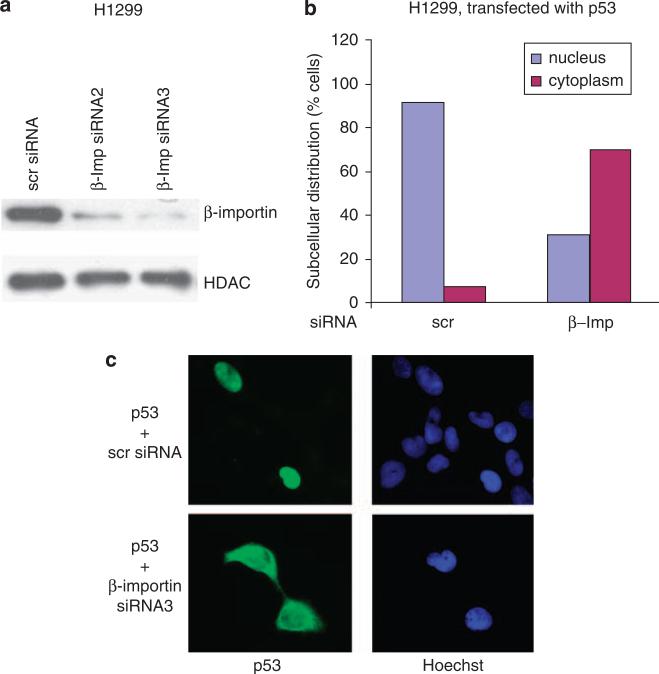
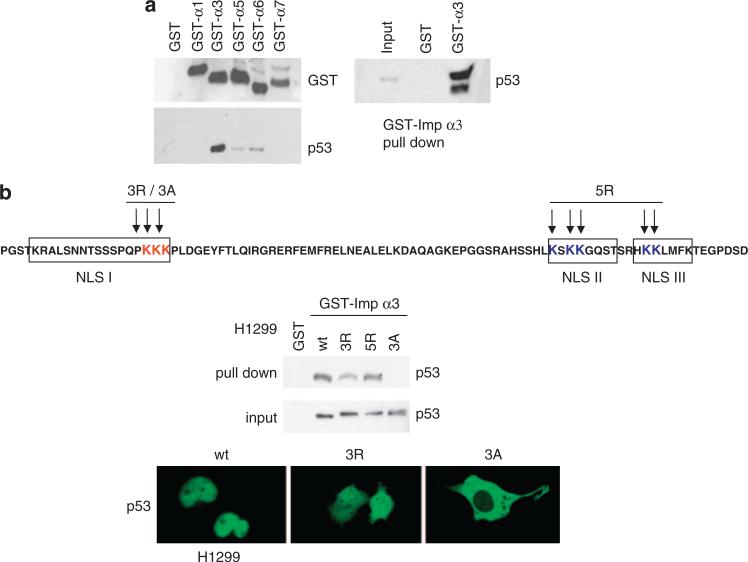
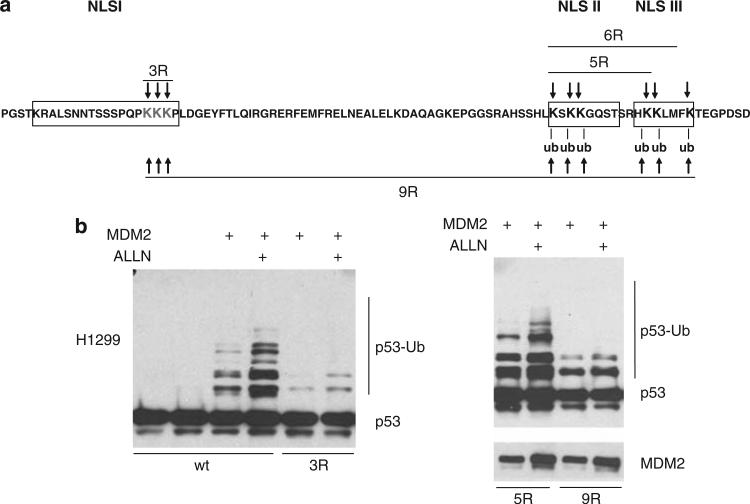
The activity of p53 as an inducible transcription factor depends on its rapid nuclear stabilization after stress. However, surprisingly, mechanism(s) that regulate nuclear p53 accumulation are not well understood. The current model of stress-induced nuclear accumulation holds that a decrease in p53 nuclear export leads to its nuclear stabilization. We show here that regulated nuclear import of p53 also has a critical function. p53 import is mediated by binding to the importin-alpha3 adapter and is negatively regulated by ubiquitination. p53 harbors several nuclear localization signals (NLS), with the major NLS I located at amino-acids 305-322. We find that direct binding of p53 to importin-alpha3 depends on the positive charge contributed by lysine residues 319-321 within NLS I. The same lysines are also targets of MDM2-mediated ubiquitination. p53 ubiquitination occurs primarily in unstressed cells, but decreases dramatically after stress. Importin-alpha3 preferentially interacts with non-ubiquitinated p53. Thus, under normal growth conditions, ubiquitination of Lys 319-321 negatively regulates p53-importin-alpha3 binding, thereby restraining p53 import. Conversely, stress-induced accumulation of non-ubiquitinated p53 in the cytoplasm promotes interaction with importin-alpha3 and rapid import. In later phases of the stress response, blocked nuclear export also takes effect. We propose that p53 nuclear import defines an important novel level of regulation in the p53-mediated stress response.
p53 作为一种诱导型转录因子的活性依赖于其在应激后迅速的核稳定。然而,令人惊讶的是,调节核 p53 积累的机制尚不清楚。目前的应激诱导核积累模型认为,p53 核输出的减少导致其核稳定。我们在这里表明,p53 的核内输入的调节也具有关键作用。p53 的输入是通过与输入蛋白-α3 适配器结合介导的,并且受到泛素化的负调控。p53 具有几个核定位信号 (NLS),主要的 NLS I 位于氨基酸 305-322。我们发现,p53 与输入蛋白-α3 的直接结合取决于 NLS I 中赖氨酸残基 319-321 所贡献的正电荷。这些相同的赖氨酸也是 MDM2 介导的泛素化的靶标。p53 的泛素化主要发生在未受应激的细胞中,但应激后会急剧减少。输入蛋白-α3 优先与非泛素化的 p53 相互作用。因此,在正常生长条件下,Lys 319-321 的泛素化负调节 p53-输入蛋白-α3 结合,从而抑制 p53 输入。相反,应激诱导的细胞质中非泛素化 p53 的积累促进与输入蛋白-α3 的相互作用和快速输入。在应激反应的后期阶段,被阻断的核输出也会生效。我们提出,p53 的核输入定义了 p53 介导的应激反应中一个重要的新的调节水平。