Curriculum in Ecology, University of North Carolina, Chapel Hill, North Carolina, United States of America.
PLoS One. 2010 Feb 17;5(2):e9278. doi: 10.1371/journal.pone.0009278.
A variety of human activities have led to the recent global decline of reef-building corals. The ecological, social, and economic value of coral reefs has made them an international conservation priority. The success of Marine Protected Areas (MPAs) in restoring fish populations has led to optimism that they could also benefit corals by indirectly reducing threats like overfishing, which cause coral degradation and mortality. However, the general efficacy of MPAs in increasing coral reef resilience has never been tested.
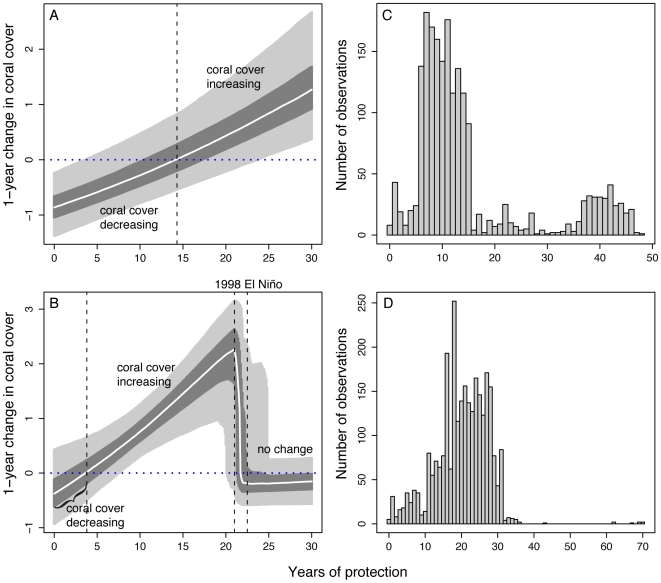
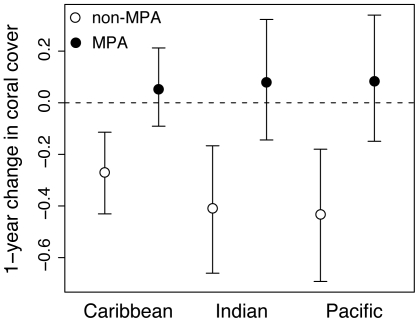
METHODOLOGY/PRINCIPAL FINDINGS: We compiled a global database of 8534 live coral cover surveys from 1969-2006 to compare annual changes in coral cover inside 310 MPAs to unprotected areas. We found that on average, coral cover within MPAs remained constant, while coral cover on unprotected reefs declined. Although the short-term differences between unprotected and protected reefs are modest, they could be significant over the long-term if the effects are temporally consistent. Our results also suggest that older MPAs were generally more effective in preventing coral loss. Initially, coral cover continued to decrease after MPA establishment. Several years later, however, rates of coral cover decline slowed and then stabilized so that further losses stopped.
CONCLUSIONS/SIGNIFICANCE: These findings suggest that MPAs can be a useful tool not only for fisheries management, but also for maintaining coral cover. Furthermore, the benefits of MPAs appear to increase with the number of years since MPA establishment. Given the time needed to maximize MPA benefits, there should be increased emphasis on implementing new MPAs and strengthening the enforcement of existing MPAs.
人类的各种活动导致了最近全球造礁珊瑚数量的下降。珊瑚礁具有生态、社会和经济价值,这使其成为国际保护的优先事项。海洋保护区 (MPA) 在恢复鱼类种群方面的成功,使人们乐观地认为,它们也可以通过间接减少过度捕捞等威胁来使珊瑚受益,过度捕捞会导致珊瑚退化和死亡。然而,MPA 增加珊瑚礁恢复力的总体效果从未经过测试。
方法/主要发现:我们编制了一个全球数据库,其中包含了 1969 年至 2006 年的 8534 次活珊瑚覆盖调查,以比较 310 个 MPA 内的珊瑚覆盖年度变化与未受保护区域的珊瑚覆盖年度变化。我们发现,MPA 内的珊瑚覆盖平均保持不变,而未受保护的珊瑚礁的珊瑚覆盖则下降。尽管未受保护和受保护的珊瑚礁之间的短期差异不大,但如果这些影响具有时间一致性,从长期来看可能会很显著。我们的研究结果还表明,较老的 MPA 通常在防止珊瑚礁丧失方面更为有效。最初,在 MPA 建立后,珊瑚覆盖继续减少。然而,几年后,珊瑚覆盖的下降速度放缓,然后稳定下来,因此进一步的损失停止了。
结论/意义:这些发现表明,MPA 不仅是渔业管理的有用工具,而且也是维持珊瑚覆盖的有用工具。此外,MPA 的好处似乎随着 MPA 建立的年限增加而增加。鉴于最大限度地发挥 MPA 效益所需的时间,应更加重视实施新的 MPA 并加强现有 MPA 的执法力度。