Bonaldo Roberta M, Pires Mathias M, Guimarães Paulo Roberto, Hoey Andrew S, Hay Mark E
Departamento de Ecologia, Instituto de Biociências, Universidade de São Paulo, São Paulo, São Paulo, Brazil.
School of Biology and the Aquatic Chemical Ecology Center, Georgia Institute of Technology, Atlanta, Georgia, United States of America.
PLoS One. 2017 Jan 25;12(1):e0170638. doi: 10.1371/journal.pone.0170638. eCollection 2017.
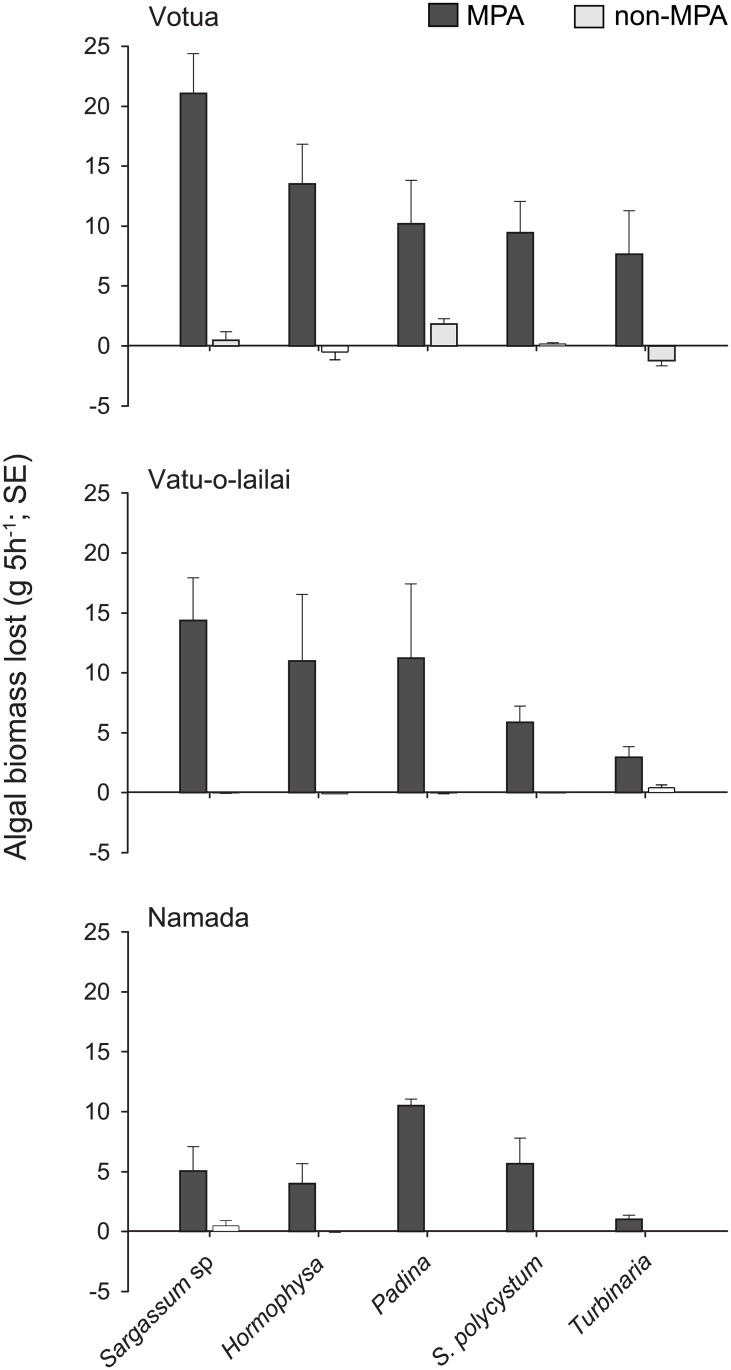
The establishment of no-take marine protected areas (MPAs) on coral reefs is a common management strategy for conserving the diversity, abundance, and biomass of reef organisms. Generally, well-managed and enforced MPAs can increase or maintain the diversity and function of the enclosed coral reef, with some of the benefits extending to adjacent non-protected reefs. A fundamental question in coral reef conservation is whether these benefits arise within small MPAs (<1 km2), because larval input of reef organisms is largely decoupled from local adult reproduction. We examined the structure of fish assemblages, composition of fish feeding groups, benthic cover, and key ecosystem processes (grazing, macroalgal browsing, and coral replenishment) in three small (0.5-0.8 km2) no-take MPAs and adjacent areas where fisheries are allowed (non-MPAs) on coral reefs in Fiji. The MPAs exhibited greater species richness, density, and biomass of fishes than non-MPAs. Furthermore, MPAs contained a greater abundance and biomass of grazing herbivores and piscivores as well as a greater abundance of cleaners than fished areas. We also found differences in fish associations when foraging, with feeding groups being generally more diverse and having greater biomass within MPAs than adjacent non-MPAs. Grazing by parrotfishes was 3-6 times greater, and macroalgal browsing was 3-5 times greater in MPAs than in non-MPAs. On average, MPAs had 260-280% as much coral cover and only 5-25% as much macroalgal cover as their paired non-MPA sites. Finally, two of the three MPAs had three-fold more coral recruits than adjacent non-MPAs. The results of this study indicate that small MPAs benefit not only populations of reef fishes, but also enhance ecosystem processes that are critical to reef resilience within the MPAs.
在珊瑚礁上建立禁捕海洋保护区(MPA)是保护珊瑚礁生物多样性、丰度和生物量的常见管理策略。一般来说,管理良好且执行有力的MPA能够增加或维持封闭珊瑚礁的多样性和功能,其中一些益处还会延伸至相邻的非保护珊瑚礁。珊瑚礁保护中的一个基本问题是,这些益处是否会在小型MPA(面积小于1平方千米)内出现,因为珊瑚礁生物的幼体输入在很大程度上与当地成体繁殖脱钩。我们研究了斐济珊瑚礁上三个小型(0.5 - 0.8平方千米)禁捕MPA及其相邻允许捕鱼区域(非MPA)内鱼类群落结构、鱼类食性组组成、底栖生物覆盖情况以及关键生态系统过程(啃食、大型藻类啃食和珊瑚补充)。MPA中的鱼类物种丰富度、密度和生物量均高于非MPA。此外,与捕鱼区域相比,MPA中啃食性草食动物和食鱼动物的丰度和生物量更大,清洁鱼的数量也更多。我们还发现,觅食时鱼类组合存在差异,MPA内的食性组通常比相邻的非MPA更加多样,生物量也更大。鹦鹉鱼的啃食量在MPA中比在非MPA中高3至6倍,大型藻类啃食量则高3至5倍。平均而言,MPA的珊瑚覆盖率是其配对的非MPA区域的260%至280%,而大型藻类覆盖率仅为5%至25%。最后,三个MPA中有两个的珊瑚幼体数量是相邻非MPA区域的三倍。这项研究结果表明,小型MPA不仅有利于珊瑚礁鱼类种群,还能增强对MPA内珊瑚礁恢复力至关重要的生态系统过程。