Department of Biochemistry and Biomedical Sciences, McMaster University, Hamilton, Ontario L8N 3Z5, Canada.
J Gen Physiol. 2010 Mar;135(3):261-74. doi: 10.1085/jgp.200910288.
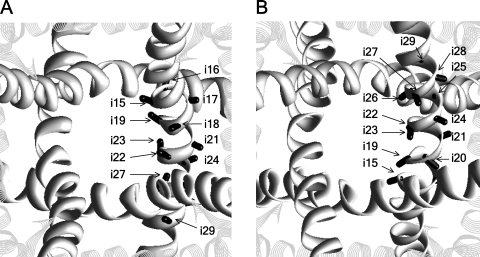
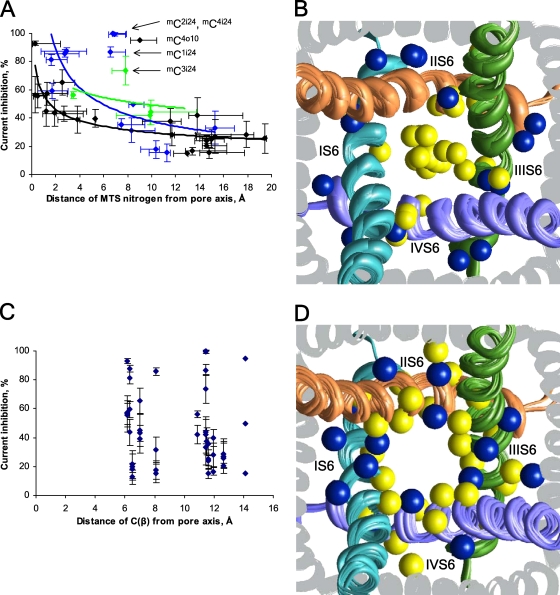
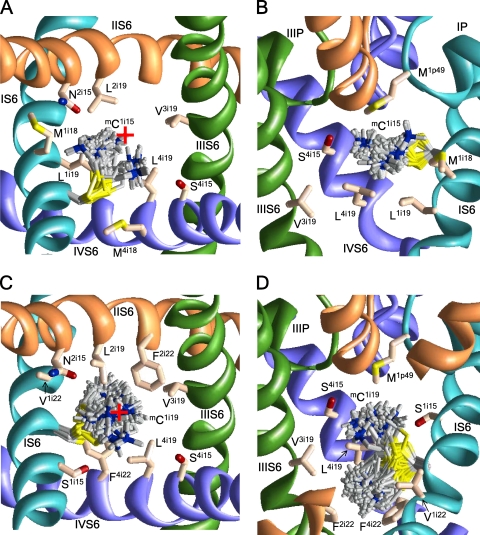
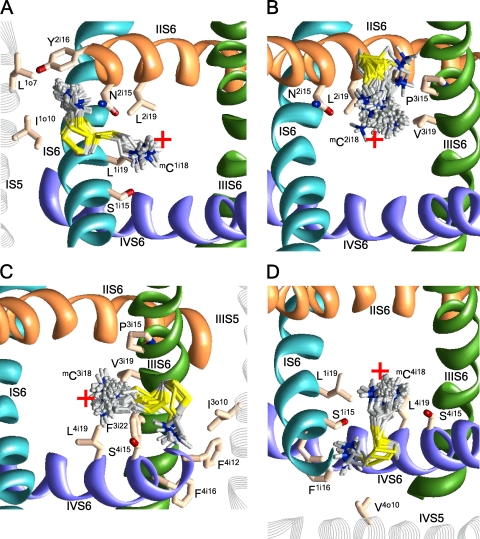
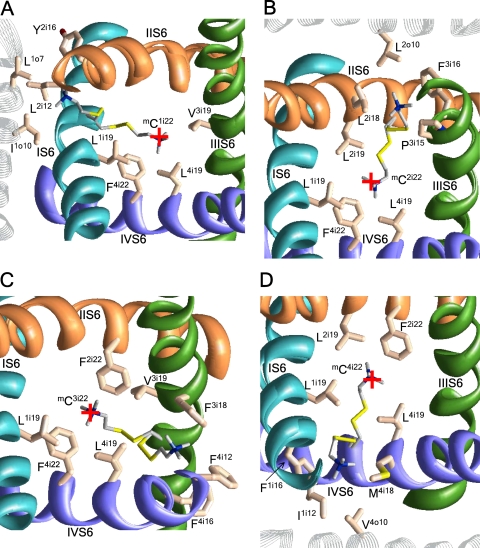
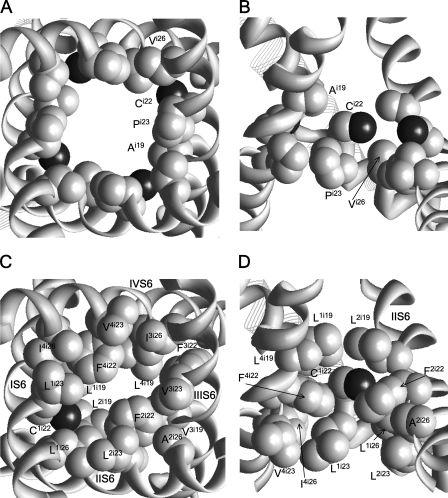
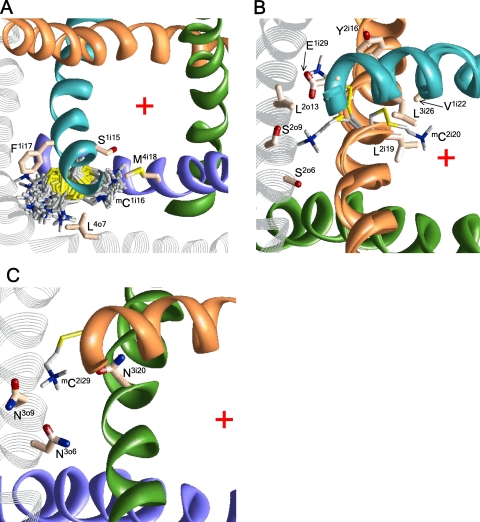
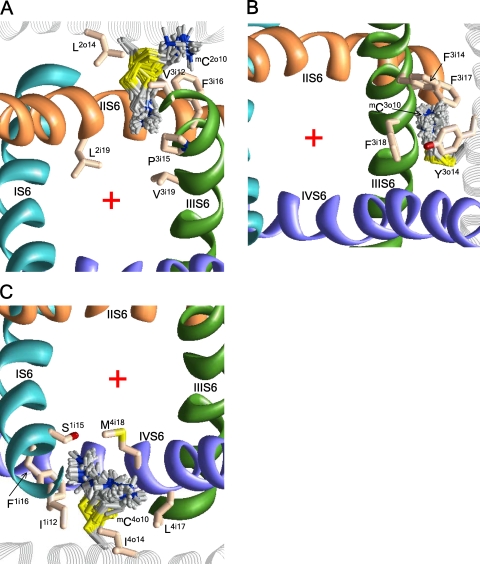
In the absence of x-ray structures of calcium channels, their homology models are used to rationalize experimental data and design new experiments. The modeling relies on sequence alignments between calcium and potassium channels. Zhen et al. (2005. J. Gen. Physiol. doi:10.1085/jgp.200509292) used the substituted cysteine accessibility method (SCAM) to identify pore-lining residues in the Ca(v)2.1 channel and concluded that their data are inconsistent with the symmetric architecture of the pore domain and published sequence alignments between calcium and potassium channels. Here, we have built K(v)1.2-based models of the Ca(v)2.1 channel with 2-(trimethylammonium)ethyl methanethiosulfonate (MTSET)-modified engineered cysteines and used Monte Carlo energy minimizations to predict their energetically optimal orientations. We found that depending on the position of an engineered cysteine in S6 and S5 helices, the ammonium group in the long flexible MTSET-modified side chain can orient into the inner pore, an interface between domains (repeats), or an interface between S5 and S6 helices. Different local environments of equivalent positions in the four repeats can lead to different SCAM results. The reported current inhibition by MTSET generally decreases with the predicted distances between the ammonium nitrogen and the pore axis. A possible explanation for outliers of this correlation is suggested. Our calculations rationalize the SCAM data, validate one of several published sequence alignments between calcium and potassium channels, and suggest similar spatial dispositions of S5 and S6 helices in voltage-gated potassium and calcium channels.
在缺乏钙离子通道的 X 射线结构的情况下,使用同源建模来合理化实验数据并设计新的实验。建模依赖于钙和钾通道之间的序列比对。Zhen 等人(2005 年,《普通生理学杂志》doi:10.1085/jgp.200509292)使用取代半胱氨酸可及性方法(SCAM)来鉴定 Ca(v)2.1 通道中的孔衬残基,并得出结论,他们的数据与孔结构域的对称结构以及钙和钾通道之间发表的序列比对不一致。在这里,我们构建了基于 K(v)1.2 的 Ca(v)2.1 通道模型,其中含有 2-(三甲基铵)乙基甲硫磺酸酯(MTSET)修饰的工程化半胱氨酸,并使用蒙特卡罗能量最小化来预测其能量最优化取向。我们发现,取决于 S6 和 S5 螺旋中工程化半胱氨酸的位置,长柔性 MTSET 修饰侧链中的铵基可以定向进入内孔、结构域(重复)之间的界面或 S5 和 S6 螺旋之间的界面。四个重复中等效位置的不同局部环境可能导致不同的 SCAM 结果。报告的 MTSET 电流抑制作用通常随预测的铵氮与孔轴之间的距离而降低。提出了对这种相关性的离群值的一种可能解释。我们的计算合理化了 SCAM 数据,验证了钙和钾通道之间的几个已发表序列比对之一,并表明电压门控钾和钙通道中 S5 和 S6 螺旋具有相似的空间排列。