Cole Eye Institute, Cleveland Clinic Foundation, Cleveland, Ohio 44195, USA.
Mol Cell Proteomics. 2010 Jun;9(6):1031-46. doi: 10.1074/mcp.M900523-MCP200. Epub 2010 Feb 22.
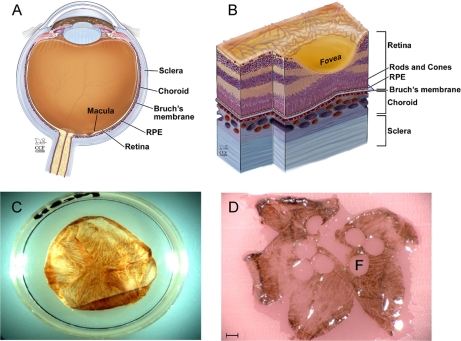
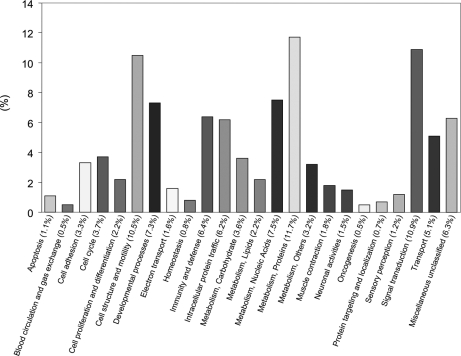
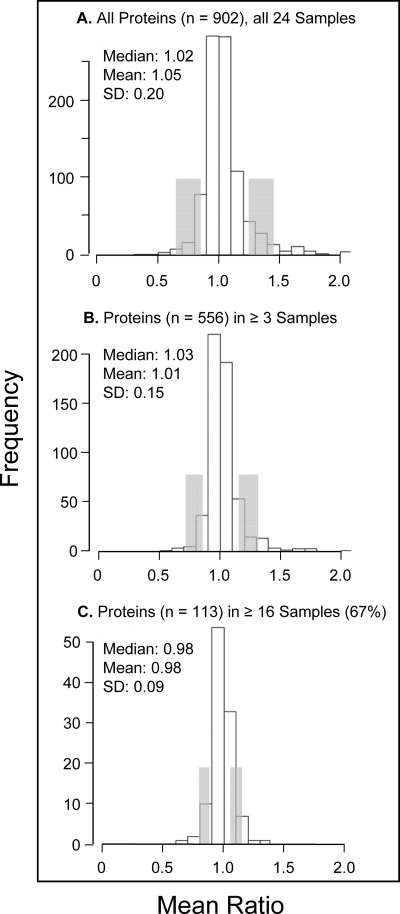
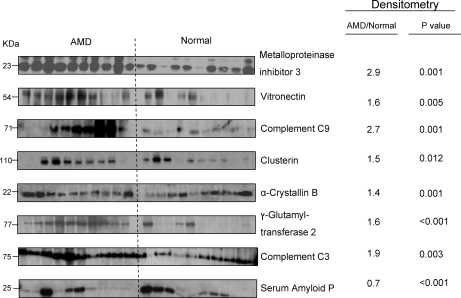
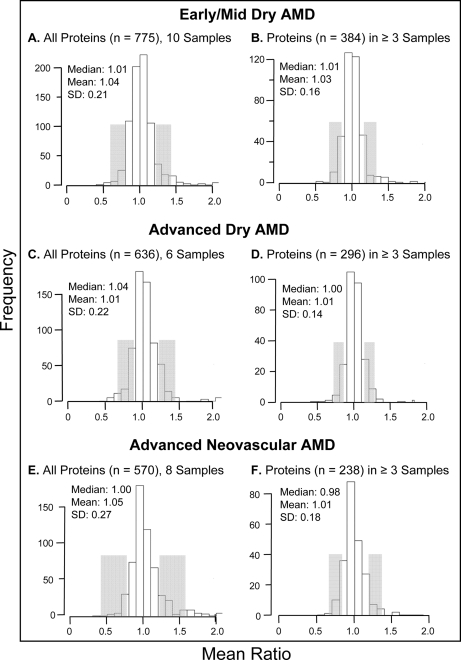
A quantitative proteomics analysis of the macular Bruch membrane/choroid complex was pursued for insights into the molecular mechanisms of age-related macular degeneration (AMD). Protein in trephine samples from the macular region of 10 early/mid-stage dry AMD, six advanced dry AMD, eight wet AMD, and 25 normal control post-mortem eyes was analyzed by LC MS/MS iTRAQ (isobaric tags for relative and absolute quantitation) technology. A total of 901 proteins was quantified, including 556 proteins from > or =3 AMD samples. Most proteins differed little in amount between AMD and control samples and therefore reflect the proteome of normal macular tissues of average age 81. A total of 56 proteins were found to be elevated and 43 were found to be reduced in AMD tissues relative to controls. Analysis by category of disease progression revealed up to 16 proteins elevated or decreased in each category. About 60% of the elevated proteins are involved in immune response and host defense, including many complement proteins and damage-associated molecular pattern proteins such as alpha-defensins 1-3, protein S100s, crystallins, histones, and galectin-3. Four retinoid processing proteins were elevated only in early/mid-stage AMD, supporting a role for retinoids in AMD initiation. Proteins uniquely decreased in early/mid-stage AMD implicate hematologic malfunctions and weakened extracellular matrix integrity and cellular interactions. Galectin-3, a receptor for advanced glycation end products, was the most significantly elevated protein in advanced dry AMD, supporting a role for advanced glycation end products in dry AMD progression. The results endorse inflammatory processes in both early and advanced AMD pathology, implicate different pathways of progression to advanced dry and wet AMD, and provide a new database for hypothesis-driven and discovery-based studies of AMD.
对黄斑部布鲁赫膜/脉络膜复合体进行定量蛋白质组学分析,以深入了解年龄相关性黄斑变性(AMD)的分子机制。通过 LC MS/MS iTRAQ(相对和绝对定量的同位素标记)技术分析了 10 例早期/中期干性 AMD、6 例晚期干性 AMD、8 例湿性 AMD 和 25 例尸检后正常对照的黄斑区环钻样本中的蛋白质。共定量了 901 种蛋白质,其中 556 种蛋白质来自>或=3 例 AMD 样本。AMD 和对照样本之间大多数蛋白质的含量差异不大,因此反映了平均年龄为 81 岁的正常黄斑组织的蛋白质组。与对照相比,AMD 组织中发现 56 种蛋白质升高,43 种蛋白质降低。按疾病进展类别分析,每个类别中发现多达 16 种蛋白质升高或降低。约 60%的升高蛋白参与免疫反应和宿主防御,包括许多补体蛋白和损伤相关分子模式蛋白,如α-防御素 1-3、S100 蛋白、晶体蛋白、组蛋白和半乳糖凝集素-3。仅在早期/中期 AMD 中升高的 4 种视黄醇处理蛋白支持视黄醇在 AMD 起始中的作用。早期/中期 AMD 中唯一降低的蛋白质提示血液学功能障碍和细胞外基质完整性和细胞相互作用减弱。半乳糖凝集素-3是晚期糖基化终产物的受体,在晚期干性 AMD 中升高最为显著,支持晚期糖基化终产物在干性 AMD 进展中的作用。结果支持早期和晚期 AMD 病理中的炎症过程,提示向晚期干性和湿性 AMD 进展的不同途径,并为基于假说和发现的 AMD 研究提供了新的数据库。