Díaz-Muñoz Mauricio, Vázquez-Martínez Olivia, Báez-Ruiz Adrián, Martínez-Cabrera Gema, Soto-Abraham María V, Avila-Casado María C, Larriva-Sahd Jorge
Instituto de Neurobiología, Campus UNAM-UAQ, Juriquilla, Querétaro, 76001 QRO, México.
Comp Hepatol. 2010 Feb 23;9:5. doi: 10.1186/1476-5926-9-5.
Temporal restriction of food availability entrains circadian behavioral and physiological rhythms in mammals by resetting peripheral oscillators. This entrainment underlies the activity of a timing system, different from the suprachiasmatic nuclei (SCN), known as the food entrainable oscillator (FEO). So far, the precise anatomical location of the FEO is unknown. The expression of this oscillator is associated with an enhanced arousal prior to the food presentation that is called food anticipatory activity (FAA). We have focused on the study of the role played by the liver as a probable component of the FEO. The aim of this work was to identify metabolic and structural adaptations in the liver during the expression of the FEO, as revealed by histochemical assessment of hepatic glycogen and triacylglycerol contents, morphometry, and ultrastructure in rats under restricted feeding schedules (RFS).
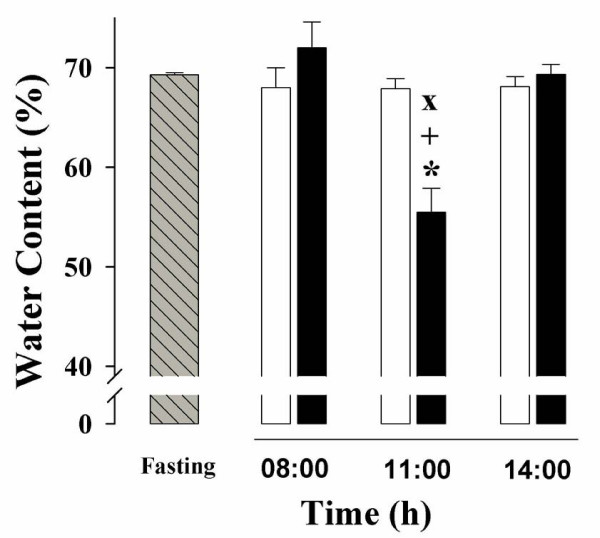
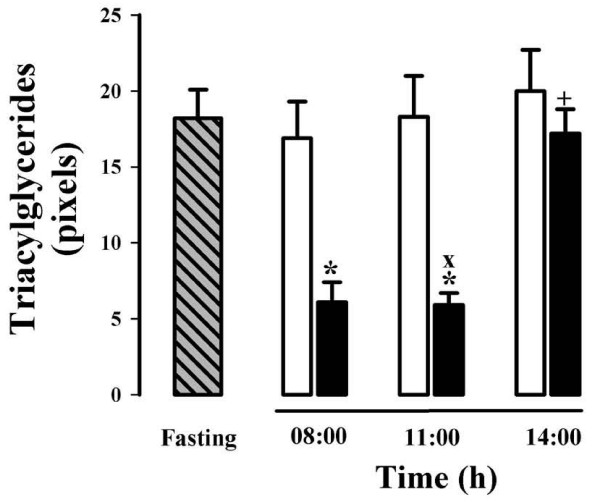
RFS promoted a decrease in the liver/body weight ratio prior to food access, a reduction of hepatic water content, an increase in cross-sectional area of the hepatocytes, a moderate reduction in glycogen content, and a striking decrease in triacylglyceride levels. Although these adaptation effects were also observed when the animal displayed FAA, they were reversed upon feeding. Mitochondria observed by electron microscopy showed a notorious opacity in the hepatocytes from rats during FAA (11:00 h). Twenty four hour fasting rats did not show any of the modifications observed in the animals expressing the FEO.
Our results demonstrate that FEO expression is associated with modified liver handling of glycogen and triacylglycerides accompanied by morphometric and ultrastructural adaptations in the hepatocytes. Because the cellular changes detected in the liver cannot be attributed to a simple alternation between feeding and fasting conditions, they also strengthen the notion that RFS promotes a rheostatic adjustment in liver physiology during FEO expression.
食物可利用时间的限时通过重置外周生物钟,使哺乳动物的昼夜行为和生理节律同步。这种同步作用是一个计时系统活动的基础,该系统不同于视交叉上核(SCN),被称为食物可调节振荡器(FEO)。到目前为止,FEO的确切解剖位置尚不清楚。这个振荡器的表达与进食前增强的觉醒有关,这种觉醒被称为食物预期活动(FAA)。我们专注于研究肝脏作为FEO可能组成部分所起的作用。这项工作的目的是通过对限制进食时间表(RFS)下大鼠肝脏糖原和三酰甘油含量、形态测量和超微结构的组织化学评估,来确定FEO表达期间肝脏的代谢和结构适应性。
RFS导致进食前肝脏/体重比降低、肝脏含水量减少、肝细胞横截面积增加、糖原含量适度降低以及三酰甘油水平显著下降。尽管在动物表现出FAA时也观察到了这些适应效应,但进食后它们会逆转。电子显微镜观察到,在FAA期间(11:00 h),大鼠肝细胞中的线粒体显示出明显的不透明。禁食24小时的大鼠没有表现出在表达FEO的动物中观察到的任何变化。
我们的结果表明,FEO的表达与肝脏对糖原和三酰甘油的处理改变有关,同时伴有肝细胞的形态测量和超微结构适应。由于在肝脏中检测到的细胞变化不能简单归因于进食和禁食状态之间的交替,它们也强化了这样一种观点,即RFS在FEO表达期间促进肝脏生理的稳态调节。