• 文献检索
  • 文档翻译
  • 深度研究
  • 学术资讯
  • Suppr Zotero 插件Zotero 插件
  • 邀请有礼
  • 套餐&价格
  • 历史记录
应用&插件
Suppr Zotero 插件Zotero 插件浏览器插件Mac 客户端Windows 客户端微信小程序
定价
高级版会员购买积分包购买API积分包
服务
文献检索文档翻译深度研究API 文档MCP 服务
关于我们
关于 Suppr公司介绍联系我们用户协议隐私条款
关注我们

Suppr 超能文献

核心技术专利:CN118964589B侵权必究
粤ICP备2023148730 号-1Suppr @ 2026

文献检索

告别复杂PubMed语法,用中文像聊天一样搜索,搜遍4000万医学文献。AI智能推荐,让科研检索更轻松。

立即免费搜索

文件翻译

保留排版,准确专业,支持PDF/Word/PPT等文件格式,支持 12+语言互译。

免费翻译文档

深度研究

AI帮你快速写综述,25分钟生成高质量综述,智能提取关键信息,辅助科研写作。

立即免费体验

真菌蛋白激酶及其相关结构域的比较分析。

Comparative analysis of fungal protein kinases and associated domains.

机构信息

Department of Biology, Technion - Israel Institute of Technology, Haifa 32000, Israel.

出版信息

BMC Genomics. 2010 Feb 24;11:133. doi: 10.1186/1471-2164-11-133.

DOI:10.1186/1471-2164-11-133
PMID:20178650
原文链接:https://pmc.ncbi.nlm.nih.gov/articles/PMC2838846/
Abstract

BACKGROUND

Protein phosphorylation is responsible for a large portion of the regulatory functions of eukaryotic cells. Although the list of sequenced genomes of filamentous fungi has grown rapidly, the kinomes of recently sequenced species have not yet been studied in detail. The objective of this study is to apply a comparative analysis of the kinase distribution in different fungal phyla, and to explore its relevance to understanding the evolution of fungi and their taxonomic classification. We have analyzed in detail 12 subgroups of kinases and their distribution over 30 species, as well as their potential use as a classifier for members of the fungal kingdom.

RESULTS

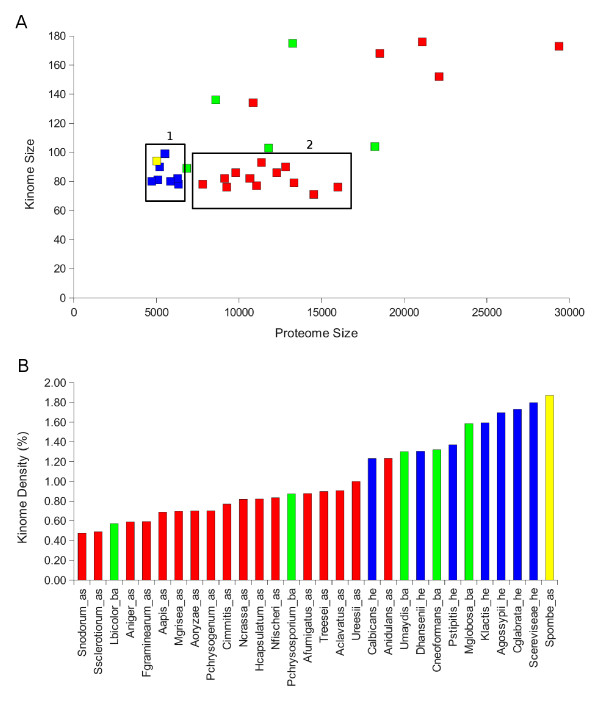
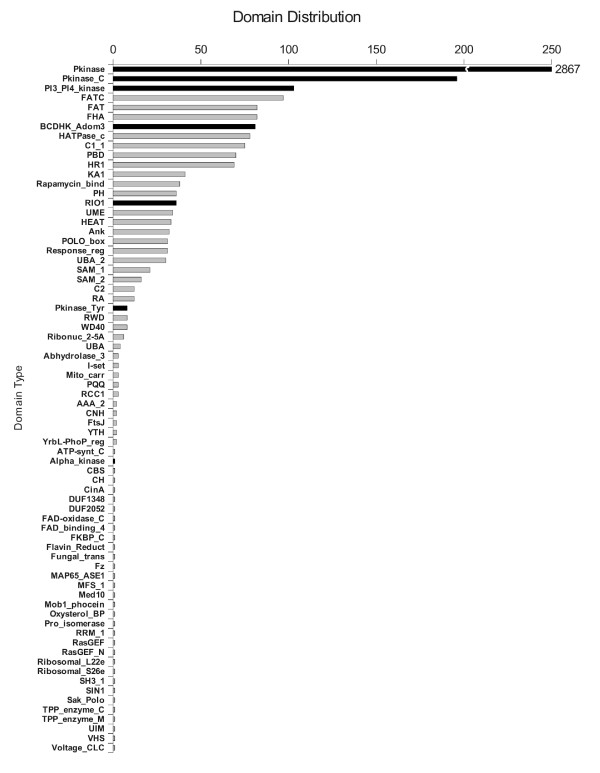
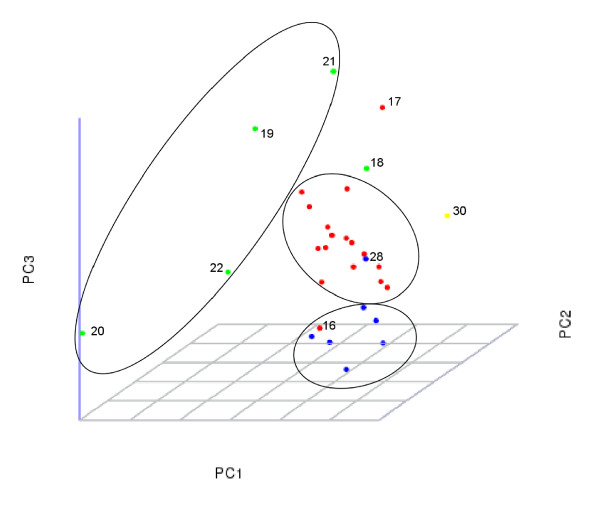
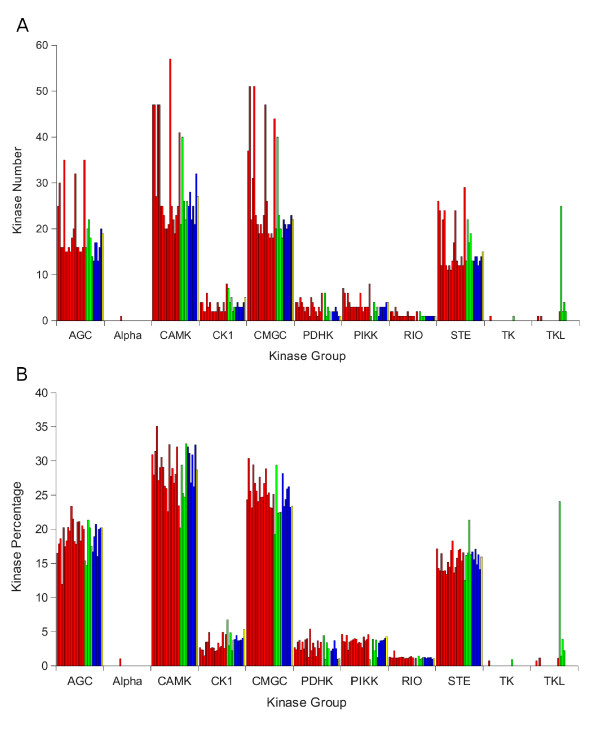
Our findings show that despite the similarity of the kinase distribution in all fungi, their domain distributions and kinome density can potentially be used to classify them and give insight into their evolutionary origin. In general, we found that the overall representation of kinase groups is similar across fungal genomes, the only exception being a large number of tyrosine kinase-like (TKL) kinases predicted in Laccaria bicolor. This unexpected finding underscores the need to continue to sequence fungal genomes, since many species or lineage-specific properties may remain to be discovered. Furthermore, we found that the domain organization significantly varies between the fungal species. Our results suggest that protein kinases and their functional domains strongly reflect fungal taxonomy.

CONCLUSIONS

Comparison of the predicted kinomes of sequenced fungi suggests essential signaling functions common to all species, but also specific adaptations of the signal transduction networks to particular species.

摘要

背景

蛋白质磷酸化是真核细胞大部分调节功能的基础。尽管丝状真菌的测序基因组列表迅速增加,但最近测序的物种的激酶组尚未得到详细研究。本研究的目的是应用不同真菌门中激酶分布的比较分析,并探索其与真菌进化和分类学分类的相关性。我们详细分析了 12 个激酶亚组及其在 30 个物种中的分布,以及它们作为真菌界成员分类器的潜在用途。

结果

我们的研究结果表明,尽管所有真菌中的激酶分布相似,但它们的结构域分布和激酶组密度有可能用于对它们进行分类,并深入了解其进化起源。总的来说,我们发现激酶组的总体代表性在真菌基因组中是相似的,唯一的例外是在 Laccaria bicolor 中预测了大量酪氨酸激酶样(TKL)激酶。这一意外发现强调了需要继续对真菌基因组进行测序,因为可能仍有许多物种或谱系特异性的特性有待发现。此外,我们发现真菌物种之间的结构域组织有显著差异。我们的研究结果表明,蛋白激酶及其功能结构域强烈反映了真菌的分类学。

结论

对已测序真菌的预测激酶组的比较表明,所有物种都具有基本的信号转导功能,但信号转导网络也针对特定物种进行了特定的适应。
https://cdn.ncbi.nlm.nih.gov/pmc/blobs/3ee2/2838846/f8d9f750c60e/1471-2164-11-133-5.jpg
https://cdn.ncbi.nlm.nih.gov/pmc/blobs/3ee2/2838846/aecaa3c11020/1471-2164-11-133-1.jpg
https://cdn.ncbi.nlm.nih.gov/pmc/blobs/3ee2/2838846/dfa6a48a05f9/1471-2164-11-133-2.jpg
https://cdn.ncbi.nlm.nih.gov/pmc/blobs/3ee2/2838846/205b563cc2dd/1471-2164-11-133-3.jpg
https://cdn.ncbi.nlm.nih.gov/pmc/blobs/3ee2/2838846/e394ef590050/1471-2164-11-133-4.jpg
https://cdn.ncbi.nlm.nih.gov/pmc/blobs/3ee2/2838846/f8d9f750c60e/1471-2164-11-133-5.jpg
https://cdn.ncbi.nlm.nih.gov/pmc/blobs/3ee2/2838846/aecaa3c11020/1471-2164-11-133-1.jpg
https://cdn.ncbi.nlm.nih.gov/pmc/blobs/3ee2/2838846/dfa6a48a05f9/1471-2164-11-133-2.jpg
https://cdn.ncbi.nlm.nih.gov/pmc/blobs/3ee2/2838846/205b563cc2dd/1471-2164-11-133-3.jpg
https://cdn.ncbi.nlm.nih.gov/pmc/blobs/3ee2/2838846/e394ef590050/1471-2164-11-133-4.jpg
https://cdn.ncbi.nlm.nih.gov/pmc/blobs/3ee2/2838846/f8d9f750c60e/1471-2164-11-133-5.jpg

相似文献

1
Comparative analysis of fungal protein kinases and associated domains.真菌蛋白激酶及其相关结构域的比较分析。
BMC Genomics. 2010 Feb 24;11:133. doi: 10.1186/1471-2164-11-133.
2
Structure and distribution of sensor histidine kinases in the fungal kingdom.真菌王国中传感器组氨酸激酶的结构和分布。
Curr Genet. 2024 Sep 14;70(1):17. doi: 10.1007/s00294-024-01301-w.
3
Identification of a fungi-specific lineage of protein kinases closely related to tyrosine kinases.鉴定出与酪氨酸激酶密切相关的真菌特异性蛋白激酶谱系。
PLoS One. 2014 Feb 27;9(2):e89813. doi: 10.1371/journal.pone.0089813. eCollection 2014.
4
Comparison of protein coding gene contents of the fungal phyla Pezizomycotina and Saccharomycotina.子囊菌门盘菌亚门和酵母亚门蛋白质编码基因含量的比较。
BMC Genomics. 2007 Sep 17;8:325. doi: 10.1186/1471-2164-8-325.
5
Kinome Expansion in the Fusarium oxysporum Species Complex Driven by Accessory Chromosomes.《由附加染色体驱动的尖孢镰刀菌物种复合体中的激酶组扩张》。
mSphere. 2018 Jun 13;3(3). doi: 10.1128/mSphere.00231-18. Print 2018 Jun 27.
6
Conservation, duplication, and loss of the Tor signaling pathway in the fungal kingdom.真菌王国中 Tor 信号通路的保守、复制和丢失。
BMC Genomics. 2010 Sep 23;11:510. doi: 10.1186/1471-2164-11-510.
7
Evolution of protein phosphorylation across 18 fungal species.在 18 种真菌物种中蛋白质磷酸化的演变。
Science. 2016 Oct 14;354(6309):229-232. doi: 10.1126/science.aaf2144.
8
Hybrid histidine kinases in pathogenic fungi.致病真菌中的杂合组氨酸激酶
Mol Microbiol. 2015 Mar;95(6):914-24. doi: 10.1111/mmi.12911. Epub 2015 Jan 30.
9
Fungal plant cell wall-degrading enzyme database: a platform for comparative and evolutionary genomics in fungi and Oomycetes.真菌植物细胞壁降解酶数据库:真菌和卵菌比较与进化基因组学的平台。
BMC Genomics. 2013;14 Suppl 5(Suppl 5):S7. doi: 10.1186/1471-2164-14-S5-S7. Epub 2013 Oct 16.
10
Dual-histidine kinases in basidiomycete fungi.担子菌真菌中的双组氨酸激酶。
C R Biol. 2014 Feb;337(2):111-6. doi: 10.1016/j.crvi.2013.12.007. Epub 2014 Feb 10.

引用本文的文献

1
Comparative meta-analysis of barely transcriptome: Pathogen type determines host preference.大麦转录组的比较荟萃分析:病原体类型决定宿主偏好。
PLoS One. 2025 Jun 30;20(6):e0320708. doi: 10.1371/journal.pone.0320708. eCollection 2025.
2
Low-complexity regions in fungi display functional groups and are depleted in positively charged amino acids.真菌中的低复杂性区域呈现出功能基团,并且带正电荷的氨基酸含量较低。
NAR Genom Bioinform. 2025 Feb 27;7(1):lqaf014. doi: 10.1093/nargab/lqaf014. eCollection 2025 Mar.
3
Integration of fungal transcriptomics and metabolomics provides insights into the early interaction between the ORM fungus Tulasnella sp. and the orchid Serapias vomeracea seeds.

本文引用的文献

1
Comparative genomic analyses of the human fungal pathogens Coccidioides and their relatives.人类真菌病原体球孢子菌及其亲缘种的比较基因组分析。
Genome Res. 2009 Oct;19(10):1722-31. doi: 10.1101/gr.087551.108. Epub 2009 Aug 28.
2
Genomic analysis of the basal lineage fungus Rhizopus oryzae reveals a whole-genome duplication.米根霉基础谱系真菌的基因组分析揭示了一次全基因组复制。
PLoS Genet. 2009 Jul;5(7):e1000549. doi: 10.1371/journal.pgen.1000549. Epub 2009 Jul 3.
3
Expansion of signal pathways in the ectomycorrhizal fungus Laccaria bicolor- evolution of nucleotide sequences and expression patterns in families of protein kinases and RAS small GTPases.
真菌转录组学和代谢组学的整合为深入了解ORM真菌土氏菌属(Tulasnella sp.)与兰花锯齿舌唇兰(Serapias vomeracea)种子之间的早期相互作用提供了见解。
IMA Fungus. 2024 Oct 25;15(1):31. doi: 10.1186/s43008-024-00165-6.
4
Novel Compound MMV1804559 from the Global Health Priority Box Exhibits In Vitro and In Vivo Activity against .新型化合物 MMV1804559 来自全球健康重点药物清单,表现出体外和体内抗. 的活性。
Int J Mol Sci. 2024 Jun 5;25(11):6227. doi: 10.3390/ijms25116227.
5
Functional analysis of the Aspergillus fumigatus kinome identifies a druggable DYRK kinase that regulates septal plugging.烟曲霉激酶组的功能分析鉴定出一种可成药的双特异性酪氨酸磷酸化调节激酶,该激酶调控隔膜栓的形成。
Nat Commun. 2024 Jun 11;15(1):4984. doi: 10.1038/s41467-024-48592-8.
6
The Kinase USK1 Regulates Cellulase Gene Expression and Secondary Metabolite Biosynthesis in .激酶USK1调节[具体对象]中的纤维素酶基因表达和次级代谢物生物合成。 (原文中“in”后面缺少具体内容)
Front Microbiol. 2020 May 20;11:974. doi: 10.3389/fmicb.2020.00974. eCollection 2020.
7
AflSte20 Regulates Morphogenesis, Stress Response, and Aflatoxin Biosynthesis of .AflSte20 调控. 的形态发生、应激反应和黄曲霉毒素生物合成。
Toxins (Basel). 2019 Dec 13;11(12):730. doi: 10.3390/toxins11120730.
8
Protein phosphatases regulate growth, development, cellulases and secondary metabolism in Trichoderma reesei.蛋白质磷酸酶调节里氏木霉的生长、发育、纤维素酶和次生代谢。
Sci Rep. 2019 Jul 29;9(1):10995. doi: 10.1038/s41598-019-47421-z.
9
Genomic features and evolution of the conditionally dispensable chromosome in the tangerine pathotype of Alternaria alternata.链格孢菌橘致病型中条件性可缺失染色体的基因组特征与进化
Mol Plant Pathol. 2019 Oct;20(10):1425-1438. doi: 10.1111/mpp.12848. Epub 2019 Jul 11.
10
Modified recipe to inhibit fruiting body formation for living fungal biomaterial manufacture.改良配方以抑制子实体形成,用于活体真菌生物材料制造。
PLoS One. 2019 May 13;14(5):e0209812. doi: 10.1371/journal.pone.0209812. eCollection 2019.
外生菌根真菌双色蜡蘑中信号通路的扩展——蛋白激酶家族和RAS小GTP酶核苷酸序列的进化及表达模式
New Phytol. 2009;183(2):365-379. doi: 10.1111/j.1469-8137.2009.02860.x. Epub 2009 May 11.
4
A supervised learning approach for taxonomic classification of core-photosystem-II genes and transcripts in the marine environment.一种用于海洋环境中核心光系统II基因和转录本分类学分类的监督学习方法。
BMC Genomics. 2009 May 16;10:229. doi: 10.1186/1471-2164-10-229.
5
Targeting the Kinome II.靶向激酶组II。
Curr Opin Cell Biol. 2009 Apr;21(2):135-9. doi: 10.1016/j.ceb.2009.03.001. Epub 2009 Apr 1.
6
Kinomer v. 1.0: a database of systematically classified eukaryotic protein kinases.Kinomer v. 1.0:一个系统分类的真核生物蛋白激酶数据库。
Nucleic Acids Res. 2009 Jan;37(Database issue):D244-50. doi: 10.1093/nar/gkn834. Epub 2008 Oct 30.
7
Eukaryotic-like protein kinases in the prokaryotes and the myxobacterial kinome.原核生物中的类真核蛋白激酶与黏细菌激酶组
Proc Natl Acad Sci U S A. 2008 Oct 14;105(41):15950-5. doi: 10.1073/pnas.0806851105. Epub 2008 Oct 3.
8
Genome sequencing and analysis of the filamentous fungus Penicillium chrysogenum.产黄青霉丝状真菌的基因组测序与分析
Nat Biotechnol. 2008 Oct;26(10):1161-8. doi: 10.1038/nbt.1498. Epub 2008 Sep 28.
9
Genome sequencing and analysis of the biomass-degrading fungus Trichoderma reesei (syn. Hypocrea jecorina).生物质降解真菌里氏木霉(同义词:嗜热毁丝霉)的基因组测序与分析
Nat Biotechnol. 2008 May;26(5):553-60. doi: 10.1038/nbt1403. Epub 2008 May 4.
10
Genomic islands in the pathogenic filamentous fungus Aspergillus fumigatus.致病丝状真菌烟曲霉中的基因组岛
PLoS Genet. 2008 Apr 11;4(4):e1000046. doi: 10.1371/journal.pgen.1000046.