Department of Molecular Genetics and Microbiology, Duke University Medical Center, Durham, NC 27710, USA.
BMC Genomics. 2010 Sep 23;11:510. doi: 10.1186/1471-2164-11-510.
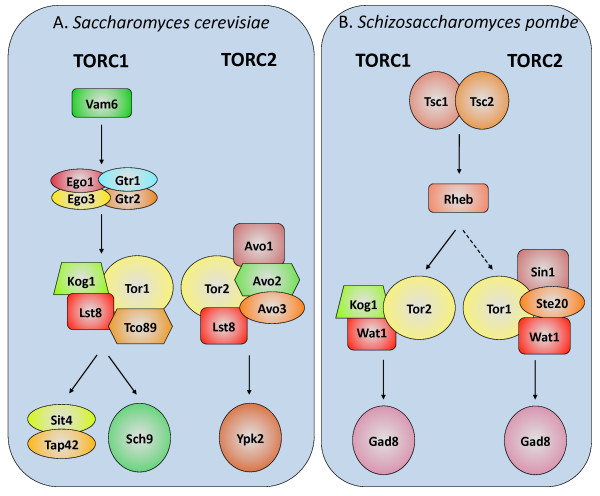
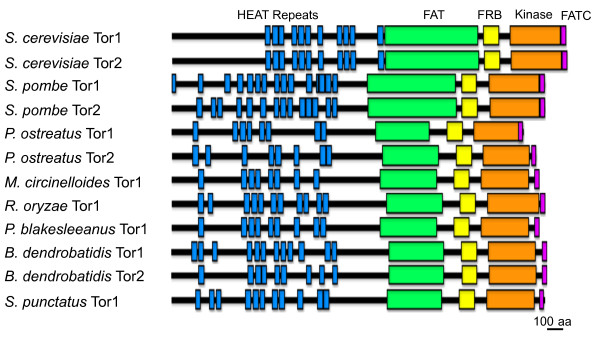
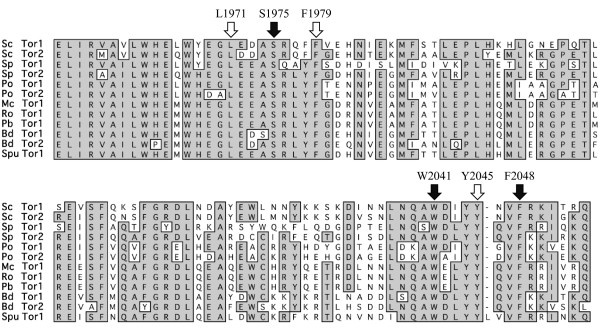
The nutrient-sensing Tor pathway governs cell growth and is conserved in nearly all eukaryotic organisms from unicellular yeasts to multicellular organisms, including humans. Tor is the target of the immunosuppressive drug rapamycin, which in complex with the prolyl isomerase FKBP12 inhibits Tor functions. Rapamycin is a gold standard drug for organ transplant recipients that was approved by the FDA in 1999 and is finding additional clinical indications as a chemotherapeutic and antiproliferative agent. Capitalizing on the plethora of recently sequenced genomes we have conducted comparative genomic studies to annotate the Tor pathway throughout the fungal kingdom and related unicellular opisthokonts, including Monosiga brevicollis, Salpingoeca rosetta, and Capsaspora owczarzaki.
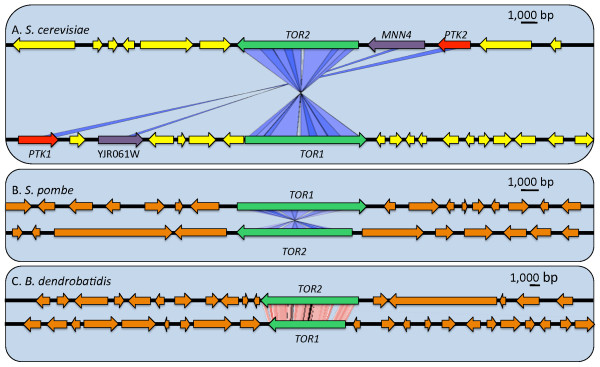
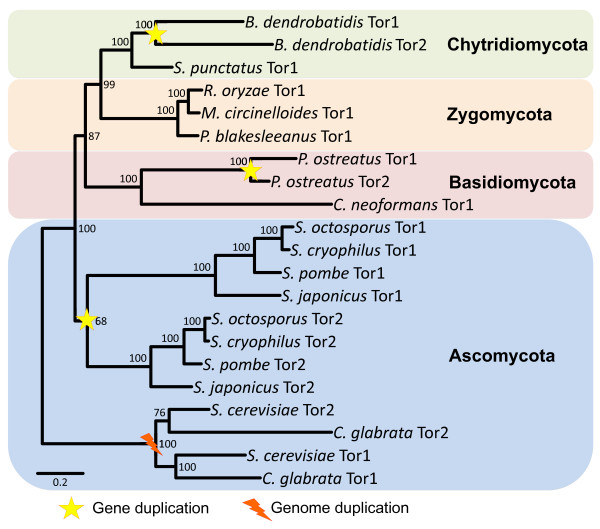
Interestingly, the Tor signaling cascade is absent in three microsporidian species with available genome sequences, the only known instance of a eukaryotic group lacking this conserved pathway. The microsporidia are obligate intracellular pathogens with highly reduced genomes, and we hypothesize that they lost the Tor pathway as they adapted and streamlined their genomes for intracellular growth in a nutrient-rich environment. Two TOR paralogs are present in several fungal species as a result of either a whole genome duplication or independent gene/segmental duplication events. One such event was identified in the amphibian pathogen Batrachochytrium dendrobatidis, a chytrid responsible for worldwide global amphibian declines and extinctions.
The repeated independent duplications of the TOR gene in the fungal kingdom might reflect selective pressure acting upon this kinase that populates two proteinaceous complexes with different cellular roles. These comparative genomic analyses illustrate the evolutionary trajectory of a central nutrient-sensing cascade that enables diverse eukaryotic organisms to respond to their natural environments.
营养感应 Tor 途径调节细胞生长,存在于从单细胞酵母到多细胞生物(包括人类)等几乎所有真核生物中。Tor 是免疫抑制药物雷帕霉素的靶标,雷帕霉素与脯氨酰异构酶 FKBP12 形成复合物,抑制 Tor 功能。雷帕霉素是 1999 年 FDA 批准的器官移植受者的金标准药物,并且作为化疗和抗增殖剂正在发现其他临床适应症。利用最近测序的大量基因组,我们进行了比较基因组研究,对真菌界和相关单细胞后口动物中的 Tor 途径进行了注释,包括 Monosiga brevicollis、Salpingoeca rosetta 和 Capsaspora owczarzaki。
有趣的是,在具有可用基因组序列的三个微孢子虫物种中,Tor 信号级联缺失,这是唯一已知的缺乏这种保守途径的真核生物群。微孢子虫是专性细胞内病原体,基因组高度简化,我们假设它们失去了 Tor 途径,因为它们适应了细胞内生长在营养丰富的环境中,并简化了它们的基因组。两个 TOR 同源物存在于几种真菌物种中,这是由于全基因组复制或独立基因/片段复制事件。在两栖动物病原体 Batrachochytrium dendrobatidis 中发现了这样一个事件,Batrachochytrium dendrobatidis 是一种导致全球范围内全球两栖动物减少和灭绝的壶菌。
Tor 基因在真菌界中的重复独立复制可能反映了作用于该激酶的选择性压力,该激酶与具有不同细胞作用的两个蛋白复合物结合。这些比较基因组分析说明了中央营养感应级联的进化轨迹,使不同的真核生物能够对其自然环境做出反应。