Faculty of Health Sciences, McMaster University, 1200 Main St, W,, Hamilton, Ontario, Canada.
BMC Public Health. 2010 Feb 24;10:95. doi: 10.1186/1471-2458-10-95.
Evidence-informed decision making is accepted in Canada and worldwide as necessary for the provision of effective health services. This process involves: 1) clearly articulating a practice-based issue; 2) searching for and accessing relevant evidence; 3) appraising methodological rigor and choosing the most synthesized evidence of the highest quality and relevance to the practice issue and setting that is available; and 4) extracting, interpreting, and translating knowledge, in light of the local context and resources, into practice, program and policy decisions. While the public health sector in Canada is working toward evidence-informed decision making, considerable barriers, including efficient access to synthesized resources, exist.
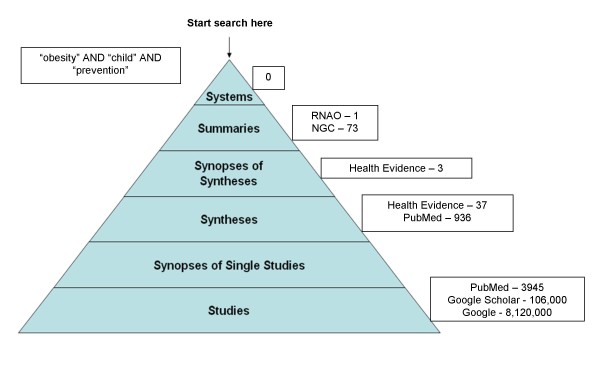
In this paper we map to a previously developed 6 level pyramid of pre-processed research evidence, relevant resources that include public health-related effectiveness evidence. The resources were identified through extensive searches of both the published and unpublished domains.
Many resources with public health-related evidence were identified. While there were very few resources dedicated solely to public health evidence, many clinically focused resources include public health-related evidence, making tools such as the pyramid, that identify these resources, particularly helpful for public health decisions makers. A practical example illustrates the application of this model and highlights its potential to reduce the time and effort that would be required by public health decision makers to address their practice-based issues.
This paper describes an existing hierarchy of pre-processed evidence and its adaptation to the public health setting. A number of resources with public health-relevant content that are either freely accessible or requiring a subscription are identified. This will facilitate easier and faster access to pre-processed, public health-relevant evidence, with the intent of promoting evidence-informed decision making. Access to such resources addresses several barriers identified by public health decision makers to evidence-informed decision making, most importantly time, as well as lack of knowledge of resources that house public health-relevant evidence.
循证决策在加拿大和全球范围内被认为是提供有效卫生服务所必需的。这个过程包括:1)明确阐述基于实践的问题;2)搜索并获取相关证据;3)评估方法学严谨性,并选择最综合、质量最高且与实践问题和背景相关的证据;4)根据当地情况和资源,提取、解释和转化知识,将其应用于实践、项目和政策决策中。虽然加拿大的公共卫生部门正在努力实现循证决策,但仍存在相当多的障碍,包括有效获取综合资源的障碍。
在本文中,我们根据之前开发的 6 级预处理研究证据金字塔,对相关资源进行了映射,这些资源包括与公共卫生相关的有效性证据。这些资源是通过广泛搜索已发表和未发表的文献领域确定的。
发现了许多具有公共卫生相关证据的资源。虽然几乎没有专门针对公共卫生证据的资源,但许多以临床为重点的资源都包含与公共卫生相关的证据,因此像金字塔这样可以识别这些资源的工具对于公共卫生决策者特别有帮助。一个实际的例子说明了该模型的应用,并强调了它在减少公共卫生决策者解决基于实践的问题所需的时间和精力方面的潜力。
本文描述了一个现有的预处理证据层次结构及其在公共卫生环境中的应用。确定了一些具有公共卫生相关内容的资源,这些资源可以免费访问或需要订阅。这将促进更容易和更快地访问预处理的、与公共卫生相关的证据,旨在促进循证决策。获取这些资源解决了公共卫生决策者在循证决策方面遇到的几个障碍,最重要的是时间问题,以及缺乏与公共卫生相关证据相关的资源的知识。