BioMedCom Consultants Inc, Montréal, Québec Canada.
BMC Health Serv Res. 2011 Nov 30;11:329. doi: 10.1186/1472-6963-11-329.
Consistent healthcare decision making requires systematic consideration of decision criteria and evidence available to inform them. This can be tackled by combining multicriteria decision analysis (MCDA) and Health Technology Assessment (HTA). The objective of this study was to field-test a decision support framework (EVIDEM), explore its utility to a drug advisory committee and test its reliability over time.
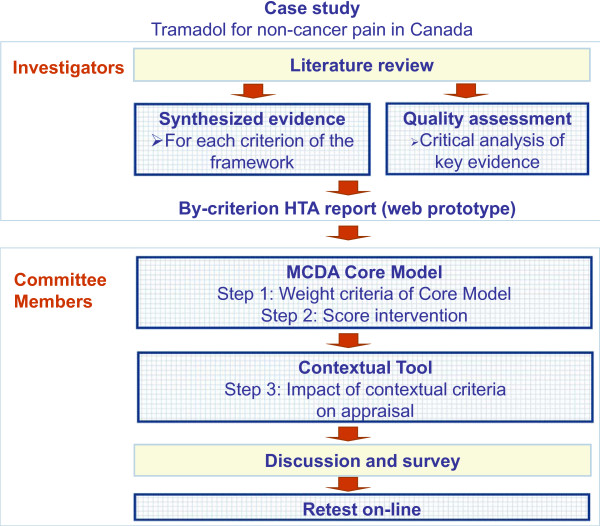
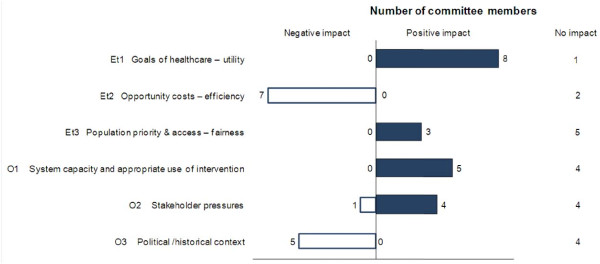
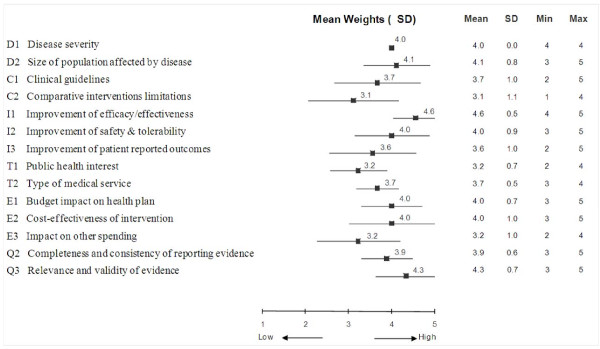
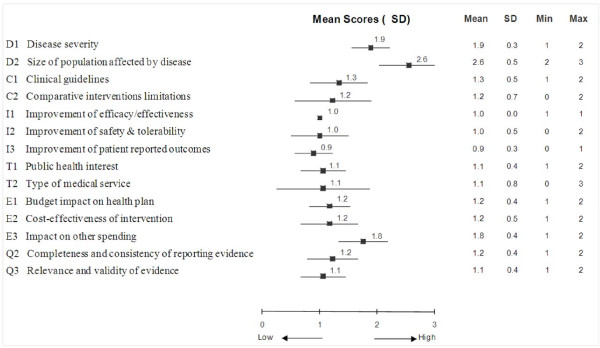
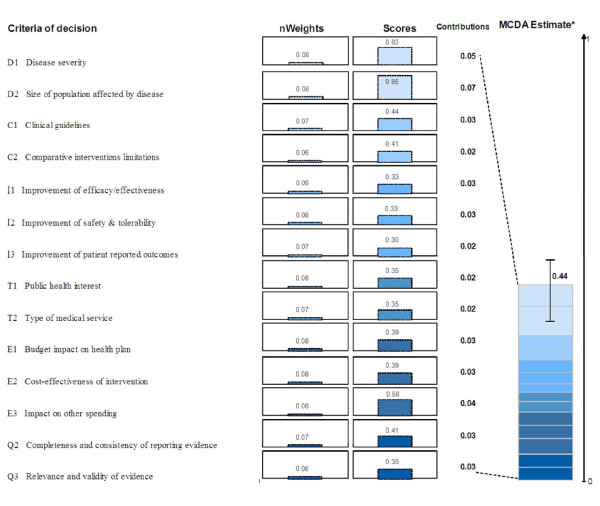
Tramadol for chronic non-cancer pain was selected by the health plan as a case study relevant to their context. Based on extensive literature review, a by-criterion HTA report was developed to provide synthesized evidence for each criterion of the framework (14 criteria for the MCDA Core Model and 6 qualitative criteria for the Contextual Tool). During workshop sessions, committee members tested the framework in three steps by assigning: 1) weights to each criterion of the MCDA Core Model representing individual perspective; 2) scores for tramadol for each criterion of the MCDA Core Model using synthesized data; and 3) qualitative impacts of criteria of the Contextual Tool on the appraisal. Utility and reliability of the approach were explored through discussion, survey and test-retest. Agreement between test and retest data was analyzed by calculating intra-rater correlation coefficients (ICCs) for weights, scores and MCDA value estimates.
The framework was found useful by the drug advisory committee in supporting systematic consideration of a broad range of criteria to promote a consistent approach to appraising healthcare interventions. Directly integrated in the framework as a "by-criterion" HTA report, synthesized evidence for each criterion facilitated its consideration, although this was sometimes limited by lack of relevant data. Test-retest analysis showed fair to good consistency of weights, scores and MCDA value estimates at the individual level (ICC ranging from 0.676 to 0.698), thus lending some support for the reliability of the approach. Overall, committee members endorsed the inclusion of most framework criteria and revealed important areas of discussion, clarification and adaptation of the framework to the needs of the committee.
By promoting systematic consideration of all decision criteria and the underlying evidence, the framework allows a consistent approach to appraising healthcare interventions. Further testing and validation are needed to advance MCDA approaches in healthcare decisionmaking.
一致的医疗保健决策需要系统地考虑决策标准和可用的证据来提供信息。这可以通过结合多标准决策分析(MCDA)和健康技术评估(HTA)来解决。本研究的目的是现场测试一个决策支持框架(EVIDEM),探索其对药物咨询委员会的实用性,并随着时间的推移测试其可靠性。
将曲马多用于慢性非癌痛被健康计划选定为与其背景相关的案例研究。基于广泛的文献综述,制定了按标准的 HTA 报告,为框架的每个标准提供综合证据(MCDA 核心模型的 14 个标准和上下文工具的 6 个定性标准)。在研讨会会议期间,委员会成员通过以下三个步骤测试框架:1)为 MCDA 核心模型的每个标准分配权重,代表个人观点;2)使用综合数据为 MCDA 核心模型的每个标准分配分数;3)对上下文工具的标准对评估的定性影响。通过讨论、调查和测试-重测来探索方法的实用性和可靠性。通过计算权重、分数和 MCDA 值估计的内部评分者相关性系数(ICC)来分析测试和重测数据之间的一致性。
药物咨询委员会发现该框架在支持系统地考虑广泛的标准方面非常有用,有助于采用一致的方法来评估医疗保健干预措施。作为一个“按标准”的 HTA 报告直接集成在框架中,为每个标准提供综合证据,便于考虑,尽管这有时受到缺乏相关数据的限制。测试-重测分析显示,个人层面的权重、分数和 MCDA 值估计具有良好到中等的一致性(ICC 范围从 0.676 到 0.698),从而为该方法的可靠性提供了一些支持。总体而言,委员会成员认可框架的大多数标准,并揭示了框架需要讨论、澄清和适应委员会需求的重要领域。
通过促进对所有决策标准和基础证据的系统考虑,该框架允许采用一致的方法来评估医疗保健干预措施。需要进一步的测试和验证来推进医疗保健决策中的 MCDA 方法。