Rheumatology Research Group, School of Immunity and Infection, College of Medical and Dental Sciences, The Medical School, University of Birmingham, Birmingham B15 2TT, UK.
Rheumatology (Oxford). 2010 Sep;49(9):1665-9. doi: 10.1093/rheumatology/keq026. Epub 2010 Feb 24.
To develop an additive numerical scoring scheme for the BILAG-2004 index.
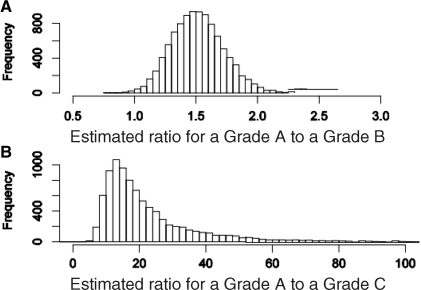
SLE patients were recruited into this multi-centre cross-sectional study. At every assessment, data were collected on disease activity and therapy. Logistic regression was used to model an increase in therapy, as an indicator of active disease, by the BILAG-2004 index score in the nine systems. As both indicate inactivity, scores of D and E were set to 0 and used as the baseline in the fitted model. The models were used to determine the numerical values for Grades A-C. Different scoring schemes were compared.
There were 1510 assessments from 369 SLE patients. The coding schemes suggested for the Classic BILAG index (A = 12, B = 5, C = 1, D/E = 0 and A = 9, B = 3, C = 1, D/E = 0) did not fit the data well. A coding scheme (A = 12, B = 8, C = 1 and D/E = 0) was recommended, based on analysis results and consistency with the numerical coding scheme of the Classic BILAG index.
A reasonable additive numerical scoring scheme based on treatment decision for the BILAG-2004 index is A = 12, B = 8, C = 1, D = 0 and E = 0.
开发 BILAG-2004 指数的附加数值评分方案。
本多中心横断面研究招募了 SLE 患者。在每次评估中,均收集疾病活动度和治疗数据。采用逻辑回归对 BILAG-2004 评分系统中 9 个系统的评分与治疗增加(作为疾病活动的指标)之间的关系进行建模。由于 D 分和 E 分均表示无活动,因此将其设定为 0 并作为拟合模型中的基线。采用该模型确定 A-C 级的数值。比较了不同的评分方案。
共纳入 369 例 SLE 患者的 1510 次评估。经典 BILAG 指数的编码方案(A=12,B=5,C=1,D/E=0 和 A=9,B=3,C=1,D/E=0)与数据拟合不佳。基于分析结果和与经典 BILAG 指数的数值编码方案的一致性,推荐使用编码方案(A=12,B=8,C=1,D/E=0)。
基于治疗决策的 BILAG-2004 指数合理的附加数值评分方案为 A=12,B=8,C=1,D=0 和 E=0。