INSERM U-698 'Recherche Clinique en Athérothrombose', Department of Cardiology, Centre Hospitalier Universitaire Bichat-Claude Bernard, 46 rue Henri Huchard, Paris Cedex, France.
Eur Heart J. 2010 May;31(10):1257-65. doi: 10.1093/eurheartj/ehq021. Epub 2010 Feb 24.
To develop a risk score to quantify bleeding risk in outpatients with or at risk of atherothrombosis.
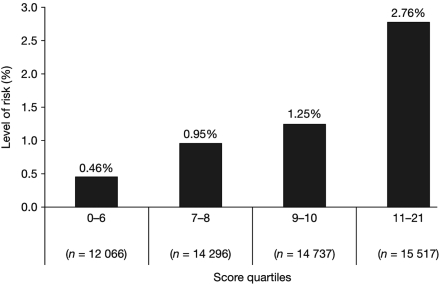
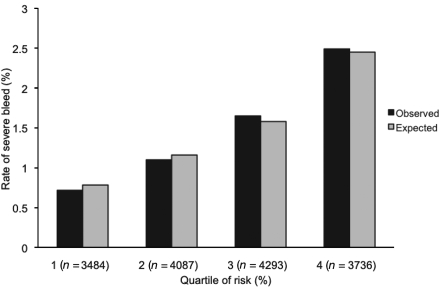
We studied patients in the REACH Registry, a cohort of 68 236 patients with/at risk of atherothrombosis. The outcome of interest was serious bleeding (non-fatal haemorrhagic stroke or bleeding leading to hospitalization and transfusion) over 2 years. Risk factors for bleeding were assessed using modified regression analysis. Multiple potential scoring systems based on the least complex models were constructed. Competing scores were compared on their discriminative ability via logistic regression. The score was validated externally using the CHARISMA population. From a final cohort of 56 616 patients, 804 (1.42%, 95% confidence interval 1.32-1.52) experienced serious bleeding between baseline and 2 years. A nine-item bleeding risk score (0-23 points) was constructed (age, peripheral arterial disease, congestive heart failure, diabetes, hypertension, smoking, antiplatelets, oral anticoagulants, hypercholesterolaemia). Observed incidence of bleeding at 2 years was: 0.46% (score < or = 6); 0.95% (7-8); 1.25% (9-10); 2.76% (> or = 11). The score's discriminative performance was consistent in CHARISMA and REACH (c-statistics 0.64 and 0.68, respectively); calibration in the CHARISMA population was very good (modified Hosmer-Lemeshow c(2) = 4.74; P = 0.69).
Bleeding risk increased substantially with a score >10. This score can assist clinicians in predicting the risk of serious bleeding and making decisions on antithrombotic therapy in outpatients.
开发一种风险评分系统,以量化有或有发生动脉粥样血栓形成风险的门诊患者的出血风险。
我们研究了 REACH 登记处的患者,这是一个有/有动脉粥样血栓形成风险的 68236 例患者队列。感兴趣的结局是 2 年内严重出血(非致命性脑出血或导致住院和输血的出血)。使用改良回归分析评估出血的危险因素。根据最简化模型构建了多种潜在的评分系统。通过逻辑回归比较竞争评分的判别能力。使用 CHARISMA 人群对评分进行外部验证。从最终的 56616 例患者中,有 804 例(1.42%,95%置信区间 1.32-1.52)在基线至 2 年内发生严重出血。构建了一个 9 项出血风险评分(0-23 分)(年龄、外周动脉疾病、充血性心力衰竭、糖尿病、高血压、吸烟、抗血小板药物、口服抗凝剂、高胆固醇血症)。观察到的 2 年出血发生率为:0.46%(评分<或=6);0.95%(7-8);1.25%(9-10);2.76%(>或=11)。评分在 CHARISMA 和 REACH 中的判别性能一致(分别为 C 统计量 0.64 和 0.68);CHARISMA 人群的校准非常好(校正 Hosmer-Lemeshow c(2)=4.74;P=0.69)。
评分>10 时出血风险显著增加。该评分可帮助临床医生预测严重出血风险,并在门诊患者中做出抗血栓治疗决策。