Mitochondrial Research Group, Institute for Ageing and Health, Medical School, Newcastle University, Newcastle upon Tyne, UK.
EMBO J. 2010 Mar 17;29(6):1116-25. doi: 10.1038/emboj.2010.14. Epub 2010 Feb 25.
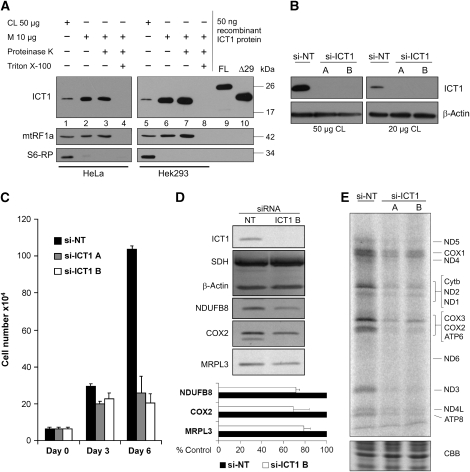
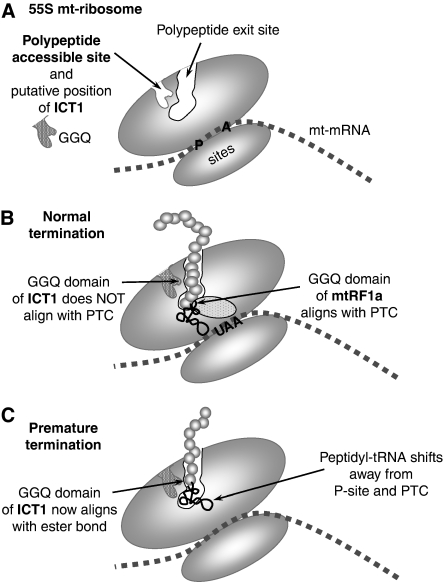
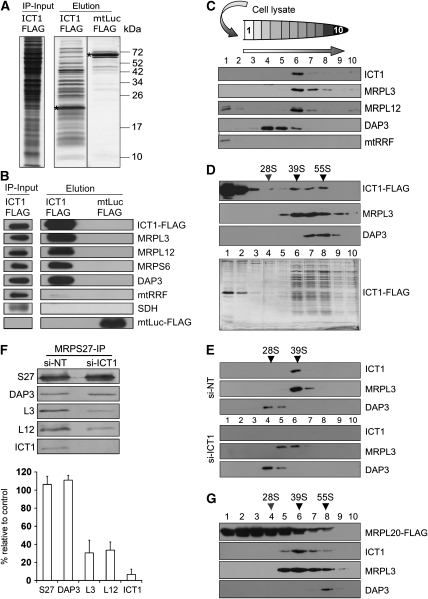
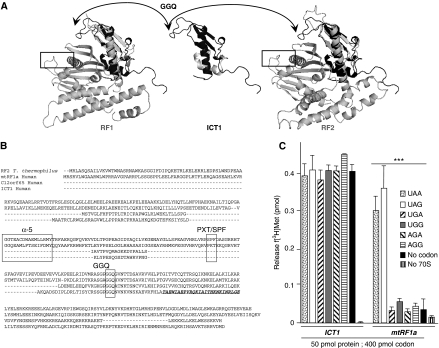
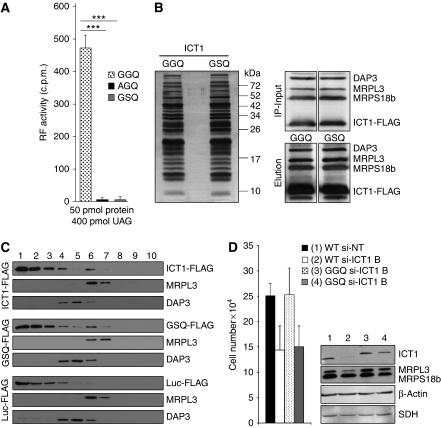
Bioinformatic analysis classifies the human protein encoded by immature colon carcinoma transcript-1 (ICT1) as one of a family of four putative mitochondrial translation release factors. However, this has not been supported by any experimental evidence. As only a single member of this family, mtRF1a, is required to terminate the synthesis of all 13 mitochondrially encoded polypeptides, the true physiological function of ICT1 was unclear. Here, we report that ICT1 is an essential mitochondrial protein, but unlike the other family members that are matrix-soluble, ICT1 has become an integral component of the human mitoribosome. Release-factor assays show that although ICT1 has retained its ribosome-dependent PTH activity, this is codon-independent; consistent with its loss of both domains that promote codon recognition in class-I release factors. Mutation of the GGQ domain common to ribosome-dependent PTHs causes a loss of activity in vitro and, crucially, a loss of cell viability, in vivo. We suggest that ICT1 may be essential for hydrolysis of prematurely terminated peptidyl-tRNA moieties in stalled mitoribosomes.
生物信息学分析将不成熟结肠癌细胞转录本 1(ICT1)编码的人类蛋白归类为四个假定的线粒体翻译释放因子家族之一。然而,这并没有得到任何实验证据的支持。由于只有该家族的一个成员 mtRF1a 被需要终止所有 13 个线粒体编码多肽的合成,因此 ICT1 的真正生理功能尚不清楚。在这里,我们报告 ICT1 是一种必需的线粒体蛋白,但与其他可溶性基质家族成员不同,ICT1 已成为人类线粒体核糖体的组成部分。释放因子测定表明,尽管 ICT1 保留了其依赖核糖体的 PTH 活性,但这种活性是无密码子依赖性的;与它失去了促进 I 类释放因子中密码子识别的两个结构域一致。共同存在于依赖核糖体的 PTH 中的 GGQ 结构域的突变会导致体外活性丧失,并且至关重要的是,体内细胞活力丧失。我们认为,ICT1 可能对于停滞的线粒体核糖体中过早终止的肽酰-tRNA 部分的水解是必需的。