
基于射频的容积血管内超声测量在轻中度冠状动脉粥样硬化中分析每段较少帧数的影响。
Impact of analyzing less image frames per segment for radiofrequency-based volumetric intravascular ultrasound measurements in mild-to-moderate coronary atherosclerosis.
机构信息
Department of Cardiology, Thoraxcentrum Twente, Medisch Spectrum Twente, Haaksbergerstraat 55, 7513 ER, Enschede, The Netherlands.
出版信息
Int J Cardiovasc Imaging. 2010 Jun;26(5):487-97. doi: 10.1007/s10554-010-9599-y. Epub 2010 Feb 27.
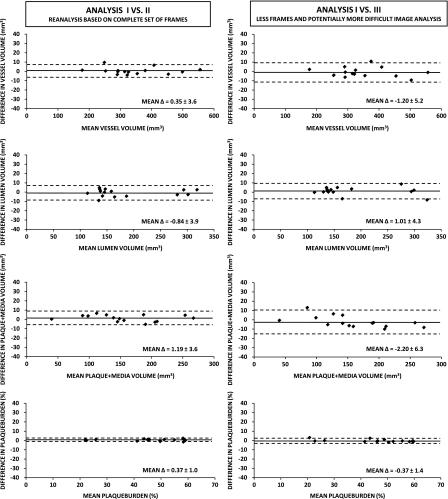
Volumetric radiofrequency-based intravascular ultrasound (RF-IVUS) data of coronary segments are increasingly used as endpoints in serial trials of novel anti-atherosclerotic therapies. In a relatively time-consuming process, vessel and lumen contours are defined; these contours are first automatically detected, then visually checked, and finally (in most cases) manually edited to generate reliable volumetric data of vessel geometry and plaque composition. Reduction in number of cross-sectional images for volumetric analysis could save analysis time but may also increase measurement variability of volumetric data. To assess whether a 50% reduction in number of frames per segment (every second frame) alters the reproducibility of volumetric measurements, we performed repeated RF-IVUS analyses of 15 coronary segments with mild-to-moderate atherosclerosis (20.2 +/- 0.2 mm-long segments with 46 +/- 13% plaque burden). Volumes were calculated based on a total of 731 image frames. Reducing the number of cross-sectional image frames for volumetric measurements saved analysis time (38 +/- 9 vs. 68 +/- 17 min/segment; P < 0.0001) and resulted for only a few parameters in (borderline) significant but mild differences versus measurements based on all frames (fibrous volume, P < 0.05; necrotic-core volume, P = 0.07). Compared to the intra-observer variability, there was a mild increase in measurement variability for most geometrical and compositional volumetric RF-IVUS parameters. In RF-IVUS studies of mild-to-moderate coronary disease, analyzing less image frames saved analysis time, left most volumetric parameters greatly unaffected, and resulted in a no more than mild increase in measurement variability of volumetric data.
血管内超声(IVUS)容积分析越来越多地被用作新型抗动脉粥样硬化治疗的研究终点。在一个相对耗时的过程中,需要定义血管和管腔轮廓;首先自动检测这些轮廓,然后进行目视检查,最后(在大多数情况下)手动编辑,以生成可靠的血管几何形状和斑块成分的容积数据。减少容积分析的横截面图像数量可以节省分析时间,但也可能增加容积数据的测量变异性。为了评估每段血管(每隔一帧)的帧数减少 50%是否会改变容积测量的可重复性,我们对 15 个轻度至中度动脉粥样硬化的冠状动脉节段(20.2 +/- 0.2 毫米长,斑块负担 46 +/- 13%)进行了重复的射频-IVUS 分析。根据总共 731 个图像帧计算体积。减少容积测量的横截面图像数量可以节省分析时间(38 +/- 9 与 68 +/- 17 分钟/节段;P < 0.0001),并且仅在少数参数上(边界)与基于所有帧的测量存在显著但轻微的差异(纤维体积,P < 0.05;坏死核心体积,P = 0.07)。与观察者内变异性相比,大多数几何和成分容积 RF-IVUS 参数的测量变异性略有增加。在轻度至中度冠状动脉疾病的射频-IVUS 研究中,分析较少的图像帧可以节省分析时间,对大多数容积参数影响不大,并导致容积数据的测量变异性略有增加。


 Zotero 插件