Papua New Guinea Institute of Medical Research, Goroka, Papua New Guinea.
PLoS One. 2010 Feb 24;5(2):e9375. doi: 10.1371/journal.pone.0009375.
The hypothesis is that hemoglobin-based metrics are useful tools for estimating malaria endemicity and for monitoring malaria control strategies. The aim of this study is to compare population hemoglobin mean and anemia prevalence to established indicators of malaria endemicity, including parasite rates, rates of enlarged spleens in children, and records of (presumptive) malaria diagnosis among populations living with different levels of malaria transmission.
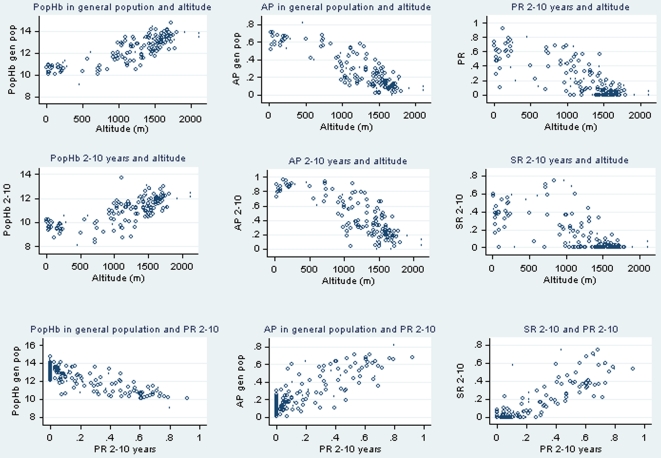
METHODOLOGY/PRINCIPAL FINDINGS: Convenience sample, multisite cross-sectional household surveys conducted in Papua New Guinea. Correlations (r(2)) between population Hb mean and anemia prevalence and altitude, parasite rate, and spleen rate were investigated in children ages 2 to 10 years, and in the general population; 21,664 individuals from 156 different communities were surveyed. Altitude ranged from 5 to 2120 meters. In young children, correlations between altitude and parasite rate, population Hb mean, anemia prevalence, and spleen rate were high (r(2): -0.77, 0.73, -0.81, and -0.68; p<0.001). In the general population, correlations between altitude and population Hb mean and anemia prevalence were 0.83 and 0.85, respectively. Among young children, parasite rate correlated highly with anemia prevalence, population Hb mean, and spleen rate (r(2): 0.81, -0.81, and 0.86; p<0.001). Population Hb mean (corrected for direct altitude effects) increased with altitude, from 10.5 g/dl at <500 m to 12.8 g/dl at >1500 m (p<0.001).
CONCLUSIONS/SIGNIFICANCE: In PNG, where Plasmodium vivax accounts for an important part of all malaria infections, population hemoglobin mean and anemia prevalence correlate well with altitude, parasite, and spleen rates. Hb measurement is simple and affordable, and may be a useful new tool, alone or in association with other metrics, for estimating malaria endemicity and monitoring effectiveness of malaria control programs. Further prospective studies in areas with different malaria epidemiology and different factors contributing to the burden of anemia are warranted to investigate the usefulness of Hb metrics in monitoring malaria transmission intensity.
假设血红蛋白指标可用于估算疟疾流行程度和监测疟疾控制策略。本研究旨在比较人群血红蛋白均值和贫血患病率与疟疾流行程度的既定指标,包括寄生虫率、儿童脾肿大率以及疟疾流行地区人群的(疑似)疟疾诊断记录,以评估这些指标在不同疟疾传播水平地区的应用价值。
方法/主要发现:本研究采用便利抽样,在巴布亚新几内亚进行了多地点、横断面家庭调查。在年龄为 2 至 10 岁的儿童和普通人群中,调查了人群血红蛋白均值和贫血患病率与海拔、寄生虫率和脾率之间的相关性(r(2));共调查了来自 156 个不同社区的 21664 人。海拔范围为 5 至 2120 米。在年幼儿童中,海拔与寄生虫率、人群血红蛋白均值、贫血患病率和脾率之间的相关性较高(r(2):-0.77、0.73、-0.81 和-0.68;p<0.001)。在普通人群中,海拔与人群血红蛋白均值和贫血患病率之间的相关性分别为 0.83 和 0.85。在年幼儿童中,寄生虫率与贫血患病率、人群血红蛋白均值和脾率高度相关(r(2):0.81、-0.81 和 0.86;p<0.001)。人群血红蛋白均值(经海拔直接影响校正)随海拔升高而增加,从 500 米以下的 10.5 g/dl 升高至 1500 米以上的 12.8 g/dl(p<0.001)。
结论/意义:在巴布亚新几内亚,间日疟原虫是所有疟疾感染的重要组成部分,人群血红蛋白均值和贫血患病率与海拔、寄生虫率和脾率密切相关。血红蛋白测量简单且经济实惠,可能是一种有用的新工具,单独使用或与其他指标结合使用,可用于估算疟疾流行程度和监测疟疾控制计划的效果。在疟疾流行病学和导致贫血负担的因素不同的地区进行进一步的前瞻性研究,有助于调查血红蛋白指标在监测疟疾传播强度方面的应用价值。