Department of Pulmonary and Critical Care Medicine, Asan Medical Center, University of Ulsan College of Medicine, Seoul, Korea.
Korean J Intern Med. 2010 Mar;25(1):58-65. doi: 10.3904/kjim.2010.25.1.58. Epub 2010 Feb 26.
BACKGROUND/AIMS: Ventilating patients with acute respiratory distress syndrome (ARDS) in the prone position has been shown to improve arterial oxygenation, but prolonged prone positioning frequently requires continuous deep sedation, which may be harmful to patients. We evaluated the meaning of early gas exchange in patients with severe ARDS under prolonged (> or = 12 hours) prone positioning.
We retrospectively studied 96 patients (mean age, 60.1 +/- 15.6 years; 75% men) with severe ARDS (PaO(2)/FiO2 < or = 150 mmHg) admitted to a medical intensive care unit (MICU). The terms "PaO2 response" and "PaCO2 response" represented responses that resulted in increases in the PaO2/FiO2 ratio of > or = 20 mmHg and decreases in PaCO2 of > or = 1 mmHg, respectively, 8 to 12 hours after first placement in the prone position.
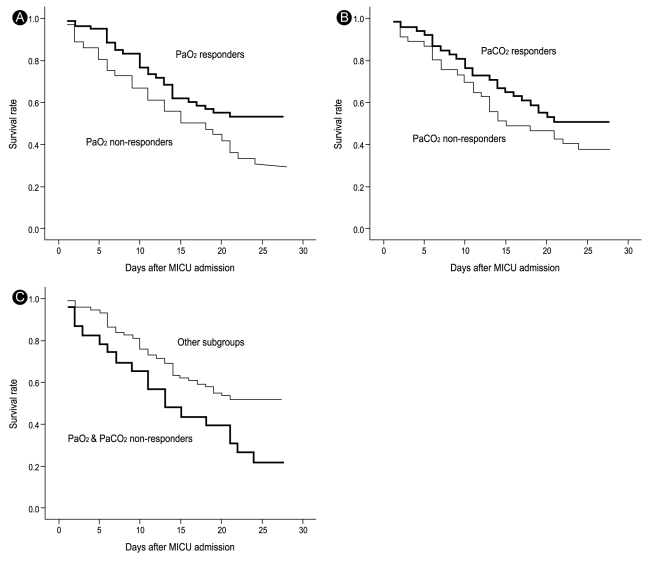
The mean duration of prone positioning was 78.5 +/- 61.2 hours, and the 28-day mortality rate after MICU admission was 56.3%. No significant difference in clinical characteristics was observed between PaO2 and PaCO2 responders and non-responders. The PaO2 responders after prone positioning showed an improved 28-day outcome, compared with non-responders by Kaplan-Meier survival estimates (p < 0.05 by the log-rank test), but the PaCO12 responders did not.
Our results suggest that the early oxygenation improvement after prone positioning might be associated with an improved 28-day outcome and may be an indicator to maintain prolonged prone positioning in patients with severe ARDS.
背景/目的:有研究表明,对急性呼吸窘迫综合征(ARDS)患者进行俯卧位通气可改善动脉氧合,但长时间俯卧位通常需要持续深度镇静,这可能对患者有害。我们评估了长时间(≥12 小时)俯卧位的严重 ARDS 患者早期气体交换的意义。
我们回顾性研究了 96 例(平均年龄 60.1±15.6 岁;75%为男性)严重 ARDS(PaO2/FiO2≤150mmHg)患者,这些患者被收入内科重症监护病房(MICU)。“PaO2 反应”和“PaCO2 反应”分别表示首次俯卧位 8-12 小时后,PaO2/FiO2 比值增加≥20mmHg 和 PaCO2 降低≥1mmHg。
俯卧位的平均时间为 78.5±61.2 小时,MICU 住院后 28 天死亡率为 56.3%。俯卧位后 PaO2 和 PaCO2 反应者与无反应者之间的临床特征无显著差异。与无反应者相比,俯卧位后 PaO2 反应者的 28 天预后得到改善,Kaplan-Meier 生存估计(log-rank 检验,p<0.05)表明存在差异,但 PaCO12 反应者则没有。
我们的结果表明,俯卧位后早期氧合改善可能与 28 天预后改善相关,可能是维持严重 ARDS 患者长时间俯卧位的指标。