Translational Immunology Unit, German Cancer Research Center, Heidelberg, Germany.
J Cell Mol Med. 2009 Sep;13(9B):4023-33. doi: 10.1111/j.1582-4934.2009.00723.x.
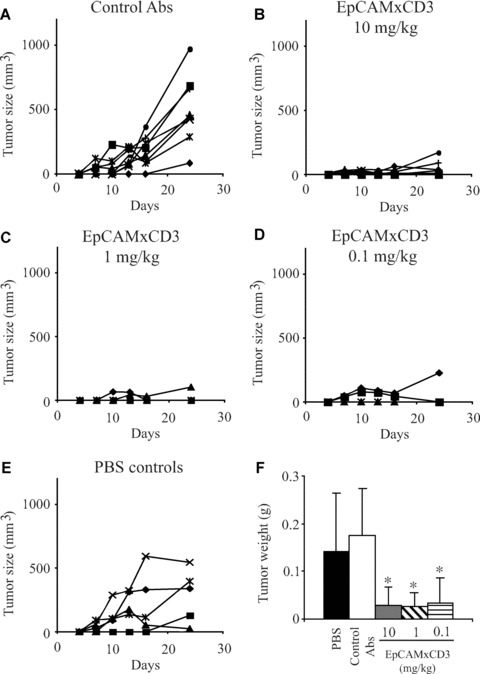
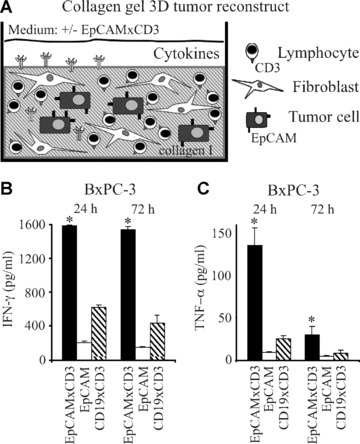
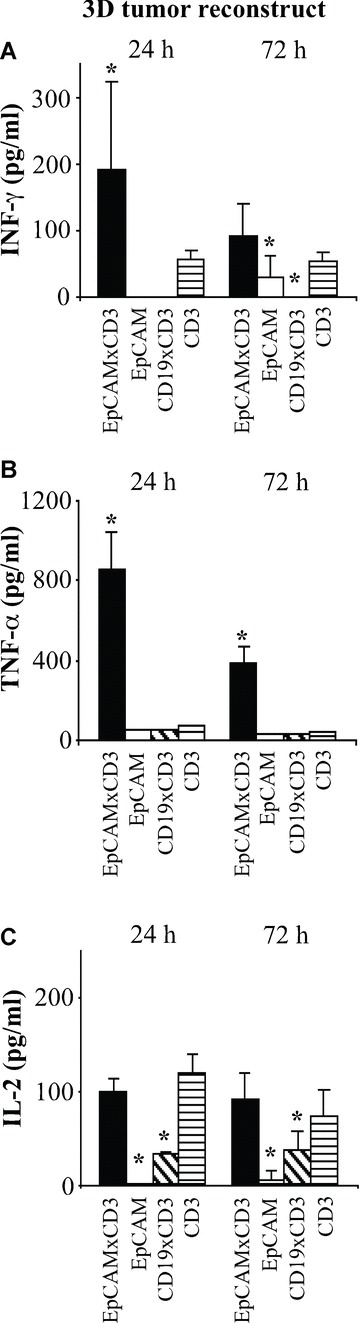
Patients with pancreatic cancer have a poor survival rate, and new therapeutic strategies are needed. Epithelial cell adhesion molecule (EpCAM), suggested as a marker for cancer stem cells, is over-expressed on most pancreatic tumour cells but not on normal cells and may be an ideal therapeutic target. We evaluated the anti-tumour efficiency of bispecific EpCAMxCD3 antibody linking tumour cells and T lymphocytes. In NOD SCID mice, EpCAMxCD3 had a long serum half-life (t(1/2) approximately 7 days). EpCAMxCD3 significantly retarded growth of BxPC-3 pancreatic carcinoma xenografts. For mimicking a pancreatic cancer microenvironment in vitro, we used a three-dimensional tumour reconstruct system, in which lymphocytes were co-cultured with tumour cells and fibroblasts in a collagen matrix. In this in vivo-like system, EpCAMxCD3 potently stimulated production of the effector cytokines IFN-gamma and TNF-alpha by extracorporally pre-activated lymphocytes. Moreover, compared with a bivalent anti-CD3 antibody, EpCAMxCD3 more efficiently activated the production of TNF-alpha and IFN-gamma by non-stimulated peripheral blood mononuclear cells. Most excitingly, we demonstrate for the first time that EpCAMxCD3 induces prolonged contacts between lymphocytes and tumour cells, which may be the main reason for the observed anti-tumour effects. As an important prerequisite for future use in patients, EpCAMxCD3 did not alter lymphocyte migration as measured by time-lapse video microscopy. Our data may open a way to improve the immune response and treatment outcome in patients with pancreatic cancer.
胰腺癌患者的生存率较差,需要新的治疗策略。上皮细胞黏附分子(EpCAM)被认为是癌症干细胞的标志物,在大多数胰腺肿瘤细胞中过度表达,但在正常细胞中不表达,可能是一个理想的治疗靶点。我们评估了双特异性 EpCAMxCD3 抗体连接肿瘤细胞和 T 淋巴细胞的抗肿瘤效率。在 NOD SCID 小鼠中,EpCAMxCD3 的血清半衰期(t(1/2)约为 7 天)较长。EpCAMxCD3 显著延缓了 BxPC-3 胰腺癌细胞异种移植物的生长。为了模拟体外胰腺癌微环境,我们使用了三维肿瘤重建系统,其中淋巴细胞与肿瘤细胞和成纤维细胞在胶原基质中共培养。在这种类似于体内的系统中,EpCAMxCD3 有力地刺激了体外预先激活的淋巴细胞产生效应细胞因子 IFN-γ和 TNF-α。此外,与二价抗 CD3 抗体相比,EpCAMxCD3 更有效地激活了未刺激的外周血单核细胞产生 TNF-α和 IFN-γ。最令人兴奋的是,我们首次证明 EpCAMxCD3 诱导淋巴细胞和肿瘤细胞之间的长时间接触,这可能是观察到的抗肿瘤作用的主要原因。作为未来在患者中应用的重要前提条件,EpCAMxCD3 如延时视频显微镜测量所示,不会改变淋巴细胞的迁移。我们的数据可能为改善胰腺癌患者的免疫反应和治疗效果开辟了一条途径。