Campen Matthew J, Lund Amie K, Doyle-Eisele Melanie L, McDonald Jacob D, Knuckles Travis L, Rohr Annette C, Knipping Eladio M, Mauderly Joe L
Lovelace Respiratory Research Institute, Albuquerque, New Mexico, USA.
Environ Health Perspect. 2010 Jul;118(7):921-7. doi: 10.1289/ehp.0901207. Epub 2010 Mar 2.
Emerging evidence suggests that the systemic vasculature may be a target of inhaled pollutants of vehicular origin. We have identified several murine markers of vascular toxicity that appear sensitive to inhalation exposures to combustion emissions.
We sought to examine the relative impact of various pollutant atmospheres and specific individual components on these markers of altered vascular transcription and lipid peroxidation.
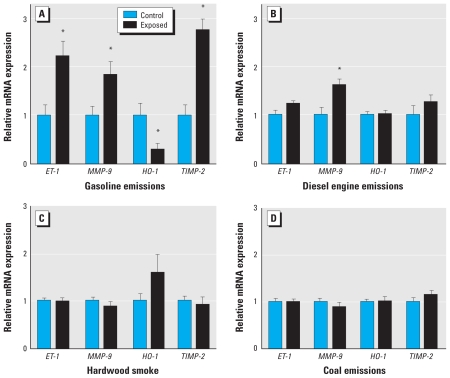
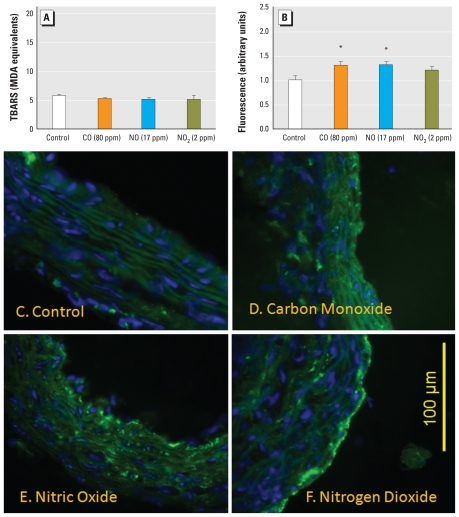
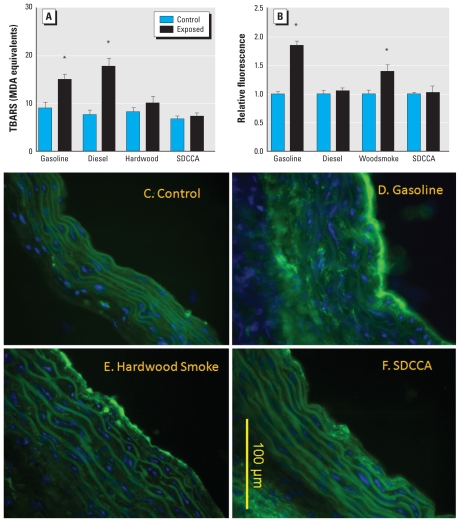
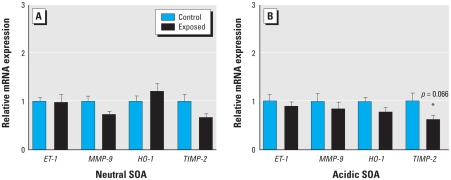
Apolipoprotein E knockout (ApoE(-/-)) mice were exposed to whole combustion emissions (gasoline, diesel, coal, hardwood), biogenically derived secondary organic aerosols (SOAs), or prominent combustion-source gases [nitric oxide (NO), NO(2), carbon monoxide (CO)] for 6 hr/day for 7 days. Aortas were assayed for transcriptional alterations of endothelin-1 (ET-1), matrix metalloproteinase-9 (MMP-9), tissue inhibitor of metalloproteinase-2 (TIMP-2), and heme oxygenase-1 (HO-1), along with measures of vascular lipid peroxides (LPOs) and gelatinase activity.
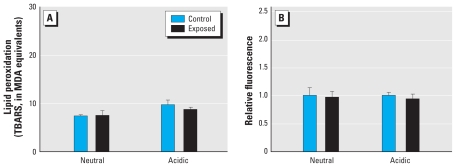
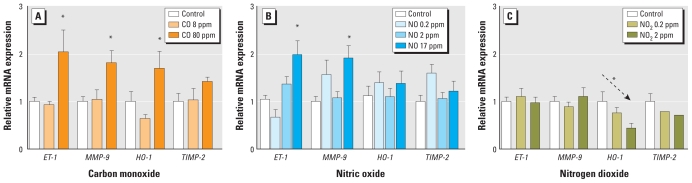
We noted transcriptional alterations with exposures to gasoline and diesel emissions. Interestingly, ET-1 and MMP-9 transcriptional effects could be recreated by exposure to CO and NO, but not NO(2) or SOAs. Gelatinase activity aligned with levels of volatile hydrocarbons and also monoxide gases. Neither gases nor particles induced vascular LPO despite potent effects from whole vehicular emissions.
In this head-to-head comparison of the effects of several pollutants and pollutant mixtures, we found an important contribution to vascular toxicity from readily bioavailable monoxide gases and possibly from volatile hydrocarbons. These data support a role for traffic-related pollutants in driving cardiopulmonary morbidity and mortality.
新出现的证据表明,全身血管系统可能是车辆来源的吸入性污染物的作用靶点。我们已经确定了几种血管毒性的小鼠标志物,它们似乎对吸入燃烧排放物敏感。
我们试图研究各种污染大气和特定单一成分对这些血管转录改变和脂质过氧化标志物的相对影响。
将载脂蛋白E基因敲除(ApoE(-/-))小鼠每天暴露于全燃烧排放物(汽油、柴油、煤、硬木)、生物源二次有机气溶胶(SOA)或主要燃烧源气体[一氧化氮(NO)、二氧化氮(NO₂)、一氧化碳(CO)]中,每天6小时,共7天。检测主动脉中内皮素-1(ET-1)、基质金属蛋白酶-9(MMP-9)、金属蛋白酶组织抑制剂-2(TIMP-2)和血红素加氧酶-1(HO-1)的转录变化,以及血管脂质过氧化物(LPO)和明胶酶活性的测量值。
我们注意到暴露于汽油和柴油排放物会导致转录变化。有趣的是,暴露于CO和NO可重现ET-1和MMP-9的转录效应,但暴露于NO₂或SOA则不能。明胶酶活性与挥发性烃和一氧化碳气体的水平一致。尽管车辆全排放物有显著影响,但气体和颗粒均未诱导血管LPO。
在对几种污染物和污染物混合物影响的这种直接比较中,我们发现生物可利用性高的一氧化碳气体以及可能的挥发性烃对血管毒性有重要影响。这些数据支持与交通相关的污染物在导致心肺疾病发病率和死亡率方面的作用。